Fold-away companionway seat adds comfort to a Catalina 25
A folding companionway step turns dead space into a 17-inch seat, giving Catalina 25 owners safer access, extra seating, and a cleaner cabin layout.
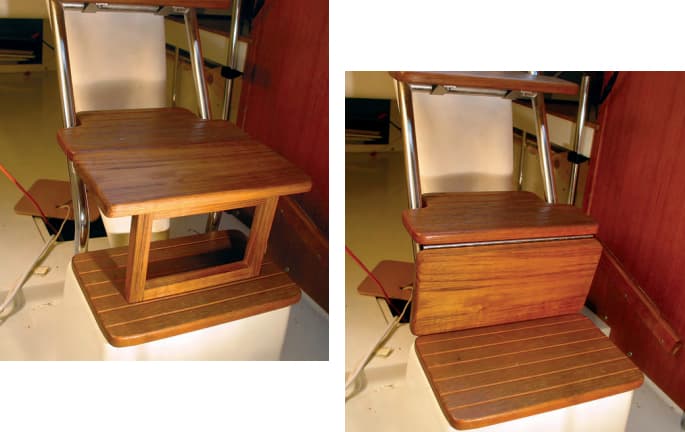
Henk and Johanna Grasmeyer found a classic small-boat truth aboard their 1995 Catalina 25: the best seat in the house was already there, it just was not comfortable. The companionway step had become the place everyone naturally used for chatting, galley work, and ducking weather, until the “numb bum” set in and the cabin started to feel smaller than it needed to be. Their answer was a fold-away extension that turns that step into a proper perch when needed, then disappears when the boat needs passage, access, and a clean profile below.
Before: a step that worked, until it did not
The Grasmeyers bought hull #151 in 2003, a couple of years before retirement, and over time they had already improved the boat in plenty of ways. Still, the companionway remained an everyday pinch point. There was not enough comfortable seating when entertaining or handling galley chores, and there was no good inside lookout spot for foul-weather watching without getting in the way of the cabin traffic.
That is the kind of problem small-boat owners know immediately. On a trailerable cruiser like a Catalina 25, every fixed surface has to justify itself twice, once when you are moving around it and again when you are trying to live with it. A companionway step that can also serve as a seat is a simple idea, but on a compact boat it solves two daily pain points at once: it reduces fatigue and frees up precious interior space.
The fold-away fix
The redesign turns part of the companionway step into a fold-away extension that works like a seat when deployed and tucks back out of the way when folded down. The modified perch sits at about 17 inches, which the Grasmeyers found close to normal seat height, so it feels intentional rather than improvised. That matters in a boat cabin, where a few inches can decide whether a seat feels usable for a meal, a watch, or a long weather delay.
Just as important, the support leg tucks diagonally under the companionway step when the seat is stowed. That detail keeps the passage open and preserves access to the main cabin, so the upgrade adds function without turning the companionway into another obstacle. The whole point is to multiply use, not crowd the boat with extra furniture.

The finish matters too. The extension was built to blend into the boat’s teak-like visual language, and that makes the modification feel like part of the Catalina 25 rather than a bolt-on afterthought. On a boat with solid teak trim and a traditional interior style, that visual restraint is part of the success.
Why it fits the Catalina 25 so well
This is a boat that was built with practicality in mind from the start. Catalina Yachts of Woodland Hills, California, produced the Catalina 25 from 1978 to 1990, with Frank Butler and Gerry Douglas credited as the designers. Practical Sailor later described it as one of the most successful small cruising sailboats ever built, noting 5,332 boats sold between 1976 and 1990 and tracing its evolution from a simple trailerable swing-keel design into a more sophisticated minicruiser.
That success created a large owner community, and with that came the kind of shared problem-solving that keeps older cruisers useful. The Catalina 25 brochure reinforced the same ethos: practical-sized, trailerable, spacious below, with solid teak trim and interior layouts that could be ordered as either dinette or traditional arrangements. The boat could also be specified with a retractable or fixed keel hull, and a flip-top that increased headroom to 6 feet 6 inches. In other words, the model was already designed around flexibility, comfort, and efficient use of space.
The Grasmeyers’ fold-away step reads as a direct continuation of that design language. It does not fight the boat’s character. It extends it.
What to copy on your own boat
If your companionway step is already where people naturally sit, that is the first clue that this upgrade may be worth copying. The strongest version of the idea is the one that serves three jobs at once: a safer and more comfortable inside perch, a place to sit for galley work or weather watching, and a structure that folds away cleanly when you need the cabin open.
- Can the added seat height stay near normal seating, around 17 inches?
- Can the support hardware stow without fouling the companionway?
- Can the finished piece match the boat’s interior trim well enough to look original?
- Can the seat be used without blocking passage to the main cabin?
A good candidate for this kind of refit should answer a few practical questions:
Those are the tradeoffs that matter on a compact cruiser. If the answer to any of them is no, the upgrade can easily become bulkier than the problem it was meant to solve. But when the geometry works, the result is a rare small-boat improvement that feels bigger than its footprint.
A small change that changes the cabin
The appeal of the Grasmeyers’ modification is how completely it changes the feel of the boat without changing the boat itself. One step becomes a safer place to sit, a better place to wait out weather, and a smarter use of a cramped interior that was already doing a lot of work. On a Catalina 25, that is exactly the kind of upgrade that makes a weekend cruiser feel more livable the moment you drop below.
And that old companionway habit remains the giveaway. If everyone keeps ending up on the step anyway, the best fix is not to stop them. It is to make that step worth sitting on.
This article was produced by Prism’s automated news system from verified source data, official records, and press releases, then run through automated quality and moderation checks before publishing. The system is built and supervised by the people who set the standards it runs under. Read our full AI policy.
Did this article answer your question?