Leeward mark quiz untangles right-of-way, mark-room, and exoneration
A dead-downwind leeward-mark quiz turns into a clean lesson in mark-room and protest risk. SO is out, PI breaks rule 10, and exoneration saves the inside boat.

Two boats bow to bow at a leeward mark can look like a simple port-versus-starboard call until the booms touch. Dave Perry’s latest quiz drops that moment into a dead-downwind approach where mark-room, right-of-way, and protest risk collide in a few seconds.
A leeward-mark puzzle built for real racing
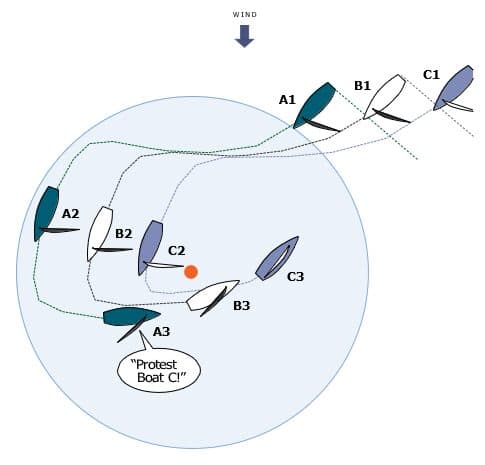
Scuttlebutt’s July 1 quiz drops you straight into a dead-downwind approach with PI on port tack and SO on starboard, both headed for a leeward mark to be left to port. PI is the inside boat at the mark, bears off slightly to round without touching it, and the booms make contact. Both boats hail protest, and SO finishes the rounding behind PI.
What the committee would call first
The first hard call is on SO. SO is disqualified for failing to give mark-room under rule 18.2(a)(1). Once the mark-room obligation attaches, the outside boat has to let the inside boat sail to the mark, round it on the required side, and leave it astern.
PI is not spotless either. She is still on port tack against SO’s starboard, so rule 10 is broken in the bare, technical sense. But the inside boat is exonerated under rule 43.1(b) because she was sailing within the mark-room to which she was entitled. In plain racing terms, the port-tacker is not punished for taking the space the rules gave her at the mark.

Rule 14, Avoiding Contact, also sits in the background. If the contact had been avoidable, that rule could have mattered too, but because there was no damage or injury, the boats would still be exonerated under rule 43.1(c) in the scenario as described.
Why the current rules cycle matters
This quiz lands in the 2025-2028 rules cycle, which World Sailing revised on the normal four-year timetable and made effective on January 1, 2025. The same edition, with U.S. prescriptions, governs sailboat racing in the United States through December 31, 2028.
US Sailing also lists Dave Perry’s 100 Best Racing Rules Quizzes Through 2028 as a new edition for the current cycle, with a free errata sheet dated January 1, 2026. World Sailing’s 2025-2028 Case Book is a complete review of prior cases and adds new cases adopted since 2021, while US Sailing’s Appeals Book for 2025-2028 collects decisions of the US Sailing Appeals Committee and an index of abstracts.
Why Perry’s teaching style sticks
US Sailing lists Perry as spending more than four decades educating sailors, and The Sailing Museum & National Sailing Hall of Fame lists him at well over 1,000 clinics and seminars. The museum credits him with winning the Clinton M. Bell Trophy in 1971, captaining Yale to the Intercollegiate Nationals title in 1975, winning the U.S. Match Racing Championship five times, and receiving the Nathanael Greene Herreshoff Trophy in 2020.
In a 2024 US Sailing Q&A, Perry said his new books were designed to give sailors practical insights and clear explanations. The scenario works like a coach’s debrief: a port-tack boat, a starboard-tack boat, a leeward mark, and a touch of booms all meeting at one point where the rules have to sort out the result.
The patterns to drill before your next start
The first pattern is that right-of-way alone is not the whole story at a leeward mark. Once the first boat reaches the zone, rule 18 normally starts about three hull lengths from the mark under US Sailing’s mark-room guide. From there, the inside boat is owed room to round the mark in a seamanlike way, not just room to squeeze through by inches.
The second pattern is that the inside boat can still break a Part 2 rule and be exonerated if she is sailing inside the mark-room she is entitled to use. That is why PI can break rule 10 and still avoid penalty under rule 43.1(b) in this quiz. The outside boat’s mistake does not cancel the inside boat’s obligation to keep the rounding under control, but it does shape how the committee reads the contact.
The third pattern is protest risk. When both boats hail protest and the booms touch with no damage or injury, the argument is not about who shouted first. It is about whether the room owed was given, whether the inside boat stayed within it, and whether the contact was avoidable. That is the kind of decision you can rehearse on shore by walking through one honest question: if I am the inside boat, have I established my mark-room entitlement early enough to protect the rounding, and if I am outside, have I given it cleanly enough to stay out of the room fight?
This article was produced by Prism’s automated news system from verified source data, official records, and press releases, then run through automated quality and moderation checks before publishing. The system is built and supervised by the people who set the standards it runs under. Read our full AI policy.
Did this article answer your question?