JPK 1050 turns weight savings into racing advantage
The JPK 1050 turns tiny weight cuts, scow-volume hull shape, and short-handed systems thinking into a Fastnet-winning package.
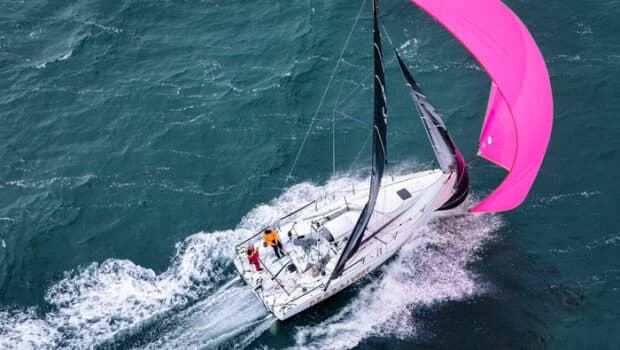
The JPK 1050 is a scow-hull IRC racer built to race solo or double-handed without water ballast. Its scow-inspired hull, very light displacement, and large sail area are the measurable choices that make that possible and still leave it looking like a weapon on corrected time.
Hull shape and the performance bargain
Start with the hull, because that is where the JPK 1050 makes its most obvious statement. The published dimensions put it at about 10.45 meters LOA with a beam of roughly 3.54 meters. That wide platform is part of the game: it creates form stability that lets the boat carry sail and stay lively instead of tender.
The numbers underneath the hull matter just as much. The boat displaces about 3,480 kilograms, with roughly 1,520 kilograms in the keel and a fin ending in a lead bulb. That is the classic modern offshore recipe in compact form, enough ballast low down to stiffen the boat, but still light enough that the whole platform can accelerate quickly when the breeze and seaway let it.
For a hands-on sailor, the lesson is not to copy the scow shape blindly. Notice how the shape, beam, and ballast work together as a system. If your own project needs more pace off the wind, better stability for a given rig, or less wallowing in short offshore legs, the JPK 1050 shows how far a designer can push volume and righting moment.
A deck and cockpit built for short-handed rhythm
That operating brief sets the deck and cockpit priorities: every control has to be easy to reach, every trim change repeatable, and every maneuver manageable with one or two people instead of a full crew.
JPK calls the boat a “mini Class 40,” which is a useful clue for anyone thinking about deck ergonomics. The Class 40 world has taught a generation of designers how to reduce workload without sacrificing speed, and the 1050 sits in that lineage with a very similar bias toward efficiency under pressure. For your own boat work, the fastest deck is often the one that reduces motion, shortens handling cycles, and keeps the helm free to make tactical decisions instead of wrestling hardware.
The JPK 1050 has already won Spi Ouest France, Transmanche, Duo Cat Amania, Course des Îles, La Trinité-Cowes, Cowes Dinard Saint Malo, and the overall Rolex Fastnet Race in 2025.
Systems decisions where grams become speed
The most revealing part of the JPK 1050 story is how openly the builder prices weight savings. The mast upgrade to a higher-modulus carbon spar saves 5 kilograms for a surcharge of 3,700 euros. The carbon boom saves 8 kilograms over aluminum for 5,300 euros. Even the propulsion choice is treated the same way, with a Lombardini shaft-drive option replacing the standard Yanmar diesel and cutting 25 kilograms.
The better question is how much performance each kilogram buys, and what the fair price of that gain is. On a boat this size, weight removed from the rig or machinery package does more than improve the brochure figure. It changes acceleration, how the boat pops onto pace after a tack, how it keeps speed through chop, and how forgiving it feels when the crew is short-handed and tired.
Here, systems selection is part of the design brief, not an afterthought. A carbon mast, a carbon boom, and a lighter engine package are a coordinated effort to keep mass out of the wrong places while preserving the kind of stability and sail-carrying power a scow hull wants.
Why the keel and ballast package matter so much
The JPK 1050’s keel package is where the boat’s modernity becomes easy to understand. With about 44 percent of displacement in the keel, the design puts a heavy share of its mass low where it can work hardest. The lead bulb at the end of the fin lowers the center of gravity and adds stiffness, which is exactly what a boat with a wide, powerful hull needs if it is going to keep its edge when conditions get loaded.
You do not have to adopt the exact JPK shape to borrow the principle: if you are chasing performance, concentrate mass where it improves righting moment and reduce weight anywhere that does not directly help the rig, keel, or handling.
The race results prove the design brief
JPK had ten JPK 1050s ready to race by February 2026, with about fifteen expected by mid-season.
Léon, sailed by Jean-Pierre Kelbert and Alexis Loison, took the overall Rolex Fastnet Race 2025 win. The race had a record 444 boats on the start line, and the victory was the second time in Fastnet history that a double-handed crew topped the overall standings. The boat then picked up Racer of the Year 2026 at the Paris Nautic Show in Le Bourget, with Jean-Baptiste Dejeanty, co-architect alongside Jacques Valer, on hand to receive the recognition.
This article was produced by Prism’s automated news system from verified source data, official records, and press releases, then run through automated quality and moderation checks before publishing. The system is built and supervised by the people who set the standards it runs under. Read our full AI policy.
Did this article answer your question?