From engineless cruising to diesel repower aboard Far Reach
After 8,000 engine-free miles, John Stone shows why Far Reach is finally getting a diesel, and which hard questions decide the job before you buy parts.
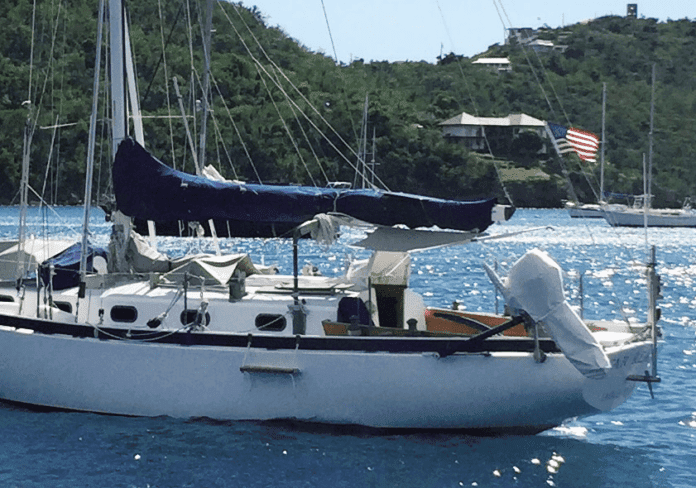
John Stone had already proven Far Reach could cross real water without an inboard. The modified Cape Dory 36 spent years sailing under a sculling oar, a custom side-mounted outboard bracket, and a lot of plain seamanship, including two round-trip offshore runs between North Carolina and the Virgin Islands. Now the boat is moving back toward a compact diesel, not because engineless cruising failed, but because the use case changed.
John Stone’s real decision point
Far Reach is not a weekend daysailer that can shrug off awkward docking. It is a heavy-displacement Cape Dory 36, with published displacement figures around 16,100 to 17,000 pounds, and that weight changes the conversation fast when you are threading canals, rivers, and crowded slips. Stone’s calculus is the one many cruising sailors eventually face: the boat may be perfectly capable of living without a motor for long stretches, but the real world still asks for precise low-speed control, dependable charging, and a setup that does not become a permanent nuisance on the stern quarter.
That is what makes this repower story useful. It is not a tale of regret. It is a case study in when a beautiful experiment in simplicity has earned the right to give way to a more practical tool.
The trigger questions before you buy a single part
Before a repower gets reduced to engine brand debates and propeller talk, the right questions are much simpler and much harder.
- How far do you really need to move under power? Far Reach sailed about 8,000 nautical miles without an inboard, so the bar was already high. If your cruising pattern includes long stretches where you need to motor in and out of harbors, navigate tide gates, or push through narrow channels, the answer may point straight toward diesel.
- Where do you dock, and how tight is the water? Stone specifically points to canals, rivers, and crowded waters. A 17,000-pound boat is one thing in open water and another in a crosswind beside a fuel dock.
- What are you asking your charging system to do? A repower is not only about thrust. It affects how you make electricity, how often you run equipment to replenish batteries, and whether the boat’s daily rhythm feels easy or strained.
- What will the boat look like, and where will things live? Stone did not like the visual and storage penalties of hanging an outboard on the stern quarter. That matters more than people admit, because ugly and awkward gear tends to become neglected gear.
- What will the next owner expect? Resale is part of the equation. An engineless cruising story can be inspiring, but many buyers still want the confidence of a proper inboard installation.
- Does the hull actually support the plan? If the boat has to accommodate engine beds, a shaft log, fuel system, wiring, and service access, the project is not just mechanical. It is architectural.
If you cannot answer those questions clearly, you are not ready to order a motor.
Why the outboard stopgap stopped being enough
Far Reach did have a practical interim answer. Earlier coverage says the boat carried a 9.9 hp gasoline engine mounted on a custom bracket designed and built by Yves Gelinas, the same name behind the Cape Horn windvane. That outboard was useful in marinas and on narrow stretches of the Intracoastal Waterway when sailing or sculling was not practical, and it served its purpose as a temporary solution.
But temporary solutions have a way of turning into permanent compromises. On a boat this size, a quarter-mounted outboard can work, yet it still leaves you with clutter on the stern, awkward access, and a propulsion system that never quite feels like part of the boat. Stone’s experience is a reminder that “it works” is not the same as “it fits the way we actually cruise.”
What the repower had to solve
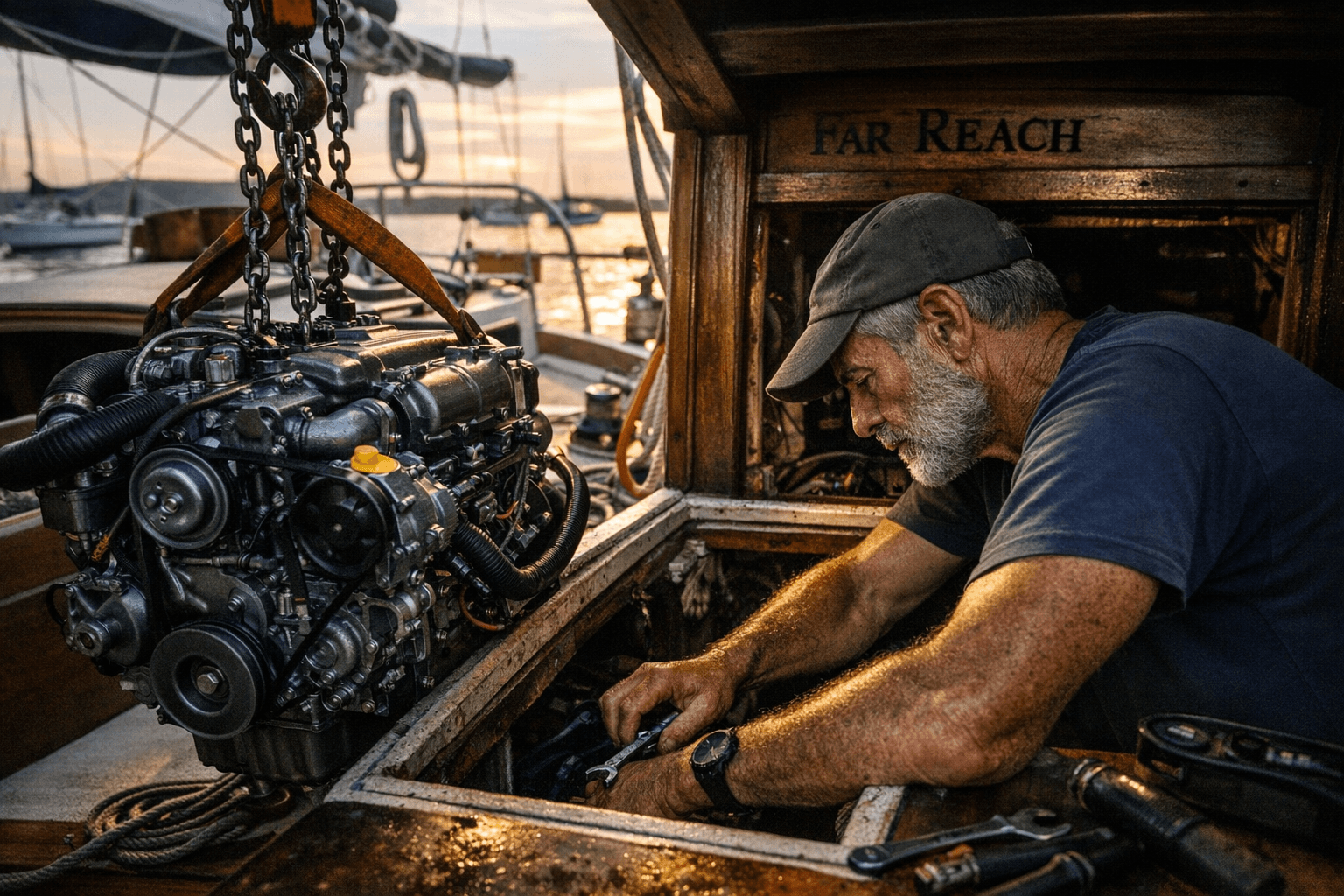
Part II of the series makes the scope plain: this was not a simple engine swap. The project started from scratch, with no existing engine beds, shaft log, wiring, or fuel system. That changes everything. You are not just replacing metal; you are deciding where loads go, how service will be done, and how the boat will live for the next decade.
The chosen setup was a Beta 25 hp three-cylinder diesel paired with a two-blade FlexOFold propeller. That combination tells you a lot about the goal. The engine is compact, and the folding prop is aimed at reducing drag when sailing, which fits a boat that already proved it could cover serious miles under sail. The real point, though, is that the installation has to be integrated, not merely powerful.
Access is as important as horsepower
Stone emphasizes careful measurements so service points stay reachable after installation. That is the part of a repower that can save you from misery later. If you have to remove half the boat to change a filter, inspect a hose, or reach a fastener, every maintenance task becomes a project.
Cape Horn’s own documentation on self-steering gear hammers home the same general lesson: careful measurement matters because boats are not generic. Everything depends on the exact geometry of the hull, the spacing of components, and the way gear fits together in the real boat, not on the drawing. A diesel installation has the same logic. The best repower is the one that you can actually maintain when you are tired, offshore, or tied up in an awkward marina slot.
The long lesson from Far Reach
Far Reach was launched on May 30, 2015 after a six-year rebuild that began in 2009, and that history matters because it shows how deliberately Stone has shaped the boat around his sailing life. He first proved that a rebuilt Cape Dory 36 could cruise without an inboard. Now he is proving something different: that a well-judged repower can be the next logical step when the cruising pattern, boat weight, and day-to-day demands change.
For DIY sailors, that is the real takeaway. A diesel repower is not a verdict on engineless cruising. It is a decision about how you want to move a heavy boat through the world, how you want to service it, and how much compromise you are willing to live with every single day. On Far Reach, the answer finally tilted toward a compact inboard, and the reasons were practical long before they were emotional.
This article was produced by Prism’s automated news system from verified source data, official records, and press releases, then run through automated quality and moderation checks before publishing. The system is built and supervised by the people who set the standards it runs under. Read our full AI policy.
Did this article answer your question?