How an O’Day 23 became a livable cruising boat
A plain O’Day 23 became a long-range cruiser through small, targeted refits that fixed sleep, storage and comfort without chasing a bigger hull.
The smartest cruising boat is not always the one you planned to own. In this case, a supposed stopgap, an O’Day 23 found on her trailer in Idaho, became the boat that had to carry the load when the owners’ plans changed and the weekend-only idea gave way to something much longer.
From interim boat to real cruising platform
The story starts with a bigger boat and a bigger cruise. After selling a 31-foot Bombay Clipper following a major summer trip, the couple expected to step away from boating for a while. That pause did not last, and by fall 2005 they were shopping for a smaller interim boat, one that could serve as a weekend cruiser until a larger one came along.
What they found was not glamorous, but it was promising: an O’Day 23 sitting on her trailer in Idaho, apparently sound and fitted with nearly new sails. That combination was enough to make the deal. The boat was small, simple, and clearly meant to be a practical stepping stone, which is exactly why it worked so well when the broader economy shifted and the “temporary” plan stopped making sense.
Why a 23-footer can work harder than expected
By 2009, the O’Day was no longer a placeholder. The couple had decided she would be their cruising boat for the foreseeable future, and that change in mission is the key to understanding every upgrade that followed. A boat that only needs to handle a few weekends can get by with compromises that become painful once you start spending longer stretches aboard.
The lesson here is blunt: comfort, storage, and sleep arrangements are not extras on a small cruiser. They are the difference between a boat that gets used casually and a boat that can support real cruising life. On a 23-footer, every square foot has to do more than one job, and the refit has to respect that from the start.
The refit was modest, but it changed the whole boat
The transformation did not come from major surgery or a full-scale rebuild. Instead, the owners made incremental interior changes that steadily improved livability. They added insulation and carpet on the hull sides, replaced the cushions, created more storage, and redesigned the cabin layout so the interior would feel less like a bare weekend cabin and more like a place where time aboard made sense.
That kind of progress is exactly what many small-boat owners end up doing. Few sailors buy the perfect boat on day one, and even fewer find that their first idea of “enough boat” matches the way they actually cruise. Small, thoughtful refits usually win because they answer real use patterns: where do wet clothes go, where do the cushions live, how do you keep the cabin comfortable, and how do you make a short interior feel open enough to live in?
Insulation and carpet on the hull sides do more than soften the look of the cabin. They make the boat feel less like a shell and more like a space, and that matters when the goal shifts from a quick overnight to a longer stay. Replacement cushions do the same kind of work, turning hard compromises into something you can use day after day without constantly noticing the boat’s original limitations.
The settee conversion is the upgrade that makes the boat usable
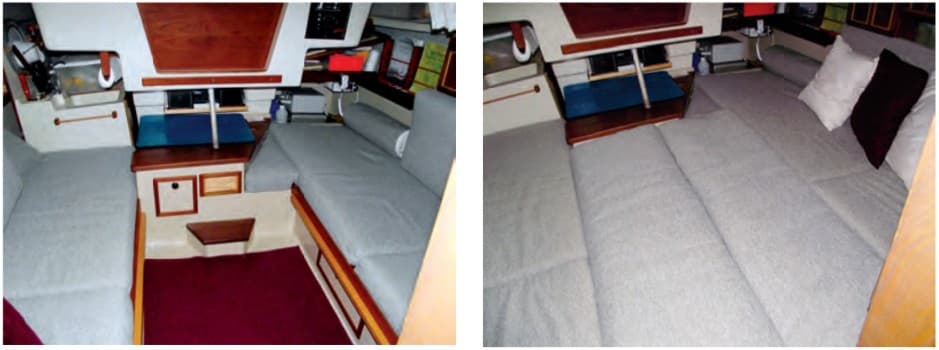
The most practical change in the whole project was the rework of the settees. The owners built them with removable cushions and supporting boards so the saloon could become a full-length berth. That single move solved one of the most common problems on a small cruiser: a cabin that looks adequate until you try to sleep in it for more than one night.
A full-length berth in a 23-footer is not luxury, it is function. It lets the boat support real rest instead of just a place to crash, and that changes how long you can stay aboard before fatigue becomes the limiting factor. The removable-board approach also makes sense for a DIY sailor because it keeps the space flexible. By day, the saloon can still serve as a living area; by night, it becomes a proper sleeping platform.
For a weekender owner, that is the kind of solution worth copying. It does not require a bigger boat, and it does not require pretending a small interior is something it is not. It simply makes one space do a better job in two different modes.
What the upgrade logic looks like on a boat like this
The broader lesson from the O’Day 23 is that a cruising refit should follow the way you actually use the boat, not the way the brochure imagines it. The owners did not chase a glossy project or try to turn a small boat into something it was never meant to be. They made it better at the things that matter most when the days on board get longer.
A weekender owner can take the same approach with changes like these:
- Improve sleeping before you chase cosmetic upgrades.
- Use removable panels or boards so one cabin space can serve more than one role.
- Add storage where gear naturally accumulates instead of forcing it into open space.
- Line the hull sides to make the cabin quieter, softer, and more comfortable.
- Replace tired cushions early, because comfort is what keeps the boat in use.
That is the practical side of sailing DIY: not the fantasy of a perfect refit, but the discipline of making a workable boat genuinely livable. The O’Day 23 did not become a cruising boat because it got bigger. It became one because the owners kept adapting it until the interior matched the life they were actually living.
In the end, that is what turned a temporary trailer-sitter into a months-on-ender. The boat stayed small, but the thinking got bigger, and that is what made the cruising life possible.
This article was produced by Prism’s automated news system from verified source data, official records, and press releases, then run through automated quality and moderation checks before publishing. The system is built and supervised by the people who set the standards it runs under. Read our full AI policy.
Did this article answer your question?