How EVA foam deck flooring improves grip, comfort, and durability
A well-placed EVA foam deck can turn a slick, hot sailboat deck into safer footing with less fatigue and more everyday confidence.
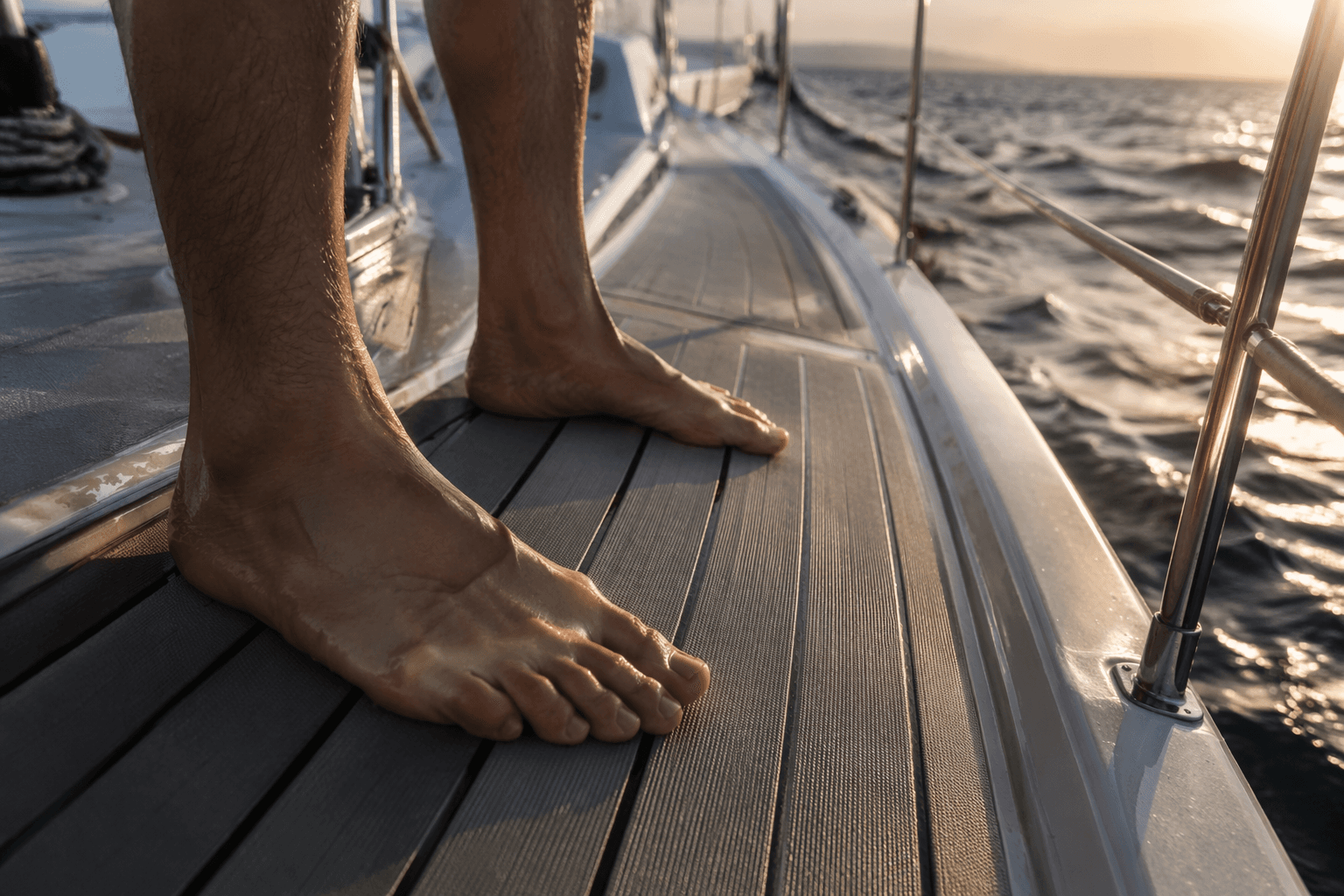
A retrofit that changes every step aboard
A tired sailboat deck is felt before it is admired. The first wet step out of the companionway, the heel-stabilizing move across the cockpit sole, the sideways shuffle along a sun-baked side deck, that is where EVA foam earns its keep. The safety case is not abstract either: the U.S. Coast Guard Boating Safety Division says it is dedicated to reducing loss of life, injuries, and property damage on U.S. waterways, and its 2019 Recreational Boating Statistics report recorded 613 fatalities, 4,168 accidents, and 2,559 non-fatal injuries.
That is why this upgrade belongs in the safety-and-traction conversation, not the cosmetic one. The best EVA foam flooring does more than freshen a deck’s look. It can change how a boat feels underfoot every time crew move around, especially on aging sailboats where cockpit traffic, salt spray, and sun exposure all punish the same walking surfaces again and again.
Why EVA foam works where sailors actually slip
SeaDek describes its marine flooring as UV-resistant closed-cell PE/EVA foam that provides traction when wet or dry and shock-absorbing comfort. That combination matters on a sailboat because the problem is rarely one thing. A deck can be slick with spray, hot under bare feet, and tiring to stand on when you are bracing in a seaway. EVA foam addresses all three by adding grip, softening impact, and reducing the hard, reflective feel of bare fiberglass or molded non-skid.
It also solves a practical maintenance problem. SeaDek positions its flooring as an alternative to marine carpet and traditional molded-in non-skid, and that makes sense for sailors who want a wear layer that protects the surface beneath from repeated foot traffic and small dings. On an older boat, that protection can matter as much as the comfort, because worn surfaces are usually the ones that become hardest to clean and most frustrating to live with.
Where it pays off most on a sailboat
The best places for EVA foam on a sailboat are the zones where balance gets tested, not the spots that only photograph well. Companionway entries see wet shoes, quick pivots, and repeated traffic. Cockpit soles take the brunt of crew weight, winch work, and bracing while the boat is moving. Side-deck step zones are where traction has to work in motion, with one hand on a shroud or rail and the other reaching for the next foothold.
Those are also the places where the comfort benefit becomes obvious after an hour underway. SeaDek’s shock-absorbing foam helps reduce the hard-footed fatigue that comes from standing on glassy, unyielding surfaces. For family crews, that can make a boat feel less punishing on day sails and more approachable for everyone stepping aboard, which is a real upgrade in daily use, not just on a calm dockside afternoon.
Comparing the usual flooring choices
The appeal of EVA foam becomes clearer when you compare it with the surfaces sailors already know:
- Marine carpet can soften the deck visually and physically, but SeaDek explicitly markets its foam as a superior alternative because the closed-cell PE/EVA construction will not absorb water and still provides traction when wet or dry.
- Traditional molded-in non-skid is durable and familiar, but it is fixed in place and does not give you the same cushioned feel underfoot. Once it is worn, the boat keeps carrying that wear unless you refinish the surface.
- EVA foam sheets and custom kits add the most flexibility for DIY work. SeaDek sells custom boat flooring kits and sheet material for projects, including custom full-sheet products listed at 6mm thickness.
For a sailor trying to retrofit a cockpit or a pair of step zones, that last category is often the sweet spot. A made-to-order kit lets you fit the shape of the boat instead of forcing the boat to accept a generic rectangle. SeaDek says custom products can take up to five weeks to ship, so the tradeoff for that fit is a little patience.
Install reality on curved surfaces and around hardware
This is where the project stops being a styling job and becomes real boatwork. Flat panels are straightforward, but sailboats are full of curves, cutouts, and penetrations, from coamings and drains to hinges, cleats, and hardware bases. A custom sheet matters here because a 40-inch by 80-inch, 6mm sheet can be trimmed for a DIY project and shaped to fit more than one walking surface.
The practical advantage is that EVA foam is marketed as easy to install, which is a big reason it has become a popular marine upgrade. The better the template, the cleaner the result around openings and edges, and the less likely you are to end up with a deck surface that traps water or looks improvised around the hardware that sailors touch most often.
Salt, sun, and the daily punishment a deck takes
A sailboat deck lives a rougher life than most people realize. Salt spray dries into a crust, sunlight beats on exposed surfaces, and every passage of crew shoes grinds a little more out of the finish. EVA foam’s UV resistance, water resistance, and closed-cell construction are what make it practical in that environment, because the material is designed not to soak up water and to keep its grip in wet or dry conditions.
That durability is also about comfort over time. Manufacturers commonly describe EVA foam flooring as easy to clean and helpful in reducing noise and heat transfer, and those traits matter on boats with exposed deck surfaces that get hot in the sun. A cooler, quieter deck is easier to live with, easier to maintain, and less likely to feel like a punishment zone when the boat is in active use.
Why safety belongs in the flooring decision
It is easy to talk about deck material as if it were a decor choice. The numbers from the U.S. Coast Guard argue otherwise. The agency says lifejackets could have saved the lives of over 80 percent of boating fatality victims, and another Coast Guard summary says 79 percent of fatal boating accident victims drowned while 86 percent of victims with reported lifejacket usage were not wearing a personal flotation device. That does not make deck flooring a substitute for basic safety gear, but it does underline why traction and secure footing are worth taking seriously.
ABYC adds another layer to that argument. The American Boat & Yacht Council says it develops globally recognized standards for boat design, construction, repair, and maintenance, and says those standards and technical information reports correlate with a significant reduction in boating accidents over past decades. In other words, the deck surface under your feet is part of the same safety culture as the hardware you trust and the systems you maintain.
That is the real promise of EVA foam on an aging sailboat: the companionway that used to feel slick, the cockpit sole that used to cook in the sun, and the side-deck step that used to demand a cautious shuffle can all become places where the boat feels steadier, cooler, and more usable every time you step aboard.
This article was produced by Prism’s automated news system from verified source data, official records, and press releases, then run through automated quality and moderation checks before publishing. The system is built and supervised by the people who set the standards it runs under. Read our full AI policy.
Did this article answer your question?