How one owner made an Ericson 27 truly trailerable
He turned a 1977 Ericson 27 into a boat he could launch, retrieve, and refit with a trailer and shed built around the hull, not the other way around.
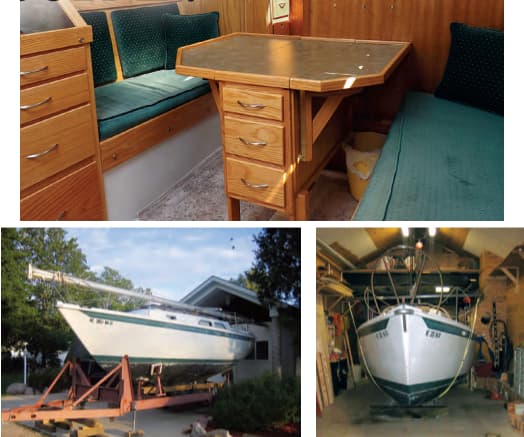
A cruiser that had to fit a couple, a truck, and a life
The key moment in this story is not a glossy launch photo. It is the cold arithmetic of trying to move a 26.75-foot cruiser that weighs about 6,500 pounds and was never designed to behave like a trailer sailer. Ken and Ginny Reinink wanted a boat they could handle as a couple, with a wheel, diesel, standing headroom, and true trailerability. That combination pushed them toward a 1977 Ericson 27, then forced them to rethink almost everything around it.
They bought Reinsnest in 1990 and sailed her as she was until 2006, when the five-year refit began. That sequence matters, because this was not a rushed makeover or a cosmetic refresh. It was a long, deliberate exercise in turning a well-liked production cruiser into a boat that could be stored, serviced, and moved on land without taking away the qualities that made the model appealing in the first place.
Why the Ericson 27 was a bold choice
The Ericson 27 already had a solid reputation before Ken began reworking it. Bruce King designed the boat, Ericson Yachts built it from 1971 to 1978, and production totals ran a little over 1,200 boats, with Practical Sailor putting the total at 1,302. Standard specs commonly listed for the boat include a 26.75-foot LOA, 9-foot beam, about 6,600 pounds of displacement, about 2,900 pounds of ballast, and a draft of roughly 3.92 feet.
That pedigree explains why the boat was attractive, but it also explains why the trailer project was so ambitious. Inboard power and wheel steering were options, and later versions added a redesigned deck and cockpit with pedestal steering, but this was still a 1970s cruiser-racer, not a hull born for easy road travel. Practical Sailor also notes that the Ericson 27 was first marketed as a stripped boat with an outboard as standard and many items as options, which helps explain the model’s flexibility and its appeal to owners willing to customize.
Building the trailer by solving the load, not guessing at it
Ken did not settle for a bigger trailer and a hope for the best. He built two trailers, with the first serving as a prototype and the second becoming the finished answer. The final setup used tandem axles rated at 6,000 pounds each, a 3,500-pound trailer frame, and a total carrying capacity of 12,000 pounds. That left a comfortable margin for a boat weighing about 6,500 pounds, but the real achievement was not raw capacity. It was control.
He worked with several Ph.D.s from Ferris State University in Big Rapids, Michigan, to calculate the trailer’s center of gravity and safe loading geometry. The result was a final tongue weight of 1,650 pounds, a number that tells you how carefully the load was balanced. Instead of relying on brute strength and oversized steel alone, Ken turned the trailer into an engineered system that would center the boat consistently and keep it secure once loaded.

The final trailer included a sectional tongue extension, a self-centering loading technique, a safety board that automatically secured the boat after loading, custom anchor rings for tie-down straps, and storage on board for the hardware needed to rig and unrig the boat. Those details are what make the whole concept useful in practice. A trailer can haul a boat once. A well-designed trailer lets you repeat the process without dreading it.
What makes the system truly trailerable
The important lesson for small-boat owners is that trailerability is not just about weight. It is about workflow. Ken’s setup shows how to think through launch, retrieval, tie-down, and breakdown as one chain rather than a set of separate chores.
- The self-centering system reduced the drama of loading.
- The sectional tongue extension gave the boatyard or ramp setup more flexibility.
- The safety board locked the boat in place once it was aboard.
- The custom anchor rings gave the straps fixed points instead of improvised solutions.
- The storage for rigging parts meant the trailer carried the gear needed to reverse the process.
That kind of integration is what lets a heavy small cruiser behave like a manageable traveling boat. It does not make the hull light. It makes the whole operation predictable.
The shed mattered as much as the trailer
The land-based side of the refit is easy to overlook, but it is one of the smartest parts of the project. Ken built a special shed with a keel pit so the deck could sit closer to floor level during the refit. By letting the keel drop into a pit, he brought the work surface down and spared his body the repeated grind of a taller ladder.
Ken estimated that the setup saved him more than four miles of climbing up and down a longer ladder over the course of the five-year project. That is the kind of figure that sounds almost humorous until you picture the same motion repeated for years. For anyone planning a major refit, the message is clear: support structure is part of the project, not an afterthought. A better work height can make a long rebuild physically possible.
The transferable idea behind Reinsnest
Reinsnest is more than a one-off restoration. It is a case study in building infrastructure around a specific life. Ken and Ginny did not start with a boat that already fit their routine. They bought a proven cruiser, then changed the trailer, the loading method, and the shed until the boat matched the way they wanted to sail.
That is the real takeaway for owners of small cruisers with bigger ambitions. If a boat is close to the right answer but not quite there, the fix may not be a different hull. It may be a better trailer, a smarter loading geometry, or a shop setup that removes the pain from the work itself. Ken Reinink proved that an Ericson 27 could be made truly trailerable, but the deeper lesson is that “impossible” ownership ideas often become workable only after you rebuild the ground under them.
When the boat rolls up the ramp and settles onto that 12,000-pound system, the whole project comes back into focus. The hull, the trailer, and the shed were all designed for the same outcome: making a serious cruiser act like it belonged in a trailerable life.
This article was produced by Prism’s automated news system from verified source data, official records, and press releases, then run through automated quality and moderation checks before publishing. The system is built and supervised by the people who set the standards it runs under. Read our full AI policy.
Did this article answer your question?


