How to Build a Mooring Bridle That Survives Storm-Force Winds
A bridle that looks tidy in flat water can fail in a gale. Greg Manning’s Storm Floris test shows why load path, chafe protection and shock control decide whether your boat stays put.
Why a storm-worthy bridle starts with fear, not fittings
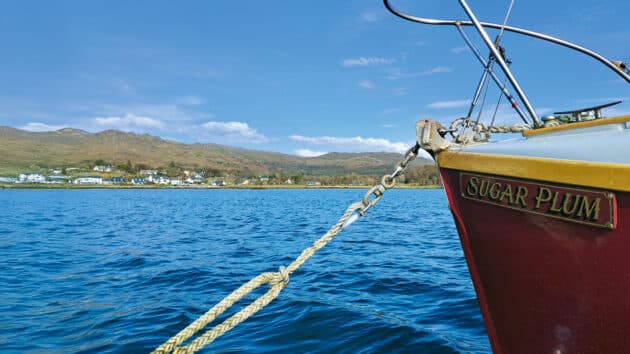
If the bridle lets go in a blow, the boat does not just drift a little. It can surge, twist, saw through its own gear, and turn one bad night into a wrecked deck fitting or a lost boat. Greg Manning’s answer came from experience, not theory: he built a mooring bridle for his Fairey Atalanta A142, Sugar Plum, and trusted it through Storm Floris while lying on a fairly exposed swinging mooring at Arisaig on the west coast of Scotland.
That trust was earned in real weather. The Met Office says Storm Floris struck northern Scotland on August 4 to 5, 2025, with widespread winds over 58 mph, worst-area gusts around 69 to 81 mph, and a peak gust of 82 mph at Wick Airport, which equalled Scotland’s August gust-speed record. The storm also left more than 70,000 properties without power across the Highlands, Moray and Aberdeenshire. In that kind of air, a mooring bridle is not a convenience item. It is the part of the system that decides whether the boat rides out the night or pays for every weakness in the setup.
Match the bridle to the boat, not the bench
The first mistake is treating a bridle like generic ropework. Manning’s point is that the bridle has to suit the boat and the mooring arrangement, because the load path runs through specific hardware: the bollard, cleat, Samson post, or other strong point on the boat, then through the stemhead fitting, then through the ground tackle riser. If any one of those links is mismatched, the bridle can pull in a direction the boat was never meant to take.
That matters even more on a swinging mooring. Chichester Harbour Conservancy’s guide says the top-chain length is commonly around 2.5 m for an average yacht, but it may need adjustment for the individual deck layout. Hull shape, draft, and even windage from canvas and sprayhoods affect how a boat lies to the mooring, so a setup that seems fine in the pontoon berth can behave very differently when it is free to swing. In other words, the bridle is not just holding the boat still, it is managing how the boat moves under load.
Keep the swivel free and the chain short
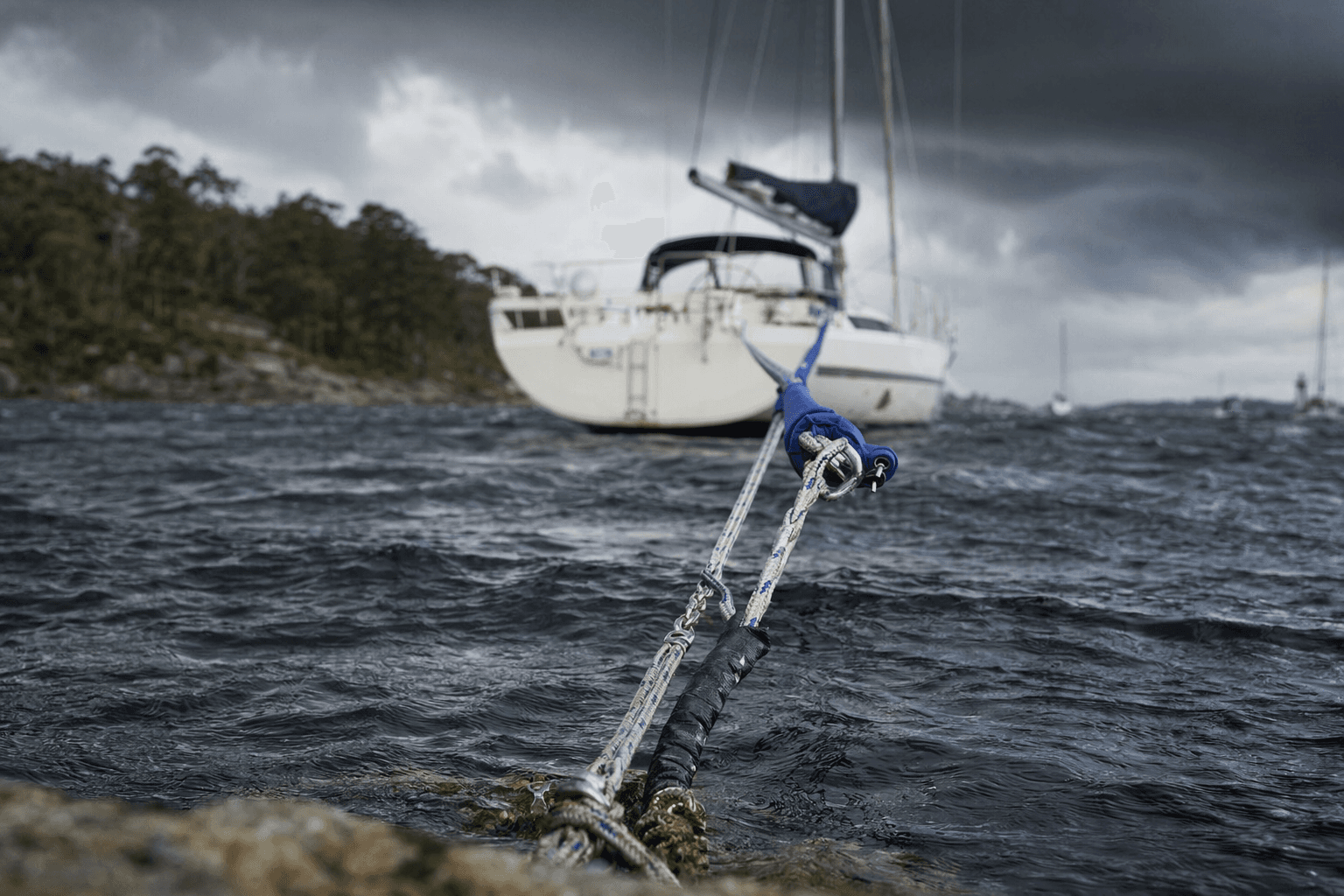
The swivel is the quiet hero of the whole arrangement. The top of the buoy needs to rotate freely, and nothing should be attached below that swivel from the boat, because a rope tied directly to the buoy can foul the swivel and twist the top chain. Once that happens, the boat no longer swings cleanly, and the system starts fighting itself instead of sharing load.
That is why the top chain should be as short as possible while still working with the boat’s geometry. A shorter chain helps limit snatch loads and reduces hull scuffing, which is exactly the kind of wear that builds up when a boat is being jerked around for hours. The goal is not to eliminate motion, which is impossible in a blow, but to control it so the motion does not become a hammer strike every time the boat yaws.
Build in anti-chafe before you need it
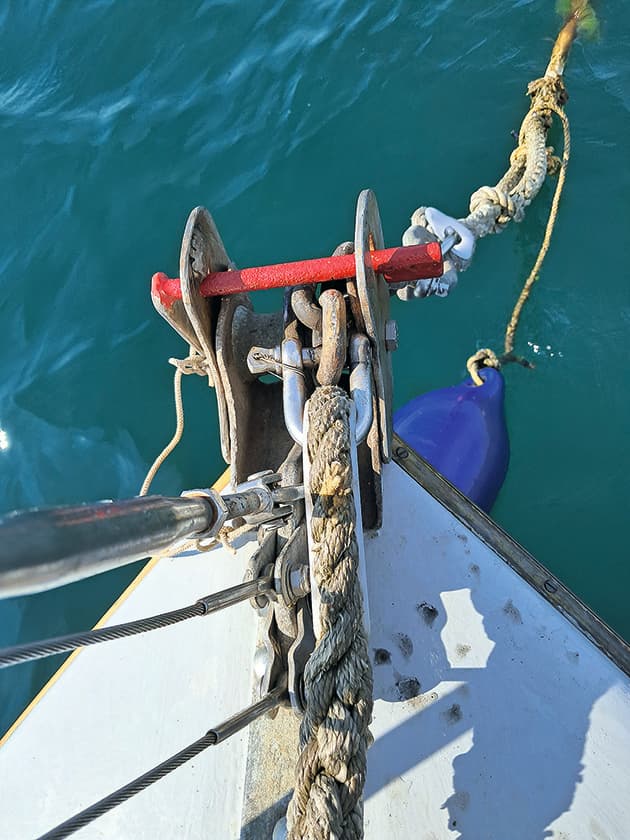
Storm-proofing a bridle is mostly about preventing one ugly failure mode: rubbing. Manning notes that loops or eyes should be formed around a thimble, and a short length of chain should be used where the bridle passes over the stemhead fitting so it cannot chafe through under movement. That detail is easy to miss in the shed and impossible to ignore once the boat starts tugging in a rising wind.
A keeper also needs to stop the bridle from jumping out of the stemhead roller, and it needs to be self-locking. This is one of those tiny bits of hardware that looks unnecessary until the boat starts moving in ugly seas, when anything loose can migrate, rattle, or shift at exactly the wrong moment. On a storm-tested setup, nothing is allowed to rely on hope.
Treat every connection like a load-bearing part
The shackle choice matters too. A two-piece shackle must be wire-locked, while a three-piece shackle with a plain pin must be split-pinned. That is not fussy seamanship, it is insurance against a pin working loose after repeated loading and unloading, which is exactly what a mooring sees when the boat surges and then snaps back.
The Maritime and Coastguard Agency says anchoring and mooring operations impose great loads on ropes, warps, gear and equipment, and its guidance also warns that risk assessments have to cover unusual or non-standard mooring arrangements and snagged lines that can suddenly release under tension. That is the right mindset for a bridle build. You are not just assembling parts that hold in calm water; you are building a system that must survive shock, reversal, and the possibility that debris or even another loose vessel could overload it.
Why the storm test matters at Arisaig
Arisaig makes a fitting proving ground. Arisaig Marine describes the place as “The Safe Bay” and says it offers moorings and marina services on the west coast of Scotland. Its materials also say the marina has 70 secure single-point moorings suitable for vessels up to 15 m and 20 tonnes, which tells you the local standard is already shaped by real weather, not marketing fantasy.
That is why Manning’s account lands so well with cruising sailors. He did not just build something that looked tidy on paper. He built a bridle that let him sleep soundly while Storm Floris pushed hard enough to make regional infrastructure fail, and that is the standard worth copying. A storm-worthy bridle is not the most glamorous upgrade on a boat, but when the wind jumps into the 70s and 80s, it becomes the difference between managing the night and surviving it with confidence.
The test you are really passing
A good mooring bridle is successful when it disappears into the system. It keeps the load path clean, lets the boat swing freely, protects every contact point from chafe, and avoids surprise slack or snatch. If you can look at your own setup and explain exactly where the swivel works, where the chain protects the stemhead, how the keeper stays locked, and how the shackles are secured, you are no longer guessing.
That is the standard Storm Floris sharpened for everyone watching from a mooring in exposed water. When the weather turns ugly, the best bridle is not the one with the neatest bench build. It is the one that still makes sense after the wind has done its worst.
This article was produced by Prism’s automated news system from verified source data, official records, and press releases, then run through automated quality and moderation checks before publishing. The system is built and supervised by the people who set the standards it runs under. Read our full AI policy.
Did this article answer your question?