Two-boat tuning helps sailors test changes faster and sail smarter
A partner boat can turn guesswork into proof, showing which tweak is real before you spend on sails or hardware.
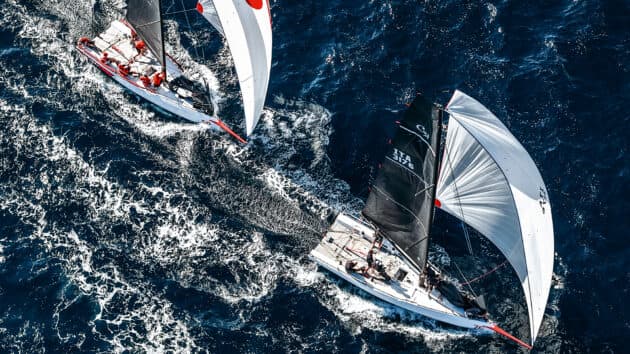
Two-boat tuning can save you from the most expensive mistake in club racing: treating a bad setup like a shopping problem. Put a second boat alongside yours and every change becomes an A/B test, not a guess, which is exactly why the best sailors use it before they spend on sails, spars, or hardware.
Why two-boat tuning works
John Gimson’s point is simple and brutal in its logic: when you sail against a partner boat, you get feedback in real time instead of trying to remember how a lonely run felt half an hour later. That matters at every level, not just in Olympic campaigns, because the water gives you an answer faster than any debrief on land.
Gimson knows the method from the sharp end of the sport. He spent years tuning with Iain Percy and Andrew “Bart” Simpson in the Star keelboat, then carried that same performance habit into foiling-catamaran racing. Percy and Simpson won Olympic gold in Beijing in 2008 and silver in London in 2012, and the Andrew Simpson Foundation says the pair dominated the Star class for more than five years. Simpson, born on 17 December 1976 and killed on 9 May 2013, remains one of the clearest reminders of how much development work sits behind a medal. Gimson later added his own record, taking Olympic silver in Tokyo 2020 in the Nacra 17 and becoming a multi-time world and European champion.
That pedigree matters because it proves two-boat tuning is not a classroom trick. It is a race-proven learning system that helps you make a boat faster without first replacing the whole boat.
Lock in a baseline boat before you touch anything
The first drill is to choose one boat as the control and leave it alone. That boat is your known standard, the reference point that tells you whether the test boat actually improved or whether the breeze, tide, or wave pattern simply changed.
Measure the boat you already trust, then copy those standard settings before you start the comparison. If the two boats differ in sails or spars, each skipper should still begin from normal tuning before the first run, because the test only works when both boats start from a clearly defined baseline. Sailing World’s guidance is blunt on this point: the whole setup has to be matched closely enough that one variable, and only one variable, is responsible for the result.
The adjustment is equally disciplined. Change one thing on the test boat, then sail the same leg again. If you alter rig tune, trim, and helm technique all at once, you have not learned anything. If you change one item and the boat keeps winning the same lane, you have learned something you can repeat.
The gain is immediate. Instead of buying new sails because the boat felt slow on one afternoon, you can identify whether the problem is actually in the tune, the handling, or the original setup. That alone can keep a club racer from spending money on a fix that never needed to be purchased.
Build a fair test lane on the water
A two-boat session only works if the boats start from a fair, repeatable position. Gimson’s advice is practical here: on flat water, the boats can start a few lengths apart, with the leeward boat slightly ahead. In waves, the separation needs to increase so the windward boat does not get washed into the leeward one.
That detail sounds small, but it is the difference between a valid test and a false positive. If the boats are too close in messy water, wake and wave interaction can make one boat look faster when the real story is just cleaner water or a better lane. Sailing World’s advice to keep the boats as closely matched as possible is about creating a comparison that survives scrutiny, not just a quick impression.
Measure the lane before you measure the result. Ask whether both boats stayed in the same pressure, whether the same boat kept a lane advantage, and whether the separation was enough to avoid interference. Then adjust the spacing before the next run, not after three confusing laps.
The payoff is that your data starts to mean something. You are not just feeling that the boat is quicker; you are seeing whether the change works when the test is fair. That is the kind of clarity you cannot get from one boat sailing alone.
Keep the verdict honest and repeatable
Two-boat tuning only pays when both crews tell the truth about what happened. If a puff, shift, or wave set made one boat look better, say so. The system depends on mutual trust, because the fastest boat on one run is not automatically the better boat on the next run.
That honesty turns the session into a repeatable drill. Pre-plan the order of the tests so everyone knows exactly what is being evaluated, then keep the language consistent from one crew to the other. The more disciplined the setup, the easier it becomes to spot whether a gain is real or just weather-driven noise.
Measure the repeatability, not just the headline speed. If the same boat wins twice in similar conditions after the same change, you have a solid answer. If the result flips every time the breeze shifts, the change is not proven yet and it is not ready to justify a bigger spend.
What you get instead of buying your way to speed
This is where two-boat tuning beats the usual shopping list. A new sail or a new piece of hardware can be a great upgrade, but only if you know which problem it is solving. Two-boat tuning tells you whether you need a different sail, a different setting, or simply a more disciplined way of sailing the boat you already own.
For club racers, that makes it the cheapest performance upgrade most people ignore. You are not just chasing a faster one-off run; you are building a faster decision-making process. Gimson’s record with Percy and Simpson, plus his later success in the Nacra 17, shows how powerful that habit can be when it becomes part of everyday sailing.
The real win is not the extra knot on one leg. It is knowing, with confidence, what changed, why it changed, and whether the next dollar should go into tuning, training, or new gear. That is how two-boat tuning helps you sail smarter long before you sail richer.
This article was produced by Prism’s automated news system from verified source data, official records, and press releases, then run through automated quality and moderation checks before publishing. The system is built and supervised by the people who set the standards it runs under. Read our full AI policy.
Did this article answer your question?


