How to heat a sailboat without shorepower in winter
A cabin heater is really a livability decision: match the heat load, fuel, and ventilation to the boat, or winter comfort turns into risk fast.
The first winter aboard always exposes the truth about a boat: the cabin is only as livable as the system that keeps it warm. On a 41-foot sailboat in New York Harbor, the crew expected a milder start and instead ran straight into the cold-weather problem every off-grid sailor eventually faces, how to heat the boat well enough without leaning on shorepower. The answer was not simply “add a heater.” It was a tradeoff between comfort, fuel, installation space, power dependence, and the hard rules of marine safety.
Start with the heat load, not the catalog
The cleanest way to think about winter heat is by demand. Burry Vanderveer estimated the saloon on the boat at roughly 8,000 BTU per hour, with 10,000 BTU or more being preferable. That number matters because a boat’s heating need is shaped by its insulation, its volume, and the conditions it actually sees, not by hope or by whatever unit looks tidy in a brochure.
That is why a heater that worked well on Chesapeake Bay did not remain the obvious answer once water temperature fell below about 38 F. Vanderveer found the heat pump could do the job until the bay got cold enough that its output dropped off too far to trust as the primary source. For a DIY sailor, that is the key lesson: if your boat is going to spend real time in winter water temperatures, your system has to be chosen for the coldest reasonable conditions, not for the shoulder-season days when everything feels easier.
Choose a fuel with the whole boat in mind
Once the load is clear, the next question is fuel. The article walks through solid fuel, liquid fuel, propane, and CNG, and that range tells you something important: there is no universal “best” heater, only the one that fits your boat, your storage, and the way you cruise. Some systems simplify fuel handling. Others simplify the cabin. Some are cheaper to install but bring more complexity in the long run.
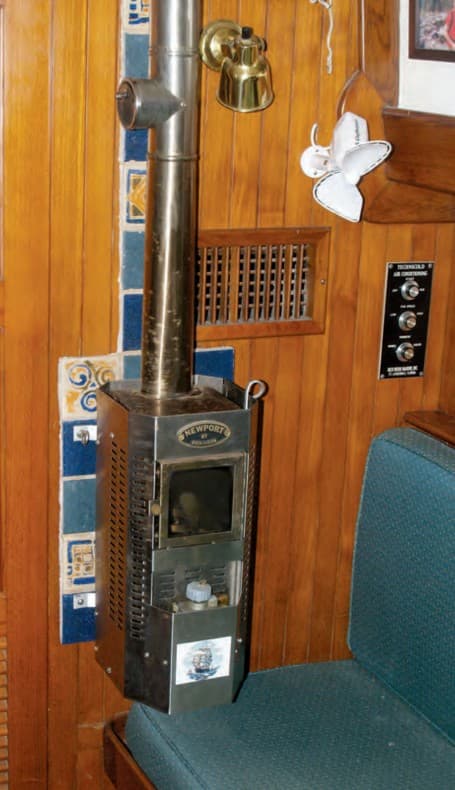
On this boat, the final choice was a Dickinson diesel fireplace-style heater. The reason was practical as much as emotional. The crew already carried plenty of diesel, so they did not need to add another fuel line or create a separate propane or gas setup. They also wanted the feel of a real flame and the simplicity that comes with a more traditional heater. In other words, this was not just a purchase decision. It was a livability call, one that weighed heat, space, and the daily reality of winter aboard.
The venting rule is not optional
Whatever fuel you choose, combustion gases have to leave the boat. The article is blunt about avoiding unvented portable heaters, and that warning is reinforced by marine safety guidance from the U.S. Coast Guard, the Centers for Disease Control and Prevention, and the American Boat and Yacht Council. On boats, carbon monoxide can come from engines, generators, cooking ranges, and heaters, and it can be deadly in enclosed spaces.
The CDC advises installing and maintaining a working marine-use carbon monoxide detector, and that should be treated as part of the heating system rather than an accessory. ABYC adds another layer of realism: carbon monoxide accumulation depends on boat geometry, ventilation openings, wind direction, and vessel attitude. That means the same heater can behave differently from one anchorage to another, or even from one day to the next. A warm cabin is never worth the gamble of trapping exhaust where people sleep.
Why the Dickinson Newport made sense on this boat
Dickinson Marine brings a long track record to this conversation, saying it has manufactured marine cookstoves, barbecues, and heaters since 1932. The Newport diesel heater they use as the example is a natural-draft unit with a required 3-inch chimney and a permanent fresh-air vent. Current product information describes it as a compact bulkhead-mounted diesel heater, and that detail matters because it explains how the stove gets installed when cabin geometry is tight.
Retail listings place the Newport in a range of roughly 6,500 to 16,250 BTU and describe it as ideal for boats around 30 to 36 feet. That makes the 41-foot sailboat in the article a useful reminder that sizing is never just about the sticker on the heater. This boat sat at the upper end of the practical discussion, which is exactly why the 8,000 BTU per hour estimate in the saloon carried so much weight. The crew also mounted the unit on the bulkhead because there was no room for a floor-standing model, another very familiar constraint for anyone trying to carve heating into a liveaboard layout.
How to decide whether a cabin heater is worth the complexity
A proper cabin heater earns its place when it extends the season and keeps the boat usable without shorepower. But it also adds demands of its own: fuel management, vent routing, combustion air, detector placement, and enough physical space to install the system safely. If your boat cannot accommodate those pieces cleanly, a heater can become a burden instead of an upgrade.
The decision gets easier if you work through it in the same order Vanderveer did:
- Estimate the cabin load in BTU, not just the desire for warmth.
- Match the heater to the boat’s volume, insulation, and expected water temperature.
- Choose a fuel that fits what you already carry and can safely stow.
- Make sure the design vents combustion outside and brings in fresh air.
- Install and test a marine CO detector as part of the system, not after the fact.
- Confirm the heater can physically fit, whether bulkhead-mounted or floor-standing.
That framework turns winter heating from a vague comfort upgrade into a proper boat-system decision. On a cold boat in New York Harbor, the real question was never whether the cabin should feel cozy. It was whether the crew could make the boat livable, safely and without shorepower, when the season refused to be reasonable.
This article was produced by Prism’s automated news system from verified source data, official records, and press releases, then run through automated quality and moderation checks before publishing. The system is built and supervised by the people who set the standards it runs under. Read our full AI policy.
Did this article answer your question?