How to Inspect and Replace Standing Rigging Before It Fails at Sea
Standing rigging looks clean right up until it fails. Nick Cook of Technical Marine Supplies breaks down the inspection and replacement process every offshore sailor needs to know.
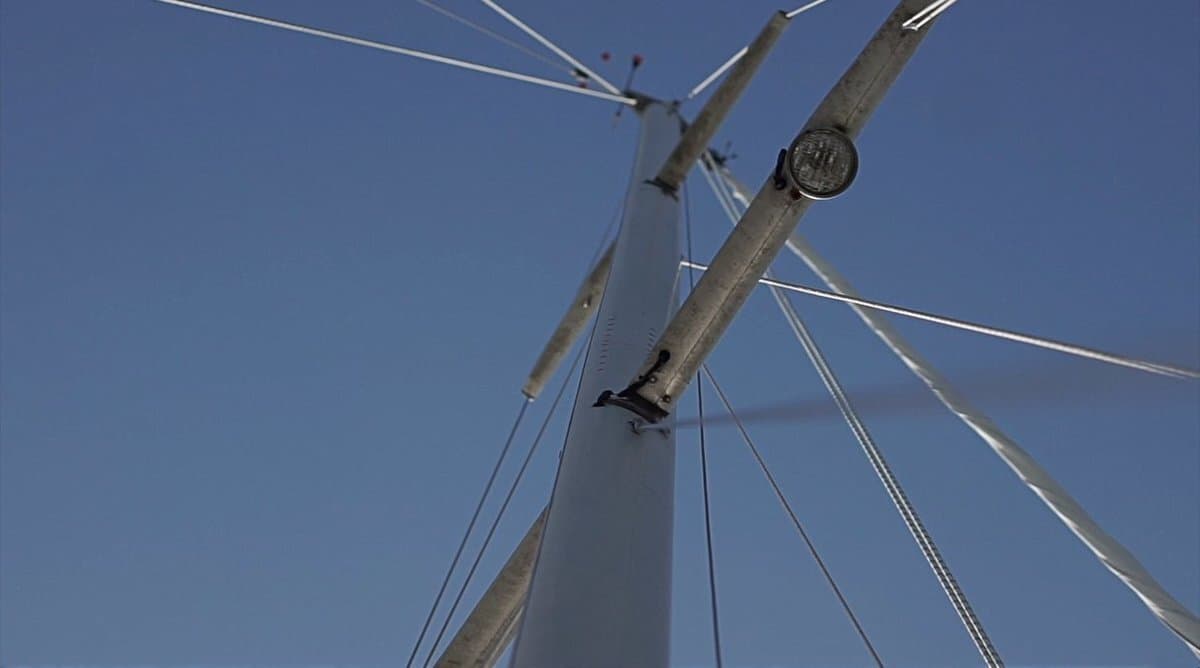
The wire that looks fine is the one that fails
A single broken strand where a shroud enters a swage fitting looks almost like nothing: a tiny proud wire, a small snag that catches your glove. Most sailors tape over it and move on. What they're actually looking at is the beginning of swage failure, and the downstream result is a terminal that holds together at the dock and lets go offshore, taking the mast with it. That's the central trap with standing rigging: the warning signs are subtle, and the failure mode is catastrophic.
Nick Cook, Senior Sales Manager at Technical Marine Supplies in Plymouth, frames the issue without softening it: "Unfortunately, stainless steel rigging won't last forever. You should view your rigging as one of your boat's consumable items, much like antifouling or sails." He adds that lifespan "will be dependent on the type, distance logged, and frequency of use" and that for standing rigging, use "is not limited to just sailing miles." Standing rigging works every time the boat moves in a swell, every time it's loaded against a dock, every gust of wind in a marina. The hours accumulate invisibly.
Why rigging fails: two hidden mechanisms
Understanding the failure modes changes how you inspect. The two primary killers are crevice corrosion and metal fatigue from cyclic loading, and both are essentially invisible until they aren't.
Crevice corrosion is most dangerous inside swage terminals, where stainless steel is deprived of the oxygen it needs to maintain its protective oxide layer. The fitting looks polished and intact on the outside while the internal wire-to-metal interface corrodes silently. One visible clue is dark spots distributed along the length of the wire itself, indicating internal corrosion developing between the strands. By the time that shows up, the process is already advanced.
Cyclic loading is subtler still. Rigging is subjected to cyclic loading, which causes unseen work-hardening of the material that in the long term can result in failure. A useful analogy: straighten a wire coat hanger, then repeatedly bend it back and forth. You can do it many times before it snaps, and there's no way to tell by looking at it when it's about to go.
Metal fatigue extends beyond the wire itself. A shroud tang failure documented in *Practical Boat Owner* was traced to fatigue: the fitting had been riveted directly to the mast without toggles, allowing bending stresses to act directly upon it. Every rigid, non-articulated connection in a rig is a potential fatigue concentration point.
How to inspect: from deck to masthead
The inspection protocol should match the stakes of your sailing. A pocket cruiser moored in a sheltered marina, sailed eight weekends a season and stored ashore for five months, should have a rig check at least once a season. A bluewater cruiser on a big passage requires deck-based checks daily, with full up-mast checks carried out before each open-water crossing. Regardless of use type, most surveyors recommend a rig-down inspection every five years.
Start at the masthead using a bosun's chair and work downward, checking every fitting in sequence:
1. At each swage terminal, look for broken wire strands where the shroud enters the fitting. Even a single broken strand is a no-sail warning. Inspect swage fittings for smoothness and evenness; any bulges or cracks may indicate serious issues.
2. Check that rigging wires are in column throughout their length, especially where they enter an end fitting. If there's a bend or the wire doesn't line up with the end fitting, there may be a problem.
3. At spreader roots and tips, remove anti-chafe padding. All too often, excess anti-chafe protection results in the spreader tips becoming a water trap that turns into a hidden corrosion bath. Cut it away, use white vinegar and a plastic scrub pad to clear oxidation, and remove spreaders from the spar where possible to inspect the sockets.
4. Examine chainplates and stemhead fittings as critical connection points, looking for signs of movement or rust. These are frequently overlooked. In one case documented before an Atlantic crossing, the standing rigging had been replaced seven years earlier but the chainplates and their mounting hardware had never been replaced at all, which set off alarm bells.
5. Run a rag or bare hand along the full length of each wire. "Meathooks" - proud, broken strands that snag cloth and skin - are an immediate flag, and you'll feel one before you see it.
6. Check roller-furling gear for ease of use. If it's difficult to operate, inspect and service the drum. It has been known for the rotation load on a stuck drum to unwind a compression terminal, which could lead to the loss of a rig.
For fittings where visual inspection leaves doubt, dye penetrant testing is the best accessible tool. A strongly coloured dye is sprayed onto clean metal and wiped away; any cracks will have residual dye left in them, making them much easier to see. It's a technique used by metallurgists, and the aerosol kits are affordable enough for any serious DIY inspection.
Material differences: how wire type affects your risk
The construction of your standing rigging changes both what you look for and how much warning you get before failure.

Standard 1x19 stainless wire, nineteen strands in a fixed geometric pattern, is the most common choice on production cruising boats. Its safety advantage is that individual strands break before the wire itself fails, producing the meathook warning. Dyform wire uses compacted strand construction to achieve higher breaking load for the same diameter, reducing weight and windage aloft, but the inspection process is identical.
Rod rigging is a fundamentally different proposition. It's stronger, more corrosion-resistant, and produces less stretch under load, which is why performance boats and many offshore cruisers use it. The significant downside, noted plainly by experienced riggers, is that rod produces no strand-by-strand warning before failure. It goes all at once, which places an even greater premium on strict replacement schedules and professional inspection intervals.
For wire grade, 316 stainless is the correct specification for any standing rigging. Its molybdenum content improves resistance to pitting and crevice corrosion in the saltwater immersion environment that rigging actually lives in. 304 stainless is slightly stronger in tensile terms but significantly less resistant to that corrosion; it isn't an acceptable substitute.
Replacement timelines: the numbers and why they differ
All standing rigging should be replaced preferably by the eighth year and by the tenth at the latest, because the rig is subjected to cyclic loading that causes unseen work-hardening of the material. Most riggers will say replace the standing rigging every 10 years, while advice from riggers in America is to change it every seven. Practical Sailor generally recommends 10-12 years for wire on an average cruising boat, assuming all terminals and end fittings are also up to standard.
The spread in those numbers reflects genuine differences in use intensity. A lightly sailed coastal boat wintered ashore with the mast down accumulates far less cyclic fatigue than an offshore passage-maker running continuous miles. Insurance policies will inevitably play a part in the decision, and there has been a general assumption within the sailing community that insurers require rigging replacement at a set interval. Not all insurers are adamant about replacement at 8 or 10 years, and some will accept a rig inspection by a qualified professional in lieu of wholesale replacement.
The practical principle: replace on schedule, not on appearance. A rig that looks clean at year eleven has still undergone a decade of work-hardening and hidden internal corrosion that no visual inspection can fully rule out.
DIY replacement: getting it done without a boatyard
Replacing all standing rigging at once is the clean approach, but single-stay replacement is achievable as a DIY project for anyone comfortable going aloft. Terminal choice is the key decision.
Swageless mechanical fittings, with Sta-Lok among the most established brands, are designed for field installation on 1x19 wire without specialist swaging equipment. An internal wedge slides over the inner strands of the unwound wire while another component acts as a bushing; the socket-like fitting tightens down to lock everything in place. No hydraulic swager required, and the fitting can be disassembled and re-inspected, which a factory swage cannot.
Many riggers use a hybrid approach: one end of each stay factory-swaged for maximum reliability, the other end finished in situ with a swageless fitting. When ordering replacement wire, specify the exact diameter, construction type, and 316-grade stainless. Measure existing lengths carefully; a stay that's even a few centimetres short means starting over.
If the whole rig is coming down, renew chainplates, toggles, and clevis pins at the same time. The cost of those components against the cost of a replacement spar makes the calculation easy. The mast foot takes the biggest compression loads of the whole rig, so give it thorough attention for corrosion or movement before anything else goes back up.
Rigging is the one system on a sailboat where the margin for error is genuinely zero. The work-hardening is invisible, the corrosion inside swage fittings is invisible, and the failure happens in seconds. As Nick Cook puts it, treat it like a consumable: inspect it as a complete system, and replace it on schedule rather than waiting for a warning that may never arrive.
This article was produced by Prism’s automated news system from verified source data, official records, and press releases, then run through automated quality and moderation checks before publishing. The system is built and supervised by the people who set the standards it runs under. Read our full AI policy.
Did this article answer your question?