Two Years Later, How Teak Deck Finishes Really Hold Up Afloat
The finish that looked pristine at launch showed differential fading and edge failure within two seasons; here's what the data actually reveals about long-term teak care.
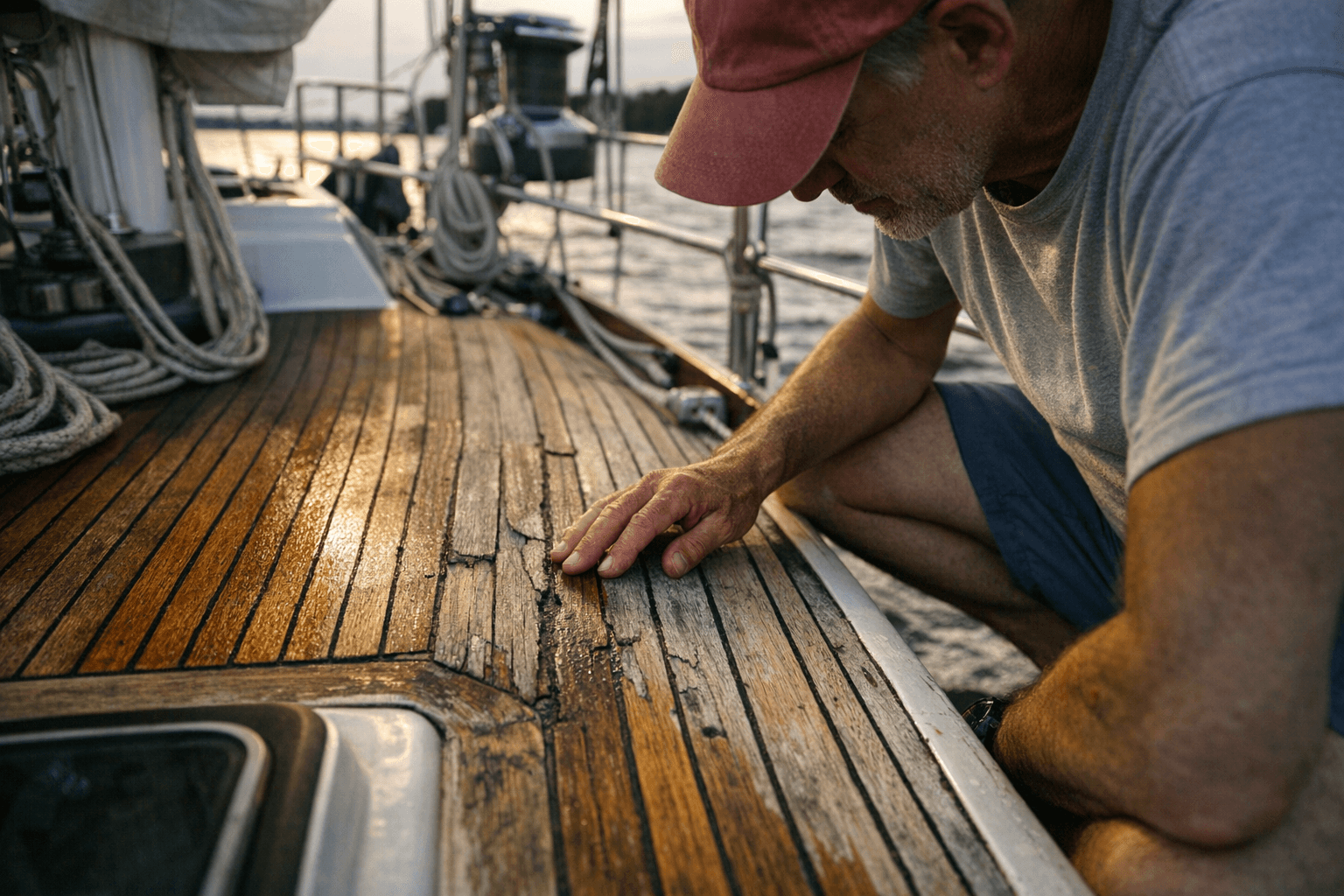
Treat a beautiful teak finish like it's maintenance-free and you'll be grinding down to bare wood inside two seasons. The failure doesn't announce itself dramatically; it shows up as a dull patch near a cleat, a lifted edge along a fastener line, or a scuffed-out section where foot traffic concentrates. By then, a light scuff-and-recoat has become a full strip job. That is the real lesson from Practical Sailor's two-year field follow-up on exterior wood finishes, and it's one that no product label will tell you.
What Two Seasons of Sun and Use Actually Do
The most important thing Practical Sailor's testing reveals is that finish degradation is rarely uniform. UV exposure, abrasion, and moisture intrusion all attack in specific zones first: edges, fastener penetrations, seams, and the highest-traffic areas of the deck surface. A panel that still looks good in the middle can be failing at its margins. This matters practically because it means a whole-boat re-strip is often unnecessary if you catch these problem areas early; it also means that a casual glance at midship won't tell you what's happening at the cleats and companionway sill.
Photographic comparisons over the test period showed measurable gloss loss, grain raising after sanding, and localized finish breakdown concentrated exactly where you'd expect: high-traffic areas and anywhere water can get under an edge. In color retention, the Schooners, Perfection Plus, and Compass all showed what Practical Sailor describes as moderate fading to a rich reddish hue, earning Good ratings. Perfection Plus separated itself on gloss, scoring Excellent at the two-year mark, with Schooner Gold, Schooner, and Compass in a tight cluster just behind.
The Standout Performers and Where the Surprises Were
Among the finishes tested, Interlux's Cetol Marine Natural Teak delivered the sharpest value proposition. In a head-to-head field test against Awlwood MA Clear, Cetol Marine Natural Teak came out holding its own, offering more affordable protection while still showing off the wood's natural grain. It's not the glossiest option on the list, but for owners who want low-drama maintenance rather than a mirror finish, its performance at two years was a genuine surprise.
Practical Sailor's long-term test results are consistent with earlier data: when it comes to single-application longevity, the Cetol Marine and Marine Light with gloss overcoats reign supreme among varnish alternatives. Perfection Plus earned its high-gloss reputation with an Excellent two-year gloss rating. Schooner Gold brought a higher viscosity formula with advanced UV technology and a useful practical benefit: it doesn't require sanding between coats, though sanding is still recommended for best adhesion. Compass Clear, with its polyurethane base, showed strong abrasion resistance and is a solid pick for spars and tillers where flex and wear are constants.
Of the 23 finishes in the original test pool, four were no longer available by the time the two-year review came around. A useful reminder: always buy a spare can of whatever you apply, because product lines change.
Film-Forming Varnish vs. Two-Component Finishes
Understanding how your finish is built chemically changes how you maintain it. Conventional single-component varnishes depend on oxidation to cure, which means they can't take advantage of antioxidant additives that would slow long-term cross-linking and brittleness. As single-component varnishes age, the long polymer chains that give the finish flexibility break down and cross-link into denser, shorter chains, making the finish progressively more brittle over time. This is why a one-part varnish that looked flawless at six months starts to craze and chip by the end of year two, especially in a tropical or high-UV environment.
Two-component finishes sidestep some of this by using chemistry that cures differently, producing a harder, more chemically resistant film that resists abrasion better than most one-part products. The trade-off is application difficulty, longer cure windows, and a less forgiving touch-up process. The right answer depends on your boat, your climate, and how much time you're willing to put into prep and upkeep. In high-sun latitudes, the case for a two-part finish gets stronger quickly.
Know Your Finish Chemistry Before You Plan Your Maintenance
The most operationally useful point in Practical Sailor's two-year report is about matching your upkeep plan to the chemistry of what you applied. Their technical guidance makes clear the distinction: a sacrificial finish is designed to be stripped and recoated on a regular cycle, while a maintenance-type topcoat is meant to be scuff-sanded and re-applied over itself. Using a sacrificial finish and then trying to maintain it like a topcoat, or vice versa, produces exactly the kind of localized failure that looks puzzling when it appears. As Practical Sailor's test team puts it, a good initial job plus scheduled small maintenance beats any claim of a miraculous one-and-done coating.
For Cetol users, this is well-established: as the surface dulls, a quick pass with a 3M scrubber is all you need to recoat. No full strip, no heavy sanding. That simplicity is exactly why Cetol has a loyal following among owners of Island Packets and other teak-coaming-heavy designs. Varnish users have a steeper learning curve: a failed film means a more aggressive prep cycle, but a well-maintained varnish finish can last considerably longer than a teak oil before it needs a full rebuild.
Where Failures Concentrate: Fasteners, Edges, and Foot Traffic
If you only inspect one thing during a seasonal check, inspect the areas around fastener penetrations and finish edges. Water that gets under a finish at a screw hole migrates laterally, lifting the film in a widening bubble that becomes visible only after the damage is done. Teak decks with exposed fasteners are a clear indicator of deferred maintenance; once exposed, water ingress increases and corrosion can compromise deck safety. Catching a fastener-line failure early, with a small spot repair and a rebed where needed, is a two-hour job. Waiting until the seam caulk cracks and water has been sitting on the substrate for a season is a weekend project at minimum, and a boat yard bill at worst.
High-traffic zones, particularly near the companionway and around cockpit hardware, wear the finish mechanically in ways that UV alone doesn't replicate. Practical Sailor's photographic comparisons showed the difference clearly: protected flat panels aged gracefully, while equivalent surfaces under foot showed faster sheen loss and grain exposure. This is why a uniform maintenance schedule misses the point. Touch-up the cockpit surround more frequently. Let the cabin side go longer.
Building a Maintenance Plan That Actually Gets Done
The most practical takeaway from two years of field observation is this: the owners whose brightwork looked good at year two were the ones who had a written plan and kept a small stash of compatible materials aboard or in the shed. Not an elaborate plan. A one-page document listing the product formula, the abrasive grades used in prep, the recoat interval appropriate for local UV exposure, and the date and condition notes from each maintenance pass.
- Document your initial surface prep with photos. Note the grit sequence, the number of coats, and the product batch.
- Schedule a spring inspection before launch and a fall check before layup; these are the two windows where light sanding and a recoat prevent deeper degradation.
- Keep a compatible sanding supply on hand: for most varnish and synthetic systems, 220-grit dry paper for between-coat prep and a 3M Scotch-Brite pad for maintenance passes are the minimum.
- Test any new product on a small patch before committing it to the full deck or coaming run.
- Budget for at least one light service pass annually; the material cost is minimal compared to a full strip.
One-part alkyd varnishes, even quality marine products, typically require maintenance before the two-year mark when left out in the elements year-round. The brands that earned Good and Excellent ratings in Practical Sailor's two-year follow-up, including Perfection Plus and Cetol Marine Natural Teak, did so partly because of their formulation and partly because the test conditions included proper prep from the start. Great products fail fast on poorly prepared wood. Mediocre products can last surprisingly long on a surface that was properly cleaned, sanded, and primed before the first coat went on.
The finish on your teak is not a set-and-forget problem. It never was. What Practical Sailor's two-year data confirms is that the sailors managing it best aren't using magic products; they're just showing up twice a year with 220-grit and a recoat brush before the failure gets ahead of them.
This article was produced by Prism’s automated news system from verified source data, official records, and press releases, then run through automated quality and moderation checks before publishing. The system is built and supervised by the people who set the standards it runs under. Read our full AI policy.
Did this article answer your question?