How to safely convert a sailboat to LiFePO4 batteries
A LiFePO4 house bank is safe only when the whole boat is redesigned around it. The real failures come from charging, fusing, cold-weather charging, and bad assumptions about old lead-acid gear.
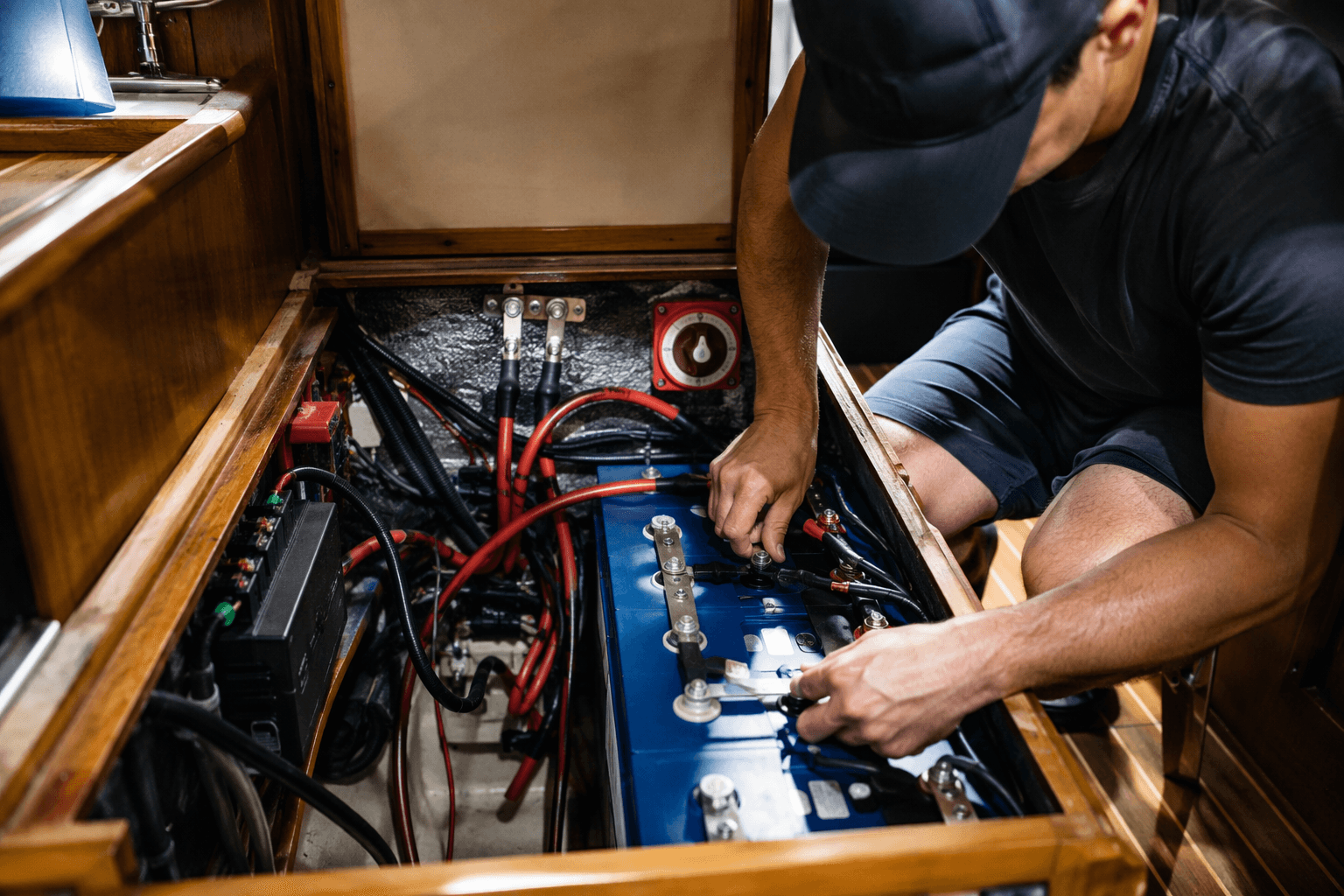
A drop-in lithium battery can fit a sailboat locker and still leave the boat unsafe. On a cruising boat, the failures usually start in the system around the cells: charging sources that were never matched to lithium, protection devices placed too far from the bank, and a BMS that does not fit the way the boat actually loads and charges.
Why LiFePO4 looks so good on a sailboat
LiFePO4 is attractive because it gives you more usable amp-hours than AGM or flooded lead-acid, it accepts charge faster, and it holds voltage better under load. Refrigeration, electronics, autopilots, cabin lighting, and charging all fight for the same energy budget. The catch is that the chemistry only solves the storage side of the problem, while the boat still has to handle charging, fault current, monitoring, wire sizing, and disconnect strategy.
The bank is a system design choice, not a product choice, a point also made in Marine How To’s DIY LiFePO4 Batteries On Boats. The alternator, shore charger, solar controller, and emergency shutoff all have to be ready for it.
The mistakes that cause real onboard failures
The classic mistake is assuming old lead-acid logic still applies. Many boats were built around automatic charging relays and charging profiles that expect lead-acid behavior, but lithium does not want to be managed that way. If you keep the old logic in place, the charging sources can confuse the battery, overwork the alternator, or leave parts of the system unprotected when a fault happens.
Another common error is weak short-circuit protection. Marine lithium banks can deliver serious fault current, so fusing close to the battery is not optional, and disconnects need to make sense in a real emergency. LiFePO4 products are not interchangeable by default, so buying cells first and designing later invites trouble.
ABYC’s standards changed the conversation
ABYC, the American Boat and Yacht Council, was created in 1954 as a non-profit to develop safety standards for the design, construction, equipage, repair and maintenance of boats. It ratified E-13, its first lithium battery standard, on 2022-08-08, and later listings continue to show the standard as 13-2025 - Lithium Ion Batteries.
E-13 is the lithium battery standard for marine vessels, and an ABYC-linked video posted on 2023-04-09 takes up the same question from another angle: what makes a lithium battery installation safe onboard.
A safe build sequence starts before the first battery goes in
1. Measure the actual house load first.
Size the bank from real overnight and multi-day use, not from the largest battery you can physically fit. Refrigeration, electronics, autopilots, and lighting are the loads that define the bank, and they define the recharge plan too.
2. Choose cells and a containment plan together.
Cell quality matters, but so does how the cells are held in place. A sailboat lives with heel, vibration, and shock, so the bank needs proper mechanical restraint and containment, not loose cells in a locker.
3. Match the BMS to the boat, not just the battery.
The BMS has to fit the cell chemistry, the maximum charge and discharge currents, and the way the bank will actually be used offshore and at anchor. If the BMS cannot control charge sources cleanly, it is not finished just because it powers up.
4. Rework the charging sources.
Alternator behavior, shore charger settings, solar regulation, and any DC-DC gear need to be checked as one system. A lithium bank should not be dropped into a lead-acid charging plan and expected to self-protect.
5. Install fusing, disconnects, and wire sizing for the fault case.
Put overcurrent protection close to the battery, size the wiring for the current the bank can actually deliver, and make the disconnect path obvious in an emergency. This is where many boats go from “works” to “safe.”
6. Commission the system with monitoring.
A battery monitor is not decoration, it is how you see charge state, current flow, and whether the charging system is behaving. Without monitoring, the boat can look fine right up until the first hidden mismatch shows itself.
Stop here if you cannot verify this
- You can identify every charging source on the boat, including alternator, shore power, solar, and any DC-DC equipment.
- You know what each source is supposed to do with lithium, and you can confirm the settings or control logic.
- You can point to the fuse or breaker that protects the bank, and it is close enough to the battery to matter.
- You know the bank’s continuous and fault current limits, and the wire and disconnects are sized for them.
- You have a BMS with clear charge and discharge control, not just a display screen.
- You have a containment plan for heel, vibration, and movement in a seaway.
- You can explain what happens if the alternator, charger, or BMS trips in the middle of a passage.
If any one of those cannot be answered cleanly, the job is not ready for a DIY finish.
Cold weather is a real boundary, not a footnote
Temperature is where many cruising owners get surprised. LiFePO4 batteries should not be charged below 32°F, or 0°C, unless the system has proper protection or management. A Batteries Plus LiFePO4 cold-weather article updated on 11/17/2021 gives the same warning, and Battle Born Batteries says storage should stay between 32°F and 77°F, with a hard warning to never charge a frozen battery and to let it warm to room temperature first.
A battery that is perfectly happy at anchor in summer can become a charging risk the moment the compartment drops below freezing. If your cruising plan includes cold mornings, the low-temperature strategy has to be built into the system before the bank ever goes aboard.
This article was produced by Prism’s automated news system from verified source data, official records, and press releases, then run through automated quality and moderation checks before publishing. The system is built and supervised by the people who set the standards it runs under. Read our full AI policy.
Did this article answer your question?