How to spot hidden corrosion in stainless sailboat hardware
A shiny fitting can still be a rigging failure in waiting. The danger is hidden corrosion in crevices, bedding, and welds where salt, moisture, and low oxygen do their worst.
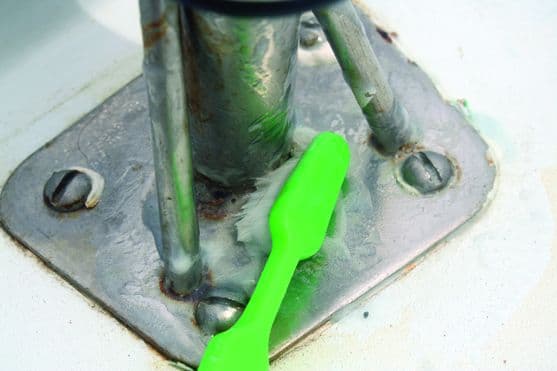
The danger is the stainless part that still looks fine
Stainless sailboat hardware fails in the least helpful way: it often looks serviceable until the damage is already inside the part, under the bedding, or inside a crevice you never thought to check. Practical Sailor’s Darrell Nicholson puts the focus where it belongs, on the real enemies of stainless in saltwater service, moisture, salt, and oxygen deprivation. That combination is what turns a clean-looking fitting into a hidden failure point on chainplates, mast tangs, handrails, cleats, and the other hardware that keeps the boat standing and the crew safe.

That is why the first mistake is cosmetic. Polishing away discoloration can erase evidence of a problem that needs to be found, not prettied up. If the goal is reliability, inspection has to come before shine.
Where stainless starts to go bad
The trouble spots are usually where water lingers and air cannot reach the metal. Nicholson calls out the base of bedded deck hardware, rolled handrails, and pitted areas that trap grime and salt as classic places where rust shows up late and quietly. Welded sections deserve extra attention too, because the heat from welding can destroy some of stainless steel’s protective qualities and leave those zones more vulnerable than the surrounding metal.
That hidden risk is why chainplates and mast tangs are such notorious failure points. They are loaded again and again as the rig works, and they are also exactly the kind of parts where tiny cracks and crevices can hold corrosion. BoatUS makes the same broader point in its rigging guidance: standing rigging is critical to sailboat safety because it transfers mast and sail loads into the hull through the chainplates, so corrosion there is not a cosmetic issue, it is a structural one.
What to inspect before you reach for the polish
A careful inspection should happen before any attempt to make the hardware look new. Dye test kits and a magnifying glass are practical tools here, especially when you are trying to spot fine cracks, corrosion at welds, or deterioration around chainplate exits and fittings that disappear into the boat. Pay attention to any area that stays damp for long periods, and do not trust the shiny exterior if the backing structure or hidden face has not been examined.
- Chainplates where they pass through the deck or into the hull joint
- Mast tangs and other loaded attachment points
- Welded joints and heat-affected areas
- Bedding edges where moisture may sit behind sealant
- Pitted surfaces that collect salt, dirt, and green or brown staining
Look closely at:
Cruising World has shown how deceptive these parts can be. In a 2022 account, the crew of Avocet narrowly avoided a dismasting after finding hidden chainplates that were crumbling from rust. That is the kind of failure that starts out invisible and ends up expensive, dangerous, or both.
Why low-oxygen crevices are so destructive
Crevice corrosion is the trap many sailors miss because the stainless steel is not failing in open air, it is failing where oxygen gets blocked. Cruising World has noted that 304 stainless, which is widely used, is prone to crevice corrosion when seawater seeps past bedding compounds and becomes stagnant on the metal. That stagnant, low-oxygen pocket is exactly the wrong environment for stainless.
NOAA’s definition of hypoxia helps explain the mechanism in plain terms. Hypoxia means low or depleted oxygen, and low-oxygen conditions can create dead zones. In corrosion terms, the same principle applies under tape, under bedding, and under trapped deposits: stainless loses the oxygen exposure it needs to protect itself, and corrosion can take off in the hidden space while the visible face still looks acceptable.
That is why the base of a deck fitting, a backing plate area, or a chainplate slot can be more dangerous than the polished surface above it. If you only inspect what you can see from the cockpit, you are missing the part that actually matters.
Cleaning that helps, and cleaning that hurts
The maintenance routine should be boring and disciplined. Fresh water first, mild soap, and thorough rinsing do more real work than aggressive scrubbing with the wrong products. The goal is to remove salt and grime before they sit long enough to create the crevice conditions that stainless hates.
On long dry passages, Nicholson recommends scrubbing decks even with seawater if that is all that is available, then wiping down with a fresh-water rag to remove the salt residue. That is a practical compromise when cruising conditions are tight, but it still ends with fresh water because salt left behind is part of the problem.
Chlorine cleaners are the product to avoid. They are highly corrosive to stainless, and using them on fittings that are already compromised by crevices or hidden bedding risks making a bad situation worse. If a fitting is stained, the first response should be cleaning and inspection, not a harsh chemical shortcut.
Restoration has a place, but only after inspection
Some parts can be restored, but restoration is not the same thing as proving the hardware is healthy. Nicholson points to passivation as a way to help restore stainless’s natural corrosion resistance, and electro-polishing as a process that can produce a longer-lasting finish while also making inspection easier by improving surface clarity. That matters because a cleaner surface can make defects easier to spot before they grow.
There are limits, though. NASA’s electropolishing specification says the process is not intended for deeply recessed areas or faying surfaces where internal cathodes cannot be effectively applied. In other words, once the problem is buried inside hidden joints and tight contact surfaces, polishing the outside does not solve the whole problem.
Industry and marine-finishing sources also note that electropolishing can improve corrosion resistance by removing surface iron and contamination. ASTM A380, which covers cleaning, descaling, pickling, and passivation of stainless steel parts, assemblies, equipment, and installed systems, supports that same careful approach, including thorough rinsing and precautions to avoid iron contamination during cleaning and passivation. For deeper testing and evaluation of crevice behavior, ASTM G78 specifically covers crevice-corrosion testing of iron-base and nickel-base stainless alloys in seawater and other chloride-containing waters.
The rule that keeps hardware alive
The lesson in all of this is simple: stainless in saltwater service is not maintenance-free. It can be strong, polished, and still be hiding a crevice problem at the base of a fitting, inside a weld, or behind a bedded joint that has been trapping moisture for years. When standing rigging depends on chainplates and related hardware to hold the mast up, that hidden corrosion becomes a direct safety issue.
The winning habit is to treat stainless as structure first and shine second. Inspect the loaded parts, check the hidden faces, clean out the salt, and distrust any fitting that only looks healthy from the outside. That is how a small patch of rust stays a maintenance note instead of becoming the moment a rig gives up.
This article was produced by Prism’s automated news system from verified source data, official records, and press releases, then run through automated quality and moderation checks before publishing. The system is built and supervised by the people who set the standards it runs under. Read our full AI policy.
Did this article answer your question?