How to understand and maintain your boat’s electrical system
Dead batteries are often just the first clue. Trace the fault from battery bank to shore power inlet, and you can catch the corrosion and bad grounds before they become a fire.

Start with the symptom, not the parts bin
A boat that runs perfectly one day and goes strangely quiet the next is usually sending you a message, not punishing you. Dead batteries, dim electronics, and intermittent failures often come from the same few places: a weak battery, a loose ground, a corroded fuse holder, or a bad shore-power connection. R. C. Compher at First Choice Marine frames the big lesson clearly: if you treat every failure as random, you will keep replacing parts and miss the actual fault.
The key is to see the boat as a chain. Power leaves the battery bank, passes through switches, cables, fuses or breakers, and charging gear, then feeds the panel and the accessories that make cruising work. Once you picture that path, a bilge pump that quits, a radio that browns out, or an engine that will not crank stops being a mystery and starts being a traceable problem.
Know what is actually in the circuit
Even a simple boat can have more going on under the deck than it first appears. Batteries, battery switches, cables, fuses, breakers, grounding paths, chargers, alternators, bilge pumps, navigation lights, trolling motors, fish finders, and the engine start circuit can all be part of one network. If one connection in that chain is compromised, several systems can fail at once, which is why electrical trouble so often feels bigger than it really is.
That complexity is also why the marine environment is so hard on wiring. Water, salt, vibration, heat, and long periods of storage all attack terminals and connectors over time. The corrosion you see on one fuse holder is often only the visible part of the problem, because resistance builds inside the connection long before the failure becomes obvious at the dash.
Use a multimeter like a map
Troubleshooting works best when you move in order, from the battery bank toward the load. The goal is not to guess which part is bad, but to find the point where power disappears or voltage falls off. A multimeter gives you that map, and it is especially useful when a symptom looks electrical but could be caused by a single bad connection.
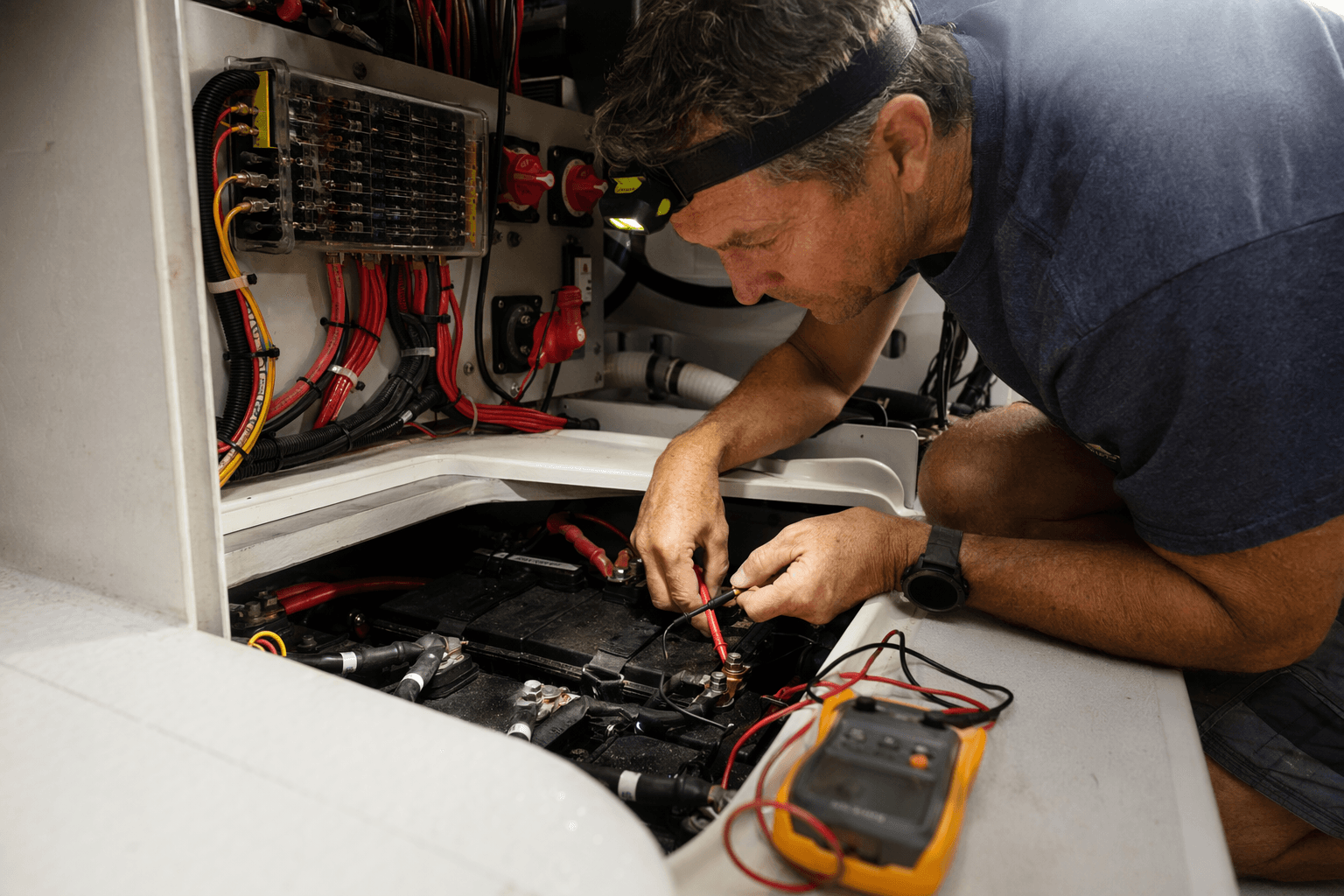
1. Start at the battery bank and measure the voltage directly at the posts. That tells you what the system has available before any switches, cables, or protection devices get involved.
2. Move to the battery switch and then to the main feed at the panel. If the reading changes sharply between those points, the problem is in the path between them, not in every device downstream.
3. Check the charger or alternator output at the battery bank. If the batteries are not receiving proper charge, the boat may seem healthy for a short time and then slowly drift into dead-battery territory.
4. Compare both sides of a fuse or breaker. If power reaches one side but not the other, the component or its connection is the point to inspect next.
5. Wiggle-test suspected connectors while watching the meter. An intermittent drop often points to a loose terminal, a corroded splice, or a ground path that only fails when vibration hits.
That process matters because many failures are not dramatic. A weak battery can look like a charging issue, a loose ground can mimic a dead panel, and a corroded connector can create a problem that comes and goes with humidity, heel, or engine vibration.
The mistakes that turn into expensive or dangerous problems
The most costly electrical errors are often the smallest. A loose ground can starve electronics one moment and heat up the next. A corroded fuse holder can leave lights dim and a pump unreliable. A bad shore-power connection can interrupt charging, trip protection, or create a fault path that should never exist in the first place.
BoatUS has said electrical systems are where many boat fires begin. Its claims analysis found that the boat’s DC electrical system caused more than a third of all fires, while AC shore power contributed another 9 percent. More than half of DC electrical fires were tied to either the engine or the batteries, which is exactly why the battery box and engine space deserve careful inspection, not casual attention.
The marine shore-power side needs special respect. BoatUS has noted that many AC electrical fires start between the shore-power pedestal and the boat’s shore-power inlet, so the weak point is often the dock-to-boat connection, not just the wiring hidden deep in the cabin. If that inlet or cord end shows heat damage, discoloration, or corrosion, it is not a cosmetic issue. It is a warning sign.
The U.S. Fire Administration, part of FEMA in the U.S. Department of Homeland Security, says boat and marina fires can spread quickly because of hazardous conditions and limited access. It specifically recommends inspecting electrical wiring, connections, cords, and battery-charging equipment to make sure they are properly installed and in good condition. That is not theoretical advice. A 2019 recreational boat fire off Southern California killed 34 people, a brutal reminder of how quickly an onboard electrical problem can turn fatal.
Use standards as the line between “works” and “built right”
ABYC has developed safety standards for boat design, construction, repair, and maintenance since 1954, and its E-11 standard is the one that covers AC and DC electrical systems on boats. ABYC describes E-11 as a minimum-performance guide for the design, construction, equipage, and maintenance of small craft, and it reviews each standard at least every five years. That gives you a practical benchmark for deciding whether a system merely functions or actually meets a recognized marine standard.
For owners who live aboard, cruise offshore, or spend long stretches away from immediate service support, that distinction matters. A boat may appear fine at the dock and still be one weak connection away from a dead start circuit or a dark cabin at sea. The U.S. Coast Guard’s 2024 Recreational Boating Statistics, its 66th annual report, is a reminder that the industry tracks these incidents year after year because the risks are real, recurring, and often preventable.
Build maintenance into the routine
The best electrical system is not the one with the most gadgets. It is the one that gets checked before corrosion, vibration, and storage time can turn a small flaw into a trip-ending failure. Look at the battery bank, the grounds, the fuses and breakers, the charger, the alternator, and the shore-power inlet as one connected chain, because that is exactly how the boat sees them.
If you keep tracing faults from the battery bank to the panel, and from the shore-power pedestal to the inlet, you stop guessing and start finding problems early. That is how a simple maintenance habit protects lights, pumps, electronics, batteries, and the boat itself.
This article was produced by Prism’s automated news system from verified source data, official records, and press releases, then run through automated quality and moderation checks before publishing. The system is built and supervised by the people who set the standards it runs under. Read our full AI policy.
Did this article answer your question?