How to understand the gaff rig, a classic sailboat setup
A gaff rig can look unfamiliar, but its logic is straightforward once you know the throat, peak, and lazy-jack sequence. Learn the hardware and the sail suddenly becomes practical, not mysterious.
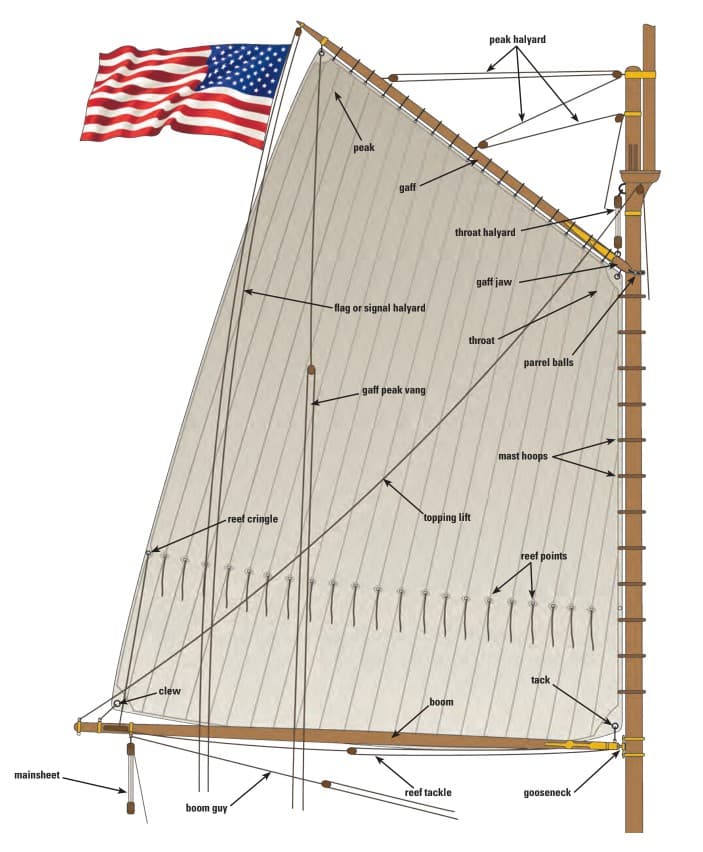
A gaff rig can feel like a relic the first time you see one at a club mooring, in a restoration shop, or aboard a traditional cruiser. For anyone raised on Bermudan rigs, the shape alone is a giveaway that you are not looking at a triangular mainsail with a familiar one-line hoist. The good news is that the system is not chaos, just different: once you understand how the gaff supports the head, how the halyards work together, and how the sail comes down, the whole setup becomes manageable.
What makes a gaff rig feel different
The key difference starts with geometry. Encyclopaedia Britannica defines a gaff rig as a fore-and-aft rig with a four-cornered sail whose head is supported by a spar called the gaff. That is a big departure from the triangular Bermudan mainsail that now forms the typical configuration for most modern sailboats. Britannica also notes that sailing technology evolved so boats could point closer to the wind, which helps explain why Bermuda-style rigs displaced older arrangements on most contemporary craft.
That shift is exactly why a gaff rig can feel odd to a modern crew. The sail is broader and more rectangular in outline, with a head that is not simply pulled up a mast track and left to sort itself out. The foot may be boomed or loose-footed, and the overall sail plan is still fore-and-aft, but the hardware and sequence are not what many sailors expect from a sloop. On a sailboat with a gaff-rig mainsail, the shape itself signals that the mast is only part of the story.
The rig still matters because it never vanished completely. Britannica’s schooner entry defines schooners as sailing ships rigged with fore-and-aft sails on their two or more masts, and that is one of the places where gaff sails still make immediate sense. On classic schooners, the fores’l between the masts may be gaff-rigged, so the shape and handling still matter on boats that are very much in service today.
How the sail goes up
The hoist is where most Bermudan sailors stop and stare. A gaff sail is usually set with two working halyards: a throat halyard at the forward end of the gaff near the mast, and a peak halyard that lifts the aft end. On larger boats, both can be multi-part tackles, and the ratios need to match so the crew can hoist in sync. That detail matters in real use, because if one side runs away from the other, the sail will not set cleanly.
The sequence is straightforward once you see it in order. The throat halyard takes the first load and sets the luff tight. Then the peak halyard brings the aft end of the gaff up until the leech firms and the sail finishes taking shape. Good Old Boat’s gaff-rig primer notes that the peak halyard attachment can slide on a gaff bridle as the gaff angle changes, which is one of the details that makes the rig work smoothly instead of binding up at odd angles.
That sliding attachment is the sort of thing a DIY owner needs to notice before trying to tune or repair the rig. A gaff is not just a stiff spar sitting overhead; its geometry changes during the hoist, and the bridle and saddle let the peak halyard find the right lead as that angle shifts. If you are used to a modern mainsail track and a single halyard, that extra moving relationship is the first piece to understand.
Reefing, dousing, and keeping control
Taking a gaff rig down is simply the reverse of the hoist, but the sail still needs help once it is descending. That is where lazy jacks come in. Good Old Boat describes lazy jacks as lines led from the upper mast to the boom that guide the sail onto the boom when reefing or dousing it, and says properly installed systems can improve safety and sail control.
For a DIY owner, that makes lazy jacks more than a nice accessory. They help corral the boom, sail, and gaff as the sail comes down, which is especially valuable when the boat is moving and the deck is not perfectly calm. Instead of trying to tame a loose pile of cloth by hand, the sail is guided into place. On a rig that already asks the crew to manage two halyards in sequence, that extra control is practical insurance.

Lazy jacks are especially useful because they fit the rest of the gaff workflow. The rig is already asking you to think in terms of shape, balance, and spar angle, not just pull and release. If the peak has to be supported by a moving attachment point on the bridle, and the throat and peak halyards must work together, then the dousing system should be just as deliberate. Lazy jacks make the whole setup feel less like a museum piece and more like usable deck hardware.
Why the rig still belongs in the modern mix
Britannica’s overview of sailing rigs puts the transition in plain terms: as boats got better at sailing closer into the wind, the Bermuda rig became the dominant choice for most modern sailboats. That does not make the gaff rig obsolete, only less common. It survived where it still suits the boat, especially on traditional craft, working vessels, and schooners, where the sail plan and deck layout were built around it.
That is why Don Launer’s primer lands so well with modern sailors. It does not treat the gaff rig as a romantic curiosity. It treats it as a system you can actually handle once you know the parts: quadrilateral sail, gaff-supported head, throat halyard, peak halyard, bridle, saddle, and lazy jacks. Britannica’s brigantine entry adds another useful reminder, noting that in northern European waters the brigantine became a pure sailing ship and that its gaff-rigged mainsail set it apart from the square-rigged brig. In other words, the gaff was not an eccentric dead end. It was a serious working solution that shaped more than one sail plan.
For a DIY sailor, that is the real translation. A gaff rig is not asking you to forget modern sailing knowledge, only to apply it to a different geometry. Once the hoist sequence makes sense and the downwind bundle is under control, the rig stops looking strange and starts looking like what it has always been: a practical sail system built for boats that still need to work.
This article was produced by Prism’s automated news system from verified source data, official records, and press releases, then run through automated quality and moderation checks before publishing. The system is built and supervised by the people who set the standards it runs under. Read our full AI policy.
Did this article answer your question?