Inspect, Repair, and Understand Your Transom-Hung Rudder Before It Fails
Transom-hung rudders fail at three predictable points — and a moisture meter, a wrench, and 20 minutes at the dock can catch all of them before they strand you.
The statistic that should stop every trailerable-boat owner cold: according to Sail Magazine's analysis of offshore incidents, mid-ocean rudder failures occur on close to 1 percent of passages, and that's on boats people *thought* were well-maintained. For transom-hung rudders specifically, the math gets grimmer, because the entire steering system lives bolted to the outside of your boat in plain sight yet rarely gets the systematic attention it deserves. The good news is that the three places where these rudders fail are predictable, reachable, and diagnosable with tools you already own.
The Three Break Points
Break Point 1: Gudgeons and Pintles
The pintle-and-gudgeon hinge system is where most transom-hung rudder problems begin, and it tends to announce itself quietly long before it becomes dangerous. Wear between the pin and the barrel creates side play; over time, that micro-movement accelerates the wear cycle until the rudder is knocking against the transom in any kind of chop. Forum accounts from owners of classic trailerable boats describe exactly this pattern: after decades of use, a 21-foot boat's mild steel pintles had worn so severely the rudder was audibly thudding against the hull in light conditions. The owners mistook the noise for a collision. It was just the hardware that should have been replaced years earlier.
Inspection here requires nothing more than two hands and your eyes. With the boat in the water or on the trailer, grasp the rudder blade at the trailing edge near the waterline and apply lateral force: any perceptible side-to-side play at the pintles signals wear. Do the same at the head of the blade. Then sight down the pintles from above: they should be perfectly co-linear. Misalignment causes binding on one tack and accelerated one-sided wear. Stainless steel pintles and gudgeons in good condition should show no measurable gap between pin and barrel; if you can rock the blade and see daylight at the hinge, that hardware is past its service life.
Break Point 2: Transom Core and Fasteners
The gudgeons are only as strong as what they're bolted through. On fiberglass boats with wooden or foam cores, the transom is the hidden variable: it can look fine on the outside while being saturated and softened around every fastener hole. Water finds its way in through micro-cracks in the gelcoat, bedding compound that has shrunk or split after years of thermal cycling, and, critically, through fastener holes that were never properly sealed. Once moisture reaches a wooden core, rot follows. The structural result is fasteners that appear tight until they don't: the first hard grounding or heavy weather load pulls them completely free of the softened substrate.
Diagnosis starts with a moisture meter. Readings significantly above ambient at the transom face, particularly clustered around the gudgeon mounting screws, indicate that water has infiltrated the laminate. Follow up with a firm tap: a knuckle-rap across the transom face should produce a consistent, solid tone; dead, hollow spots near fastener locations signal delamination or core breakdown underneath. If you have interior access through a locker, look at the backing side of every through-bolt. Any staining, corrosion rings, or soft substrate around the nuts is a red flag regardless of what the exterior looks like. One cautionary note from hardware failure case histories: aluminum backing plates paired with stainless steel fasteners in a saltwater environment create a galvanic couple that can reduce a backing plate to "coarse hash" in a single season, leaving the gudgeons with nothing solid to bear against.
Break Point 3: Blade and Head Connection
The third failure point is the rudder blade itself, specifically the connection between the structural head and the blade laminate, and the integrity of the blade's peripheral bond. On foam-cored fiberglass rudder blades, the outer skins are bonded together along a seam at the trailing edge and around the perimeter. If that peripheral bond was undersized at manufacture, or if an impact has cracked it, the skins can begin to delaminate and separate. Sail Magazine's technical coverage of rudder construction describes the failure mode plainly: once the peripheral bond lets go, the skins peel away and the foam core disintegrates, leaving nothing structural to transmit steering forces.
At the head-to-blade junction, look for cracks in the gelcoat radiating outward from where the pintles or the head fitting attach to the blade. These stress fractures are not cosmetic; they indicate that load is being concentrated at a hard spot rather than distributed through the laminate. A grounding that deforms the blade can also twist the head fitting out of true alignment with the pintles, introducing a bind that makes steering feel heavy or sticky on one tack. The test-steer confirmation is simple: with the boat in the water, work the rudder through full lock-to-lock travel and feel for any resistance, stick, or delayed response. Binding that isn't explained by a tiller-to-quadrant fit issue almost always traces back to blade deformation or misaligned hardware.
The Repair and Upgrade Ladder
Once you've identified what's wrong, the decision about how to fix it follows a logical progression from simplest to most involved.
Rebedding: The First Rung
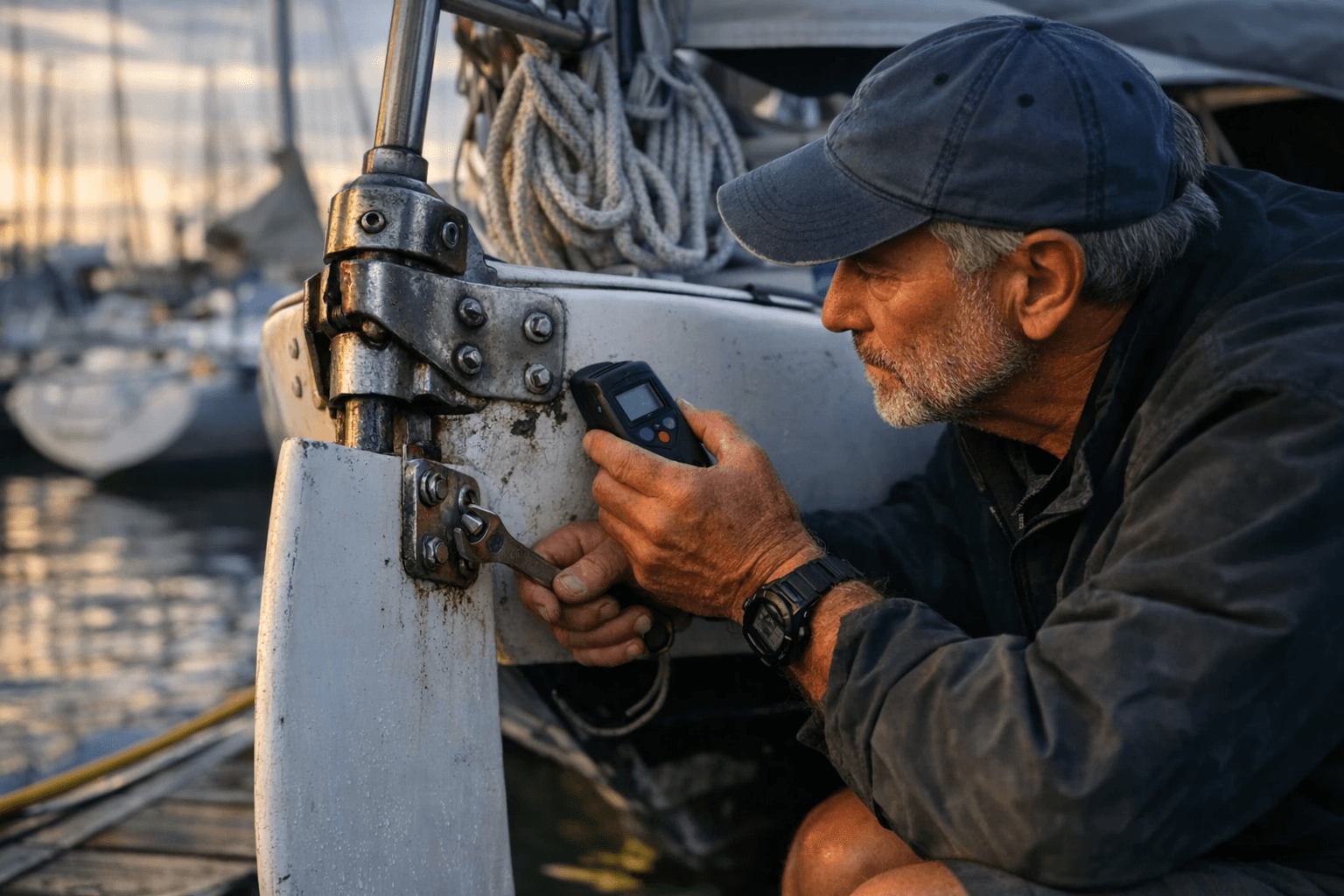
If inspection shows that gudgeon fasteners are intact and the transom is solid, but the bedding compound has cracked and is admitting moisture, rebedding is a morning's work and costs almost nothing. Remove each gudgeon in turn, clean the fastener holes and mounting surface, fill any elongated or cracked holes with thickened epoxy, allow to cure fully, then re-drill and reinstall with fresh polysulfide or polyurethane bedding. The critical step that most owners skip: overdrilling each hole, packing it with epoxy, and re-drilling to the correct diameter. This seals the core from the fastener hole outward and is the single most effective long-term moisture barrier at any through-fastener location.
Backing Plates: The Second Rung
If the existing backing arrangement is inadequate, whether because the original plates were too small, the wrong material, or have already corroded, upgrading to properly sized stainless steel backing plates is the next step. Plates should distribute load across enough area that the transom laminate itself is not in stress concentration around any single bolt. Through-bolt with stainless bolts, flat washers, and lock nuts rather than self-tapping screws wherever geometry allows. This upgrade can be done with the boat on the trailer and does not require a haul-out, provided you have interior access to the transom face.
Core Rebuild: The Third Rung
Elevated moisture meter readings that don't improve after rebedding, hollow tap tones across a broad area, or visible rot on the interior face of the transom mean the core itself must be addressed. This is the point where the repair crosses into structural territory. At minimum, the affected core must be excavated, dried thoroughly, treated, and replaced with new material, typically marine plywood or structural foam bonded with epoxy, followed by re-laminating the skin over the new core. This job almost always requires a haul-out for proper access and to keep the repair environment dry. If you are not comfortable with fiberglass lamination work, this is where professional help is appropriate. A failed core repair that traps moisture will simply rot again, often faster than the first time.
Hardware Spec Change: The Top Rung
If the pintles and gudgeons themselves are worn, undersized, or the wrong material for the application, replacement is non-negotiable. Specify the correct pin diameter for your fittings: pintles and gudgeons are sized together and mixing pin diameters accelerates wear immediately. For boats that see regular use or sail in exposed conditions, upgrading from cast bronze or aluminum hardware to heavy-section stainless steel is worth the cost. When sourcing replacement fittings, confirm the blade thickness against what's available off the shelf: some older designs have blades thick enough that standard hardware doesn't fit without modification.
When to DIY, When to Haul, When to Replace Proactively
The decision framework is straightforward. Rebedding and backing plate upgrades are owner-serviceable at the dock or on the trailer. A core rebuild requires a haul-out and comfort with structural fiberglass work; if neither is true for your situation, contract it out. Hardware replacement is DIY-friendly as long as you're replacing like-for-like and have interior access; if the transom geometry makes backing-plate access impossible without cutting inspection ports, factor that time in.
Proactive replacement makes sense for pintles and gudgeons on any boat over 15 years old that hasn't had the hardware changed: wear is cumulative and largely invisible until the play becomes dramatic. The cost of a new set of quality stainless pintles and gudgeons is a fraction of a single towing bill. For transom core integrity, run a moisture meter across the entire transom surface at every haulout. A reading that trends upward year over year is telling you something; catching it at the rebedding stage, rather than the core-rebuild stage, is the entire point of the inspection ladder.
The transom-hung rudder is one of the most accessible systems on a sailboat, which is precisely what makes neglecting it so avoidable. Every failure mode maps to an inspection step you can complete with a wrench, a moisture meter, and your hands. Pre-launch season is the time to work through it methodically, because the alternative is working through it while anchored on a lee shore.
This article was produced by Prism’s automated news system from verified source data, official records, and press releases, then run through automated quality and moderation checks before publishing. The system is built and supervised by the people who set the standards it runs under. Read our full AI policy.
Did this article answer your question?