Man-overboard drills, why sailing crews must practice both recovery methods
The best man-overboard recovery is the one your crew has already rehearsed. On small cruisers, the right turn depends on boat, crew, and wind, not guesswork.

The difference between a clean rescue and a dangerous drift is often a few rehearsed turns. On a small cruising boat, the RYA and Royal Ocean Racing Club methods are not rival doctrines so much as two tools for different situations, and the right one depends on how your boat handles, how many hands you have, and how much wind is in play. If your crew can move from the alarm to the recovery in a practiced sequence, those critical minutes stop feeling like chaos.
Why the drill matters
Man-overboard recovery is not a nice extra for a calm afternoon. The Royal Yachting Association says Maritime Accident Investigation Branch research found crews have, on average, less than 11 minutes to recover a crewmate in cold water before the person becomes unresponsive, and that window gets shorter as the water gets colder or the sea state rougher. MAIB and the RYA also cited analysis of 308 man-overboard occurrences reported between 2015 and 2023, with 40 percent ending in a fatality, and 47 percent of pleasure-craft cases proving fatal.
That is why the drill has to be treated as seamanship, not theatre. In some incidents, crews had only four or five minutes to coordinate a complex recovery under pressure, and MAIB’s message is blunt: do not just think about recovery, practice it realistically. The scale of the problem is not limited to yachts either. MAIB receives just over 1,400 accident reports each year, and the wider maritime data show that service ships had the best recovery rate, with only 15 percent unsuccessful recoveries, while cargo vessels, inland waterways and passenger ships also recorded fatalities.
RYA and RORC: two turns, two jobs
The British RYA method sends the boat away and brings it back in a controlled approach that avoids a gybe. That makes it the more measured option, especially when you want to keep the boat predictable, keep the crew calm, and reduce the chance that a rushed turn turns into a second emergency. It suits boats and crews that benefit from a wider, more deliberate recovery pattern, particularly when the deck layout or sail plan makes a tight, aggressive turn awkward under pressure.
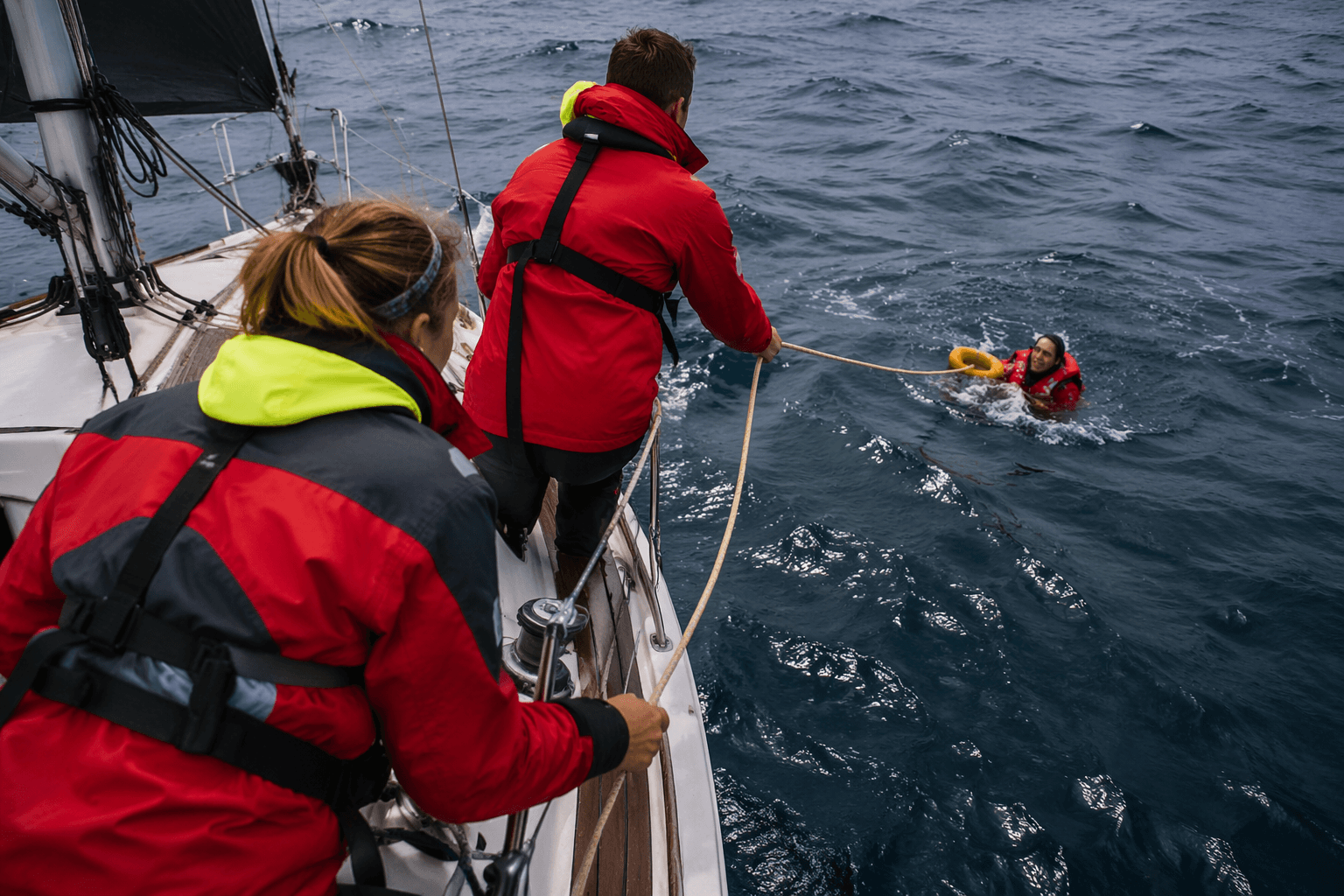
The RORC approach stays closer and generally gets the boat back sooner, but it does involve a gybe. That extra speed can matter when you need to regain the casualty quickly and the crew can manage the boat confidently through the maneuver. It is the sharper tool, but it demands better timing, better line handling and a helmsman who is completely comfortable with where the wind is coming from and how the boat will react.
For small cruising boats, that difference matters. A heavier, more sedate cruiser often rewards the more controlled RYA-style return, while a responsive boat with a practiced crew may be able to use the closer RORC turn without losing time. The deciding factor is not theory. It is whether your crew can execute the turn you choose without hesitation.
Wind awareness is the difference between recovery and drift
Harding’s point, and it is the one crews forget fastest, is that the helmsman must understand the wind direction relative to both the boat and the person in the water. Without that awareness, even a simple looking recovery can go wrong. The boat may lose the casualty, overshoot the approach, or leave the recovery line useless because the crew has not kept the boat where it needs to be.
That matters because the casualty is not just a point on the water. Wind, drift and boat speed all change the geometry of the rescue. A method that looks smooth in light air can become messy if the boat is moving too fast or if the helmsman misjudges the angle on the final approach. Harding’s warning is simple: experienced sailors have been lost in conditions that looked straightforward, which is why routine man-overboard turns need to be practiced as if they were real.
Build the routine around your own boat
The best drill is the one that matches your actual boat, not an abstract diagram. Harding’s practical message is that every boat should have a rehearsed man-overboard routine that fits the real deck layout, the sail plan and the crew size aboard. A two-person crew on a compact cruiser will not work the same way as a fuller crew on a roomier boat, and your recovery plan should reflect that reality.
That is also why crews should know both methods, or at least know which one suits the boat they sail most often. If you are sailing a boat where a gybe under pressure would add unnecessary risk, the RYA-style turn may be the better default. If you have a small, nimble boat and a crew that can keep the maneuver tight and controlled, the RORC option may get you back to the casualty sooner. Either way, the point is to decide before somebody falls in.
Next time you practice, check these basics
- Pick the approach angle before you start. Do not let the boat wander in aimlessly and force a last-second correction.
- Control speed early. The goal is to arrive alongside the casualty, not charge past them and turn the drill into a chase.
- Keep line handling clean. Recovery gear should be ready, clear and managed without tangles, because fumbling lines costs time and creates hazards.
- Match the turn to the crew. If your crew cannot handle a gybe cleanly, do not build the recovery around one.
- Keep the wind picture in mind. Know where the wind is pushing the boat and where it is pushing the person in the water.
- Rehearse realistically. MAIB’s warning is clear: a theoretical rescue plan is not enough when the clock is running.
That message was underlined publicly at Westminster Boating Base on the River Thames, where Baroness Vere joined the Maritime Accident Investigation Branch, the Royal Yachting Association and the Met Police Marine Police Unit for a live demonstration of recovery techniques. The point was not to impress anyone with boat handling. It was to show how little time there really is once someone is in the water.
The safest crews are the ones that already know which turn their boat needs, which angle to hold, how to bleed off speed and how to keep the recovery line under control. When the alarm goes up, there is no time to debate theory. The boats that bring people back cleanly are the ones that have already practiced the move until it feels like part of the sailing.
This article was produced by Prism’s automated news system from verified source data, official records, and press releases, then run through automated quality and moderation checks before publishing. The system is built and supervised by the people who set the standards it runs under. Read our full AI policy.
Did this article answer your question?