Mechanical advantage explained for sailors using block-and-tackle systems
A mainsheet or vang only feels manageable when purchase, friction, and block layout are working for you. Decode the rigging math and choose smarter hardware.
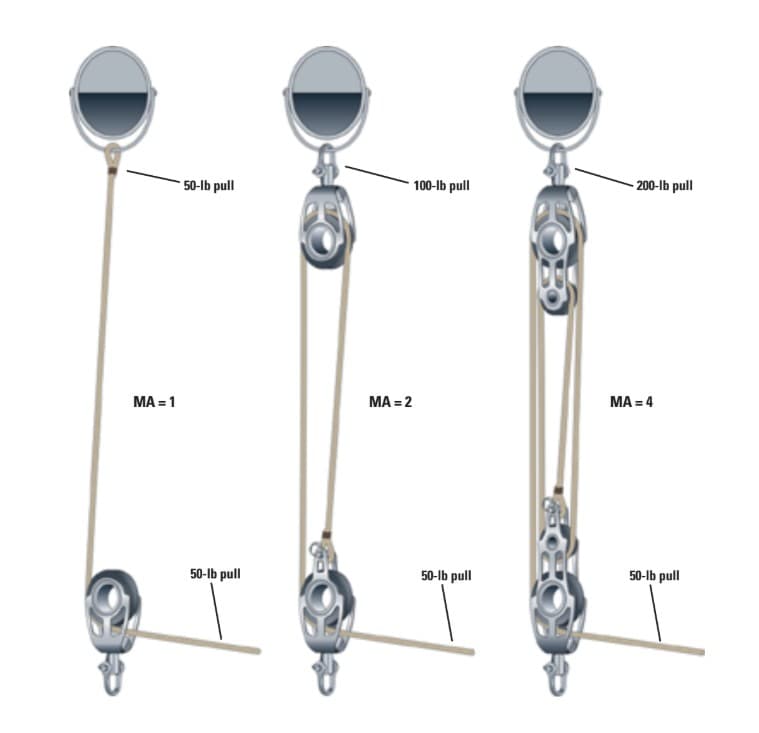
When a sail loads up, a mainsheet, vang, traveler, or cunningham moves by muscle only because of mechanical advantage. The same idea decides whether a control feels smooth or stubborn on your boat.
Why purchase matters on deck
In sailing, the rope-and-pulley system that multiplies force is usually called purchase. On deck, sailors feel it in centerboards, swing keels, traveler cars, boom vangs, halyards, and sheets. That is the everyday reality of small-boat rigging, where the load can be more than a single person can haul directly.
The point is not just to make things easier to pull. It is to let you control a force that would otherwise be too large for a hand or a winch handle to manage cleanly. That is why the same block-and-tackle logic shows up across so many controls, from the mainsheet to the vang to the lines that shape and support the sail plan.
The old idea that still rules modern rigging
The principle goes back to Archimedes, who used compound pulleys to pull a ship onto dry land. Britannica places Archimedes in the 3rd century BCE and commonly gives his birth year as 287 BCE. That ancient example is still the cleanest way to picture what is happening on deck today: one person pulls a longer distance on a line so a larger load moves a shorter distance with more force.
Gloucester fishing schooners famously worked huge sail forces without the luxury of modern winches, except for the windlass, so they relied on multiple-part block-and-tackle arrangements. Nearly every small to medium-sized sailboat still uses the same principle to control the boom.
How to read the math without making it complicated
Theoretical mechanical advantage can be calculated two ways. You can compare the distance the effort moves to the distance the load moves, or compare the force applied to the load to the force applied by the effort. In a 4:1 system, the effort moves four times as far as the load, which is the trade you make for a lighter pull.
That is the clean textbook version, and it is the starting point for choosing purchase on a mainsheet or vang. A 2:1, 4:1, 8:1, or higher purchase gives you different combinations of power, line travel, and control feel, and that is why rigging discussions keep coming back to those ratios. More purchase means less force per pull, but it also means more line to haul and more hardware in the system.

For a sailor trying to decode a rig, that is the first question to ask: do you need more mechanical advantage, or do you just need a cleaner run and better trim geometry? If the load is modest, extra purchase can be more clutter than cure. If the load is heavy, more purchase can turn an awkward tug into a control you can actually use under load.
Why real purchase never matches the brochure
Theoretical advantage is not the same as actual advantage. Friction in the sheaves, the weight of the blocks, and other real-world losses reduce the system’s true effectiveness, so the pull you feel on deck is always worse than the pure ratio suggests. That is the part that matters when a vang or mainsheet feels heavier than the numbers on paper.
If a control line runs through more blocks than it needs, or if the hardware is older, dirtier, or heavier than it should be, the system can lose a surprising amount of efficiency. The math may say 4:1, but the hand on the tail may feel something closer to “still a workout.”
That is also why line layout deserves as much attention as the number of parts. A neat run with sensible angles and good blocks can feel dramatically better than a theoretical upgrade that adds friction at every turn.
Decode the main lines on your boat
The United States Naval Academy’s Navy 44 Mk II Boat Information Book shows the mainsheet running through a block on the end of the boom to a block mounted on each end of the traveler car and then to a winch. That path shows exactly how a sheet can be led to gain control while still allowing the trimmer to adjust the boom under load.
The same book describes the boom vang as a 4-part block-and-tackle system. Harken’s system diagrams describe the vang as giving vertical adjustment of the boom and as an extremely important tool for shaping the main for speed, because tensioning it tightens the leech, flattens the sail, and bends the mast.
Use that lens on your own rig. If a mainsheet, vang, or cunningham feels underpowered, look first at whether the purchase is appropriate for the load. If the system already has enough mechanical advantage, then the real problem may be friction, bad lead angles, or hardware that is too heavy for the job.
This article was produced by Prism’s automated news system from verified source data, official records, and press releases, then run through automated quality and moderation checks before publishing. The system is built and supervised by the people who set the standards it runs under. Read our full AI policy.
Did this article answer your question?