Practical Sailor says used C&C 40 still offers strong value
A clean C&C 40 can still be a bargain, but only if you inspect the keel, rig load points, and sail-handling gear before the racer-cruiser romance turns into a repair bill.
A clean C&C 40 can still be the kind of used boat that makes a sailor’s pulse jump at the dock, but the wrong one can turn into an expensive lesson fast. Practical Sailor’s April 2024 review says the value is real, yet the boat only stays a bargain if you look past the pedigree and into the places hard racing and age leave their mark.
Why the C&C 40 still pulls buyers in
The appeal starts with the design’s reputation. Cruising World calls the C&C 40 one of the best racer-cruisers of the 1970s and 1980s breed, and notes that Rob Ball’s design became one of Cuthbertson and Cassian’s most successful models, with nearly 200 launched. That kind of track record matters in the used market because it means there are enough examples out there to compare, but not so many that the model feels generic.
The boat also comes with the kind of history that explains both its strengths and its risks. Practical Sailor frames it as a well-regarded racer-cruiser, but one that may have spent years being driven hard. That matters because a boat that spent time in the race fleet often comes with useful upgrades, but those upgrades may sit on top of decades of heavy loading.
What the boat’s history tells you before you climb aboard
The C&C 40’s roots go back to 1968, when the Crusader version was introduced and built until 1971 at Belleville Marine Yards. C&C Yachts Limited formally formed on September 26, 1969, and the production run folded into that larger company history. That puts the boat squarely in the era when C&C was building some of its most recognizable performance cruisers, not a watered-down sedan with a mast.
That background also explains why older C&Cs often live a double life. A 2017 Cruising World feature described the old-school routine where race crews slept aboard at regattas and then cruised home afterward, which is a reminder that these boats were meant to work for both competition and family use. The C&C 40 is not just old, it is old in a way that can mean big miles, varied owners, and a wide spread in condition.
Where the DIY buyer needs to inspect first
Practical Sailor’s warning list is the part that should slow you down before you fall in love with a glossy topsides shot. The keel area deserves close attention, along with the mast and rudder attachment zones, because that is where race loading and decades of use tend to show up first. On a boat like this, the structure around those load paths tells you far more than fresh varnish or a shiny cockpit table.
The deck deserves the same hard look. You are not just checking for cosmetics, you are checking whether the boat’s working surfaces still support the loads of a big, fast forty-footer. If the chainplate areas, fasteners, and deck hardware show movement or tired bedding, that is not a minor age issue, it is a warning that the boat has been asked to carry serious rig loads for a long time.
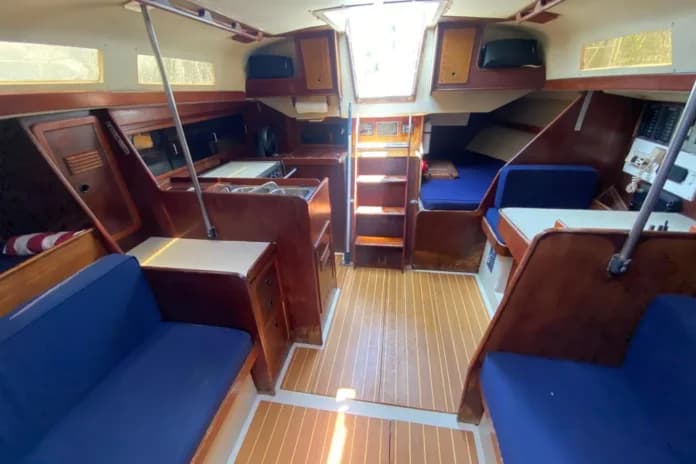
Interior aging matters too, but not in the abstract, yacht-brochure sense. A C&C 40 that has spent years racing and cruising may have a cabin that looks serviceable at first glance, yet still needs you to inspect for tired joinery, worn cushions, moisture creep, and hardware that no longer matches the way you actually want to use the boat. If the interior is going to support shorthanded cruising, it needs to work as a live-in space, not just a post-race refuge.
The numbers that define its compromises
The published figures make the boat’s priorities clear. One C&C 40 Crusader variant is listed at 39.67 feet LOA, 11.17 feet of beam, 18,225 pounds of displacement, and 4.5 feet of maximum draft. Those are not just spec-sheet trivia, they explain why the boat feels substantial, reasonably narrow by modern standards, and limited in where its fin keel can comfortably go.
That 4.5-foot draft is the number that should stay in your head if you sail shallow harbors or anchorages. Practical Sailor specifically flags draft restrictions, and that is exactly the sort of tradeoff that turns a good performance hull into a less forgiving cruising choice in some waters. If your normal sailing ground includes skinny entrances or shoal anchorages, the boat’s strengths come with a built-in boundary.
How to make it work for real cruising
Practical Sailor also points directly to the sail-handling question, which is where many dream boats become practical boats or exhausting ones. A short-handed couple will want headsail furling and a solid reefing setup, because a forty-footer with racing roots can be too much boat if the sail plan demands too many hard moves at once. The boat may still be fun, but fun gets expensive when every tack feels like a small deck evolution.
That is also why older C&Cs can remain strong candidates for owners who are willing to improve the layout intelligently. Practical Sailor notes that a clean-survey boat can still be excellent value for club racing or shorthanded cruising if the deck layout is reworked with purpose. In other words, the boat does not need to be turned into something it is not, but it does need the right hardware to make its original performance bias livable.
Modernizing an old C&C 40 is not theory. A 2019 Cruising World piece documented a repowering with a new Yanmar diesel, proof that owners are still investing real money to keep these boats relevant decades later. That kind of upgrade makes sense only if the hull, structure, and basic systems are worth saving, which is why the inspection stage matters so much more than the romance stage.
A good C&C 40 is not a nostalgia purchase, and it is not a museum piece. It is a used boat with a real pedigree, real compromises, and real places where age concentrates the cost of ownership. If the keel, rig attachment zones, deck hardware, and sail-handling setup all check out, it can still be the bargain the reputation promises. If they do not, the racer-cruiser glow fades quickly, and the repair bill is what you remember instead.
This article was produced by Prism’s automated news system from verified source data, official records, and press releases, then run through automated quality and moderation checks before publishing. The system is built and supervised by the people who set the standards it runs under. Read our full AI policy.
Know something we missed? Have a correction or additional information?
Submit a Tip