Sea Trial Shows Prop Tuning Is Key After Diesel Repower
The sea trial did more than prove the engine ran. It showed whether the prop, shaft, and cooling system were finally working as one.
Why the sea trial is the real payoff test
A diesel repower is not finished when the engine drops into the boat. It is finished when the boat proves, under load, that the installation is right: the motor spins freely, the cooling system behaves, the propeller matches the engine, and the whole drivetrain pushes without shake, smoke, or strain. That is the lesson from the Cape Dory 36 Far Reach, where the final sea trial became the clearest test of whether all the workshop decisions had actually paid off.
The value of this story is that it treats the splash as a verification step, not a victory lap. On a repower that started with an empty hull, the sea trial is where alignment, prop load, cooling, and vibration stop being theories and start being facts. If the engine is overpropped, poorly aligned, or cooling unevenly, the water will expose it fast.
What makes this repower different
Far Reach had sailed for five years without an inboard engine before the project began. That matters, because this was not a simple engine replacement in a boat that already had a mature propulsion system. There were no existing engine beds, shaft log, wiring, or fuel system to build around, so the repower had to be created from scratch.
The installed package was a Beta 25-hp three-cylinder diesel paired with a two-blade Flexofold propeller. That combination set up the central challenge of the whole project: not just fitting the engine into the boat, but making sure the propeller let the engine operate in its intended range once the boat was actually underway. In other words, the last mile was not fabrication. It was tuning.
That is why this final installment matters to anyone converting an older sailboat to diesel power. Once the engine, beds, shafting, wiring, and fuel system are in place, the remaining work is about whether those pieces behave as one system. Repowers often fail quietly first, by loading the engine wrong, hiding vibration in the drivetrain, or making cooling issues look smaller than they are.
Prop tuning is where the repower becomes real
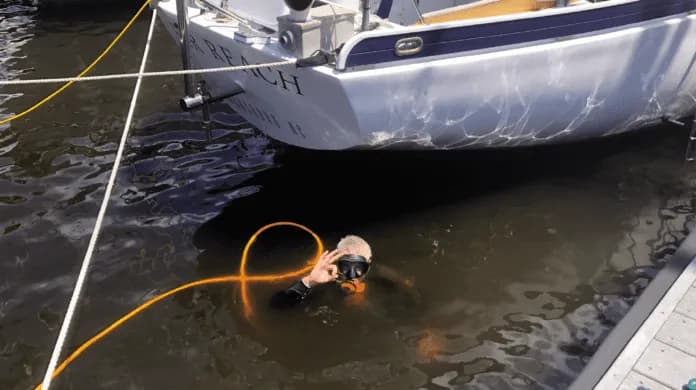
John Stone reports that he used a DIY hookah rig to swap prop blades on the Flexofold propeller, and that the job took only a few minutes. That kind of quick underwater adjustment can look minor from the dock, but it is exactly the sort of change that decides whether a repower feels crisp or strained.
The key move was going to a smaller-diameter prop with less pitch. That change allowed the engine to reach its maximum rated RPM, which is the point Beta Marine’s Farron Peffer had stressed from the start: the goal should be to achieve max RPM at wide-open throttle so the prop does not overload the engine. That advice lines up with what many diesel installers learn the hard way. A prop that is too aggressive can make a healthy engine feel tired, even when the installation itself is sound.
Flexofold’s own product range helps explain why prop tuning matters so much. Its folding props come in 2-blade, 3-blade, and 4-blade versions, with multiple sizes and pitches. That flexibility is useful because small changes in diameter or pitch can alter how the engine loads, how much vibration reaches the hull, and how much usable speed the boat actually sees. Flexofold customer examples also show the practical upside of a prop change: one report notes a top speed improvement from 4.5 knots to 5 knots, and another shows an engine moving from a 3,600 RPM maximum to 3,700 RPM after the prop change.
For repower owners, the message is simple: if the engine cannot reach rated RPM under normal running load, the prop is not just a detail. It is part of the problem.
Launch prep is part of the test
The sea trial did not begin when the throttle went forward. It began with launch preparation. Stone’s checklist included a fairing around the prop zinc, a new barrier coat, fresh antifouling paint, and topping off the fuel tank before launch. Those steps do not sound dramatic, but they are exactly the sort of finishing work that determines whether the test water is clean enough to trust.
A repower can be mechanically perfect and still be hard to evaluate if the bottom work is sloppy, the zinc area is disturbed, or fuel level leaves too many unknowns. The launch prep on Far Reach shows the right mindset: remove as many variables as possible before the first run. When the trial starts, you want to be watching the engine, not wondering whether a prep step will become the next repair.
Post-install verification checklist
A good sea trial should answer a simple question: is the repower actually done, or is it still hiding expensive problems? On a project like Far Reach, the answer comes from a structured check of the basics.
Before leaving the dock
• Confirm the engine starts cleanly and idles without hunting.
- Watch for leaks around fuel lines, cooling hoses, shaft fittings, and any newly installed connections.
- Verify coolant flow immediately after start-up.
- Check that the stuffing box behaves normally, with no unusual heat, drip rate, or wobble.
- Make sure the transmission engages smoothly in both forward and reverse.
Under power
• Bring the engine up through the throttle range and confirm it can reach its maximum rated RPM at wide-open throttle.
- Watch for vibration at different speeds, especially as the boat transitions from idle to cruising load.
- Listen for driveline noise that could point to alignment trouble, prop imbalance, or shaft issues.
- Check steering response and thrust in both forward and reverse.
After the run
• Inspect again for leaks, seepage, or overheating.
- Recheck the stuffing box and shaft area after the boat has worked under load.
- Confirm that the propeller choice is matching the boat’s real-world performance, not just the engine room numbers.
What this sea trial proves about a true repower
The Far Reach project shows why a repower has to be judged as a system. Engine beds, shaft log construction, electrical changes, cooling, prop sizing, and launch prep all feed into the final result. If one piece is off, the sea trial will reveal it, even if the installation looked spotless in the yard.
That is the bigger lesson for older sailboats and full inboard conversions. The work is not complete when the motor is bolted down. It is complete when the boat goes out, loads the engine correctly, cools properly, and shows the right balance of RPM, thrust, and vibration. A repower is only as finished as its first real run under way, and on Far Reach, the prop tuning made that verdict unmistakable.
This article was produced by Prism’s automated news system from verified source data, official records, and press releases, then run through automated quality and moderation checks before publishing. The system is built and supervised by the people who set the standards it runs under. Read our full AI policy.
Did this article answer your question?