Shore History's Boatbuilding Class Assembles Bevin's Skiffs for All Ages
Shore History's $50 boatbuilding class in Onancock kicked off April 4 building two Bevin's Skiffs, a Virginia-designed boat with more than 1,000 builds worldwide.

The boat at the center of Shore History's new community workshop has a name that tells you something about how it came to be: Bevin's Skiff was named after the dog who lived at the Alexandria Seaport Foundation's boatyard when designer Joe Youcha and his team completed hull number one in 1997. That first skiff launched a design since assembled more than a thousand times by programs, families, and individuals worldwide. Now, a class at the Historical Society of the Eastern Shore of Virginia is adding two more to that count.
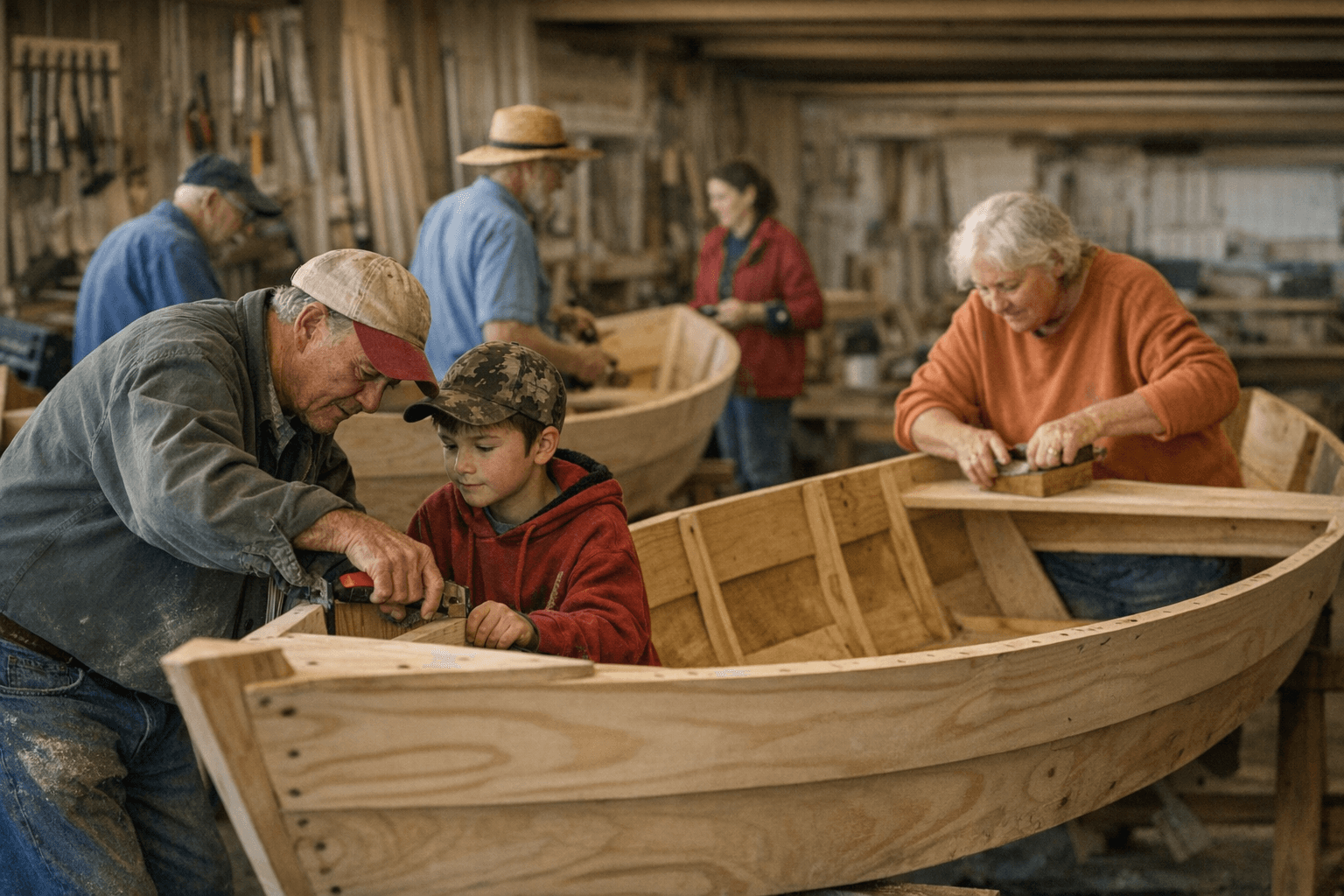
Shore History's "Introduction to Boatbuilding" kicked off April 4 at the organization's workshop in Onancock, Virginia, with sessions continuing through May 27 on Saturday mornings and Wednesday evenings. Students are building two complete Bevin's Skiffs using precut plywood parts, epoxy, and temporary fasteners, the same method that has made the design what kit supplier Chesapeake Light Craft calls "a mainstay of amateur boat building."
At $50 for the full program, with reduced or free spots for children accompanied by a parent, the class fits the community-supported model Shore History operates as a 501(c)(3) nonprofit founded in 1957. The program is explicitly aimed at beginners, described in the event listing as the right starting point "if you have an interest in boat building but don't know where to start."
The skills covered transfer directly to real DIY work: panel fit-up, epoxy filleting, basic fiberglassing, fairing, and launch procedures. These are the same core techniques involved in cockpit sole repair, transom patching, and dinghy restoration. The finished hull comes in at 11'8" long, weighing 120 pounds, with a 460-pound load capacity.
That design has Virginia roots. Youcha, who served as Executive Director of the Alexandria Seaport Foundation from 1995 to 2010, drew on traditional Chesapeake flat-bottomed forms, particularly Uncle Gabe's Skiff as described by Sam Rabl in "Boatbuilding in Your Own Backyard" and the Westport Skiff documented by Bob Baker. WoodenBoat noted that Youcha designed the skiff specifically "to teach math and boatbuilding skills to their apprentices." The White House, Virginia Governor's Office, Virginia Attorney General's Office, and Alexandria Public Schools superintendent all commended his program; Youcha himself was named Washingtonian of the Year and an Alexandria Living Legend.
The Bevin's Skiff has since become a fixture of community boatbuilding programs from Maryland to Massachusetts. The Cape Cod Maritime Museum has run a Bevin's Skiff youth program with the Barnstable Recreation Department since 2012, placing middle schoolers in 10-to-12-week builds in a waterfront workshop. In April 2011, six youths in GreenFleet's after-school program launched two Bevin's Skiffs they had assembled themselves. Shore History's class enters a documented landscape of thinning maritime craft knowledge: the Chesapeake Bay Maritime Museum in St. Michaels, Maryland, runs a state-certified Shipwright Apprentice Program noting the bay's shoreline "was once home to scores of small shipyards where skilled shipwrights built and maintained hundreds of wooden vessels," and maritime institutions across New England and the mid-Atlantic are reporting a growing shortage of skilled craftspeople.
Shore History holds its sessions in Onancock, where its headquarters at Ker Place has stood since it was built between 1799 and 1803 at 69 Market Street, now a National and Virginia Historical Landmark. By spring, two flat-bottomed skiffs built in that town will be ready to row.
This article was produced by Prism’s automated news system from verified source data, official records, and press releases, then run through automated quality and moderation checks before publishing. The system is built and supervised by the people who set the standards it runs under. Read our full AI policy.
Did this article answer your question?