Shorthanded sailing safety, planning, and simple crew roles explained
Gilbert Park turns two-person sailing into a system, not a scramble. Simple roles, tight planning, and hard safety rules carry the load.
Why shorthanded sailing succeeds or fails before you leave the dock
Gilbert Park’s approach starts with a blunt truth: a small crew only works if the boat is set up to be manageable before the lines come off the pier. In his own cruising with his wife, Máire, and his friend James, the answer is not more effort at sea but less confusion from the start. Máire is not a keen sailor, but she keeps watch and helps with mooring. James is enthusiastic and usually takes the helm. The lesson is simple and useful: shorthanded sailing becomes safer when every person has a narrow, realistic job and the skipper plans around the limits of the team.
That mindset matters because the cost of getting it wrong shows up fast. A shorthanded crew does not have spare hands to absorb a bad approach, a missed radio call, or a vague docking plan. Park’s system reduces that risk by stripping the trip down to decisions that can be made early, communicated clearly, and repeated under pressure.
Which maneuvers need rethinking first?
The first maneuvers to simplify are the ones that demand the most coordination: arrival, mooring, and any moment where the boat must change direction while the crew is busy. Park’s model assumes that no one on board should be guessing what comes next. That is why he gives Máire a watchkeeping role and a mooring role, while James can stay focused on the helm instead of being asked to do everything at once.
For a two-person boat, this means treating each close-quarters task as a sequence rather than a scramble. Before the approach, decide who looks out, who handles the line, who speaks on the radio, and which port or marina will be the fallback if the first plan starts to unravel. The fewer surprises in the maneuver itself, the more the crew can save its attention for the bits that really change minute by minute.
How does the passage plan reduce workload?
Park leans on a passage-planning mnemonic, Mr Ramsgate, to make sure nothing essential gets left out. It forces the plan to cover meteorology, route, radio channels, alternative ports, mooring details, special hazards, gas, food, tides, and emergency information. That list is more than administrative neatness. It is a way to prevent the kind of last-minute improvisation that becomes costly when there are only two people aboard.
The practical payoff is that the crew can leave the dock with fewer unknowns. If the weather shifts, the route is already thought through. If the preferred landing spot is awkward, an alternative port is already in the plan. If a hazard appears, the crew has already talked through it, instead of trying to decode it while tired, busy, or short on hands.
What gear matters most when the crew is small?
The most useful gear is the gear that keeps the crew informed and connected. Park uses a Spot X satellite communicator because SafeTrx is no longer available, and he shares voyage information with a shore contact. That communication setup gives the trip an outside layer of safety, especially when the boat is out of easy reach and the crew is limited.

Equally important is how the information is presented onboard. Park uses two screens to brief the crew before departure, showing blackwater dump points, turn-back options, escape ports, and other decision points. That kind of briefing turns gear into a planning tool. Instead of relying on memory once the boat is moving, the crew can see the important places and choices before they are under pressure.
Which habits create the biggest safety margin?
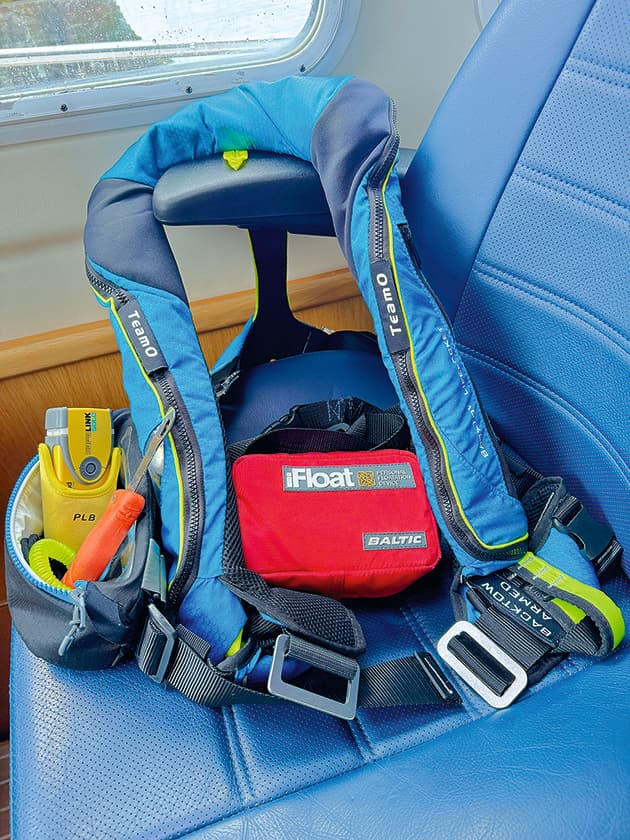
The strongest safety margin comes from habits that remove ambiguity. Park is explicit about two rules: no alcohol underway, and lifejackets worn all the time when the boat is moving. Those are not decorative rules or ceremonial cautions. They are simple standards that make a small crew more predictable, more alert, and faster to react.
He also sends a check-in message before arrival and then phones later, so someone ashore knows the boat is in. That double check matters because a shorthanded passage is not complete just when the sails come down. It is complete when the shore contact knows the crew is safe. In a small-crew system, that follow-through is part of the voyage, not an afterthought.
How do you brief a crew that is not equally experienced?
Park’s setup works because it does not pretend every person aboard is equally committed to sailing. Máire may not be keen, but she still has a defined role that matters. James is enthusiastic and can take the helm most of the time. That mix is common on cruising boats, and it is exactly why the skipper has to build a crew system that fits the people, not the other way around.
The briefing should be direct and visual. Show the escape ports, the blackwater dump points, the turn-back options, and the special hazards before departure. Then connect those points to the actual plan: where the boat is heading, what the alternative is, and what each person does if the first choice stops making sense. The goal is not to turn everyone into an expert. The goal is to make sure no one is surprised.
What shorthanded sailing really asks of the skipper
Shorthanded sailing is less about toughness than about discipline. Park’s article makes clear that the skipper’s job is to narrow the decision tree before the boat gets underway. That means choosing simple roles, planning with precision, using communication tools that fit the trip, and enforcing rules that keep the crew alert and protected.
When the boat is designed around fewer hands, the whole trip changes shape. Docking becomes a rehearsed sequence, not a test of muscle. Passage planning becomes a working system, not a paper exercise. And the crew, even when it is only two or three people, can handle the day with less strain because the important decisions were made early, clearly, and in the right order.
This article was produced by Prism’s automated news system from verified source data, official records, and press releases, then run through automated quality and moderation checks before publishing. The system is built and supervised by the people who set the standards it runs under. Read our full AI policy.
Did this article answer your question?