Simple Tools That Make Impossible Sailboat Maintenance Possible
Hidden sailboat jobs usually fail because of access, not effort. Jim Norris shows how a basin wrench and belt jack tame Lakota’s buried engine spaces.
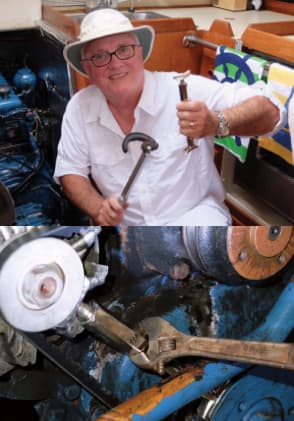
A frozen-looking fastener behind a panel, a hose clamp buried under the engine, and a stuffing-box nut tucked where a wrench can barely swing all trigger the same bad decision: assuming brute force will solve a space problem. On Jim Norris’s Pearson 386, Lakota, the better lesson is simpler and more useful. After more than 20 years aboard a boat that has cruised Long Island Sound and beyond, he has learned that impossible maintenance is often just ordinary maintenance trapped in a bad layout.
The first fix is diagnosis, not muscle
Norris’s story works because it starts with the shape of the problem. Lakota’s engine space is tight enough that the difference between success and frustration comes down to whether you need reach, leverage, or a way to hold one setting while tightening another. That distinction matters on older inboard sailboats, where the most miserable jobs are rarely dramatic failures. They are the little things that hide under sole boards, behind the engine, or deep in the shadows of a V-drive installation.
- If you can see the fastener but not touch it, it is an access problem.
- If you can touch it but cannot swing the tool, it is a leverage problem.
- If the adjustment moves while you tighten the hardware, it is a sequencing problem.
A quick mental check helps sort the job before you start:
Lakota presents all three, and that is why Norris’s answer is so practical. He does not try to make a standard wrench behave like a special-purpose tool. He reaches for the tool that matches the space.
The basin wrench solves the reach problem
The first of Lakota’s miserable jobs is the stuffing box, tucked so far under the engine block that adjusting it by hand means lying on the cabin sole with almost no room for a wrench to move. That is exactly the kind of place where a basin wrench earns its keep. It reaches far under and behind the engine to get onto nuts that are otherwise nearly impossible to touch, which turns a near-impossible job into a slow but controllable one.
That matters because the problem is not just that the nut is hard to reach. In a boat with a cramped inboard installation, the cost of the wrong tool is extra time, scraped knuckles, and a half-finished job that gets pushed off until the next haulout or yard visit. Norris’s point is not that a basin wrench is glamorous. It is that the right low-tech tool changes the whole conversation from “Can I even get there?” to “Now I can actually work.”
The belt-tensioning jack solves the hand-you-don't-have problem
Lakota’s second headache is setting accessory-belt tension. This is not a glamorous repair either, but it can become maddening because the space leaves little leverage and no spare hand to hold the adjustment while you tighten hardware. That is a classic sequencing problem: the setting is right for a moment, then everything slips before you can lock it in.
Norris’s answer is a belt-tensioning jack, which holds the current setting in place so the adjustment does not walk away as soon as you reach for the fastener. West Marine sells an adjustable jack screw designed to install on the alternator tensioning arm for easy belt adjustment, which lines up neatly with the kind of job Norris is describing. Balmar adds another useful layer to the same logic by recommending belt-tension monitoring after every charge cycle for the first several weeks, then using a belt-tension gauge for accurate measurement.
That is the real lesson here: if the belt is set by feel alone, you are asking the engine room to cooperate when it has already told you it will not. A jack screw or similar tensioning aid turns the job from a balancing act into a repeatable process.
Why Lakota is such a convincing test case
Lakota is not an abstract example from a tool catalog. It is a Pearson 386, the aft-cockpit version of the Pearson 385, a William Shaw design first built in 1984. Published specifications put the boat at about 38.3 feet overall, 11.5 feet of beam, 16,915 pounds of displacement, and a 30-foot waterline. Those numbers explain why the engine room feels the way it does: there is plenty of boat around you, but not much room where the work actually happens.
The powerplant adds to the challenge. Lakota carries a Perkins 4-108 configured as a V-drive, and that setup is a familiar old-boat mix of rugged and cramped. Technical references list the 4.108 as a four-cylinder, 1.76-liter diesel making roughly 37 to 45 horsepower, while a Perkins brochure describes a 49 shp marine version with a 2:1 reduction. It is an older engine, but not an irrelevant one, which is why parts, manuals, and workarounds still matter in so many cruising boats.
What the stuffing box teaches about maintenance rhythm
The stuffing box is a perfect example of why access and maintenance philosophy are tied together. Traditional stuffing boxes are not “set and forget” equipment. West Marine says they need regular adjustment and repacking every 1 to 3 seasons, while Practical Sailor notes that a few drips per minute are acceptable but more can signal that adjustment or packing replacement is due. West Marine also points to dripless shaft seals as a maintenance-reducing alternative, though they come with a higher upfront cost.
That context matters because a sailor who understands the maintenance rhythm will choose tools differently. If you know the job will come back around, you stop thinking in terms of one heroic repair and start thinking in terms of repeatable access. A basin wrench that can get back into the same dark corner next season is worth more than an all-purpose wrench that only works on the bench.
The real win is adapting the tool kit to the boat
Norris’s article is not really about two gadgets. It is about refusing to let the boat dictate frustration. Older inboard sailboats are full of jobs where the repair itself is straightforward, but the space around it turns everything into a wrestling match. Once you separate access from leverage and leverage from sequencing, the right simple tool becomes obvious.
That is why these little tools change so much. They do not make the engine room bigger, and they do not make the stuffing box friendlier. They do something better: they make the impossible job possible without turning the process into a yard bill, a bruised weekend, or a repair that never quite gets finished.
This article was produced by Prism’s automated news system from verified source data, official records, and press releases, then run through automated quality and moderation checks before publishing. The system is built and supervised by the people who set the standards it runs under. Read our full AI policy.
Did this article answer your question?