Underwater epoxy tested for emergency sailboat leak repairs
A small below-waterline leak is not the time for theory. This test shows which underwater epoxies are worth keeping aboard when a haul-out is not an option.
When the leak is below the waterline, time becomes the real variable
A small breach below the waterline can turn a normal passage into a race against the bilge pump. If there is no practical way to haul out immediately, the question stops being academic and becomes brutally simple: what can buy safe time until you reach proper repairs? That is the lens Practical Sailor uses in its emergency underwater epoxy test, and it is the right one for cruising boats where through-hulls, rudder tubes, bow thrusters, and other penetrations are exactly the places a manageable problem can start.
The hard truth is that a large hole is often beyond a field fix. But smaller failures are different. They may not be glamorous, and they may not be permanent, yet they are often the difference between stabilizing a leak and losing control of it. That is why underwater repair compounds deserve a place in the same mental category as a backup bilge alarm or a spare seacock wrench: not as magic, but as the thing you hope never to need and are glad to understand before the boat is already taking on water.
How the test was set up matters as much as the tubes on the shelf
The comparison was built around fiberglass coupons, which is exactly the kind of plain, repeatable test surface that helps strip away wishful thinking. Each coupon was sanded with 60-grit paper, then bonded in two conditions, dry and underwater. That setup keeps the focus where it belongs, on cure behavior, adhesion, and how a product handles the ugly reality of repair work rather than the polished promise on the package.
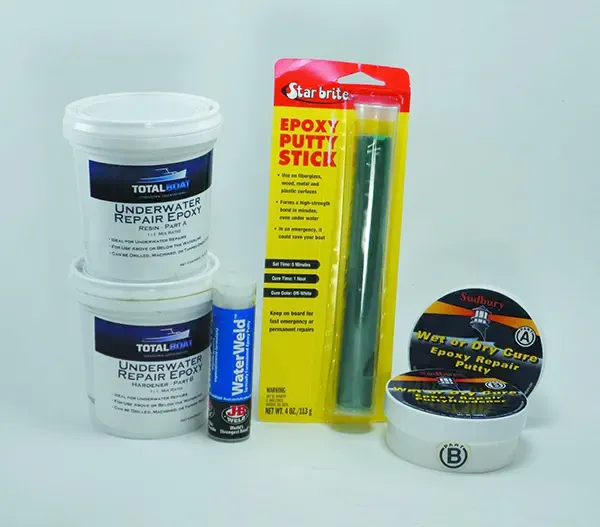
The lineup covered a useful cross-section of products sailors are likely to encounter in an emergency kit or chandlery bin: Pettit Splash Zone, JB Water Weld, Total Boat Underwater Repair Epoxy, Star brite Epoxy Putty Stick, and Sudbury Wet or Dry Cure Epoxy Repair Putty. These are not exotic lab samples. They are the kinds of compounds cruisers actually reach for when a fitting starts weeping or a fitting bed gives up and the ocean decides to participate in the day.
What underwater epoxy can really do onboard
The most important lesson from this kind of test is not that one product is magical and another is useless. It is that underwater epoxy works inside a narrow job description. It is best understood as a contingency tool for stabilizing a leak, not a substitute for a proper repair once the boat is out of the water and the damaged area can be opened, dried, and rebuilt correctly.
That distinction matters because a field fix is shaped by more than chemistry. Surface prep still counts, even in an emergency. Surface area still counts, because the bond has to grab enough material to hold back water pressure. And the nature of the failure still counts, because a tidy crack at a fitting is a very different problem from a large structural break. The practical skipper is not asking whether epoxy is impressive in the abstract. The real question is whether it can buy enough time, under enough stress, to let the boat stay afloat until the proper repair window opens.
The onboard decision is really about fit, not just brand names
A good emergency repair kit starts with the assumption that not every wet repair is the same. Some products are putties that can be kneaded and pressed into place. Others are aimed at broader cure behavior in wet or dry conditions. Knowing which style you have aboard matters when you are trying to work in cramped quarters, with a dripping overhead, a flashlight clenched between your teeth, and the bilge telling you exactly how much margin you do not have.
A sensible kit built around this test would include more than the epoxy itself:
- A product that can be applied fast in tight spaces
- Sandpaper or abrasive prep material, because 60-grit-level tooth is part of the equation
- Disposable gloves for handling wet compound and contaminated surfaces
- A scraper or putty knife for pressing and shaping the repair
- A plan for isolating the leak site before the compound is applied
The point is not to make the boatyard repair at sea. The point is to make the leak small enough that the boat remains manageable. That is a different and more realistic standard, and it is the standard that matters when the damage appears under the waterline and the nearest haul-out is not an option.
Why practice belongs in the kit too
Underwater epoxy is easy to romanticize and easy to misuse. If you only learn it when water is already moving through the boat, you are doing your first field repair under pressure, in poor posture, with limited visibility and no room for error. The better move is to handle the material in calmer conditions first, so you know how quickly it kneads, how it shapes, and what kind of surface it likes to grab.
That practice also helps set expectations. These products are there to stabilize a breach, not erase the damage. If the failure is too large, too structural, or too awkwardly placed, the honest answer may be that the epoxy is only one part of a larger damage-control effort. But when the breach is small and the clock is running, that small packet or stick of compound can be the difference between a controlled run to safety and a worsening flood.
A small below-waterline leak is never just a leak. It is a test of whether the boat is prepared, whether the crew knows the tools, and whether the right compound is already aboard when the water starts coming in. The value of this comparison is that it keeps the promise modest and the goal clear: underwater epoxy is not there to make a bad day disappear, only to buy the time that turns a crisis back into a repair.
This article was produced by Prism’s automated news system from verified source data, official records, and press releases, then run through automated quality and moderation checks before publishing. The system is built and supervised by the people who set the standards it runs under. Read our full AI policy.
Did this article answer your question?


