Vintage Seafarer sailor rigs temporary diesel tank to keep sailing
A 6-gallon outboard tank kept a 1968 Seafarer moving while its diesel system was opened up, but only because the plumbing was made secure and diesel-rated.
Larry Schremmer kept his 1968 Seafarer moving in New Haven, Connecticut, on Long Island Sound with a temporary diesel supply while its main tank was cut open for cleaning and its fuel lines were replaced. The tank had to stay secure, the hoses had to be right for diesel, and the return line had to be handled as carefully as the feed.
A stopgap that keeps the boat in the game
Schremmer has owned the Seafarer since 1985 and says he has been messing about with good old boats, power and sail, for 50 years. He was not trying to disguise a repair as a permanent installation. He was trying to avoid leaving a working sailboat stranded in a slip for the full time it took to open a tank, clean it, and replace the fuel lines.
On a boat like this, engine power is not a luxury. Maneuvering in and out of a slip is harder without it, and the margin gets thinner when you are dodging commercial traffic on Long Island Sound.
How the temporary tank was built
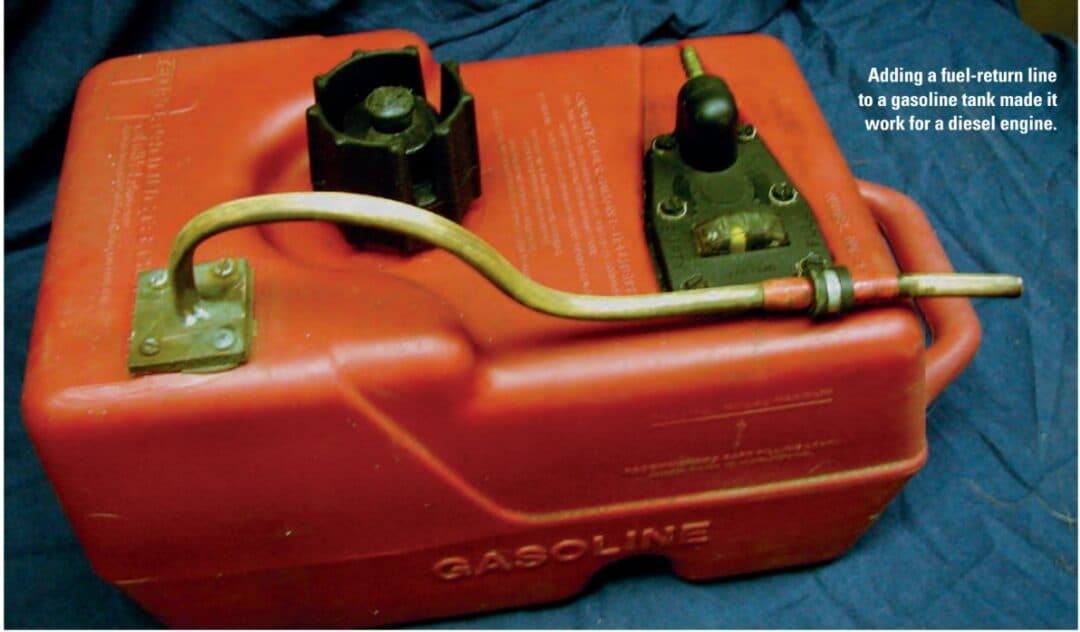
The core of Schremmer’s setup was a 6-gallon plastic outboard tank repurposed for diesel. Into that tank he added an insert for the fuel-return line by bending 1/4-inch copper tubing into shape and soldering it to a 2-inch by 2-inch copper plate. He drilled a hole in the tank, fastened the plate with stainless-steel sheet-metal screws, and used silicone as a sealant.

He then replaced the outboard hose connection with a hose barb and bought two diesel-rated fuel hoses long enough to reach the inlet on the fuel pump of his Yanmar diesel and the return-line connection.
Why the arrangement actually works underway
The tank sits on the settee in the cabin, higher than the engine. That gives Schremmer an easier time bleeding air out of the system, which is often the part that turns a simple repair into a miserable one. He also says the auxiliary tank takes just minutes to connect.
There is one more practical wrinkle in his setup. He noted that he could use the same arrangement to carry extra fuel if he sealed the open return tube by clamping a short hose between the return tube and the feed-hose barb. If the return side is left open or poorly controlled, the arrangement becomes a spill hazard.
The line between a clever workaround and a fuel-system bodge
Diesel is less volatile than gasoline, but it is still a fire and environmental hazard, and the fuel system on any boat needs to be treated with respect. Secure mounting comes first, because a tank that shifts in a seaway can strain fittings, crack seals, and turn a tidy temporary setup into a leak source.
Venting and filtration matter too, even in a stopgap. A temporary tank should not defeat the boat’s normal fuel management just because it is smaller or portable. If the arrangement cannot breathe correctly, if it cannot keep dirt out, or if it cannot stay leak-free around every fitting and hose barb, it has crossed the line from smart to sketchy. That is especially true in a cabin, where a loose hose or a weeping seal can turn an ordinary repair into a fire risk.
Boats often outlast their diesel tanks. Replacement can be complicated not only because tanks are awkward to remove, but because the work has to respect the standards that keep a diesel system safe. ABYC H-33 is the main voluntary standard for recreational marine diesel fuel systems, and even a temporary arrangement has to account for that rulebook. A stopgap should borrow the discipline of a proper installation: rigid support, compatible materials, tight plumbing, and no casual shortcuts.
Why older Seafarers end up in this kind of work
There is also a bigger story behind the boat itself. Seafarer Yachts was founded in 1964 by William Tripp Sr. in Huntington, New York, and closed in 1977 after building affordable fiberglass cruising sailboats. That history helps explain why so many surviving Seafarers are now owner-maintained boats, with systems that have aged far beyond the original factory era.
A separate Good Old Boat case involved a couple facing a failed diesel tank who chose to keep their sailing plans alive with a temporary arrangement while the permanent replacement was underway.
This article was produced by Prism’s automated news system from verified source data, official records, and press releases, then run through automated quality and moderation checks before publishing. The system is built and supervised by the people who set the standards it runs under. Read our full AI policy.
Did this article answer your question?