Why ferrules stop corroding, loose wire ends on boats
Ferrules turn loose, corroding wire ends into gas-tight terminations that stay cool, tight, and reliable, even when a boat shakes, soaks, and bakes.
The hidden failure starts the moment you strip the wire
A stripped wire end can look ready for service and still be headed toward trouble. The instant insulation comes off, corrosion and oxidation begin, and on a boat that process has a fast lane: damp air, salt, vibration, and awkward access all work against a clean connection. Marine How To’s wiring guidance gets to the heart of it, because the failure is not dramatic at first. It is the slow kind, the kind that hides inside a terminal block until the connection loosens, heats, and starts acting like a resistor instead of a conductor.
That matters because finely stranded marine wire does not always stay put the way a casual DIY install suggests it will. Once it is first tightened, the strands can keep splaying and settling, which means a connection that feels snug on day one can need re-torque later. In a boat’s DC system, that is more than a maintenance nuisance. Loose connections create resistance, and resistance creates heat. Left alone, that becomes a hot, high-resistance failure point, exactly the sort of hidden defect that can turn into an electrical problem nobody sees until something fails.
Why ferrules change the game
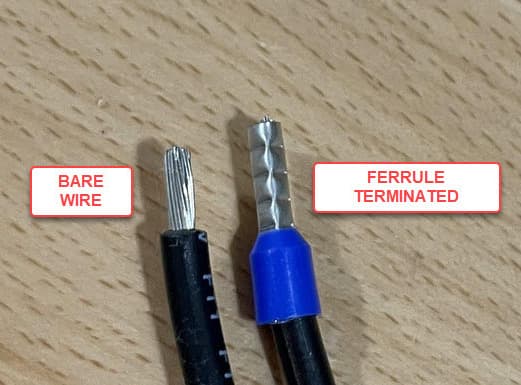
Ferrules are the cleanest answer to that problem in a lot of marine terminations. A proper ferrule compresses the strands into a tight, gas-tight bundle, which helps keep moisture and oxidation out of the connection. Instead of loose strand ends fanning out under a screw or clamp, the ferrule gives the terminal block a solid, uniform conductor to bite onto.
That is why ferrules are not just a tidy-shop choice. Industrial and electrical-component guidance treats them as a way to prevent fraying, conductor breakage from vibration, and unreliable connections in terminal blocks. Manufacturers such as ABB and Phoenix Contact describe them as a preferred alternative to twisting wire strands or tinning the end before termination. On a boat, that advice lands with extra force, because vibration and humidity are not edge cases. They are the operating environment.
Where the rule matters most: terminal blocks, bus bars, and panel rewires
The places owners actually touch are the places where bad terminations show up first. Terminal blocks, bus bars, and back-of-panel rewires are common places to see stranded wire jammed straight under a screw, or worse, strands trimmed, twisted, and hoped into place. That can work for a while, but it is a weak link in a marine system that has to stay reliable for years.
Federal rules make the expectation clear. Under 46 CFR 183.340, electrical equipment on a vessel must be installed and maintained to protect passengers, crew, other persons, and the vessel from electrical hazards, including fire. The same regulation says wire connectors used with screw-type terminal blocks must be captive types, such as ring or flanged spade connectors. That is not a style preference. It is a safety rule that recognizes how a screw-type connection behaves when looseness, vibration, and repeated service are part of the picture.
That is also why many clamping terminal blocks, even when they are common in the field, are not truly ideal for finely stranded marine wire. Blue Sea Systems markets terminal blocks as a marine solution for isolating circuits and simplifying wiring, but the underlying mechanical lesson stays the same: the connection has to match the wire, the load, and the environment. A good-looking install that relies on bare stranded ends is still vulnerable.
The practical rule set for choosing the right termination
The simplest way to decide is to start with the connection style and then match the termination to it.
- Use a ferrule when a clamping terminal block or similar device is meant to grip a stranded conductor directly, and you need to stop fraying, keep the bundle compact, and reduce the chance of strand breakage under vibration.
- Use a captive crimp terminal, such as a ring or flanged spade, when the connection is made to a screw-type terminal block or other fastening point that calls for a secure, captive end.
- Do not rely on twisted strands as a finishing method. Twisting may make a wire look tidy, but it does not create the same stable, gas-tight contact as a proper ferrule or captive terminal.
- Avoid treating tinning as a catch-all fix. Manufacturers that make ferrules commonly prefer them over tinning for terminal-block terminations because the soldered end can behave differently under pressure and heat.
The point is not to collect gadgets. The point is to make the conductor, the connector, and the hardware agree with one another. That is what keeps current flowing without excess resistance, heat, or future loosening.
Why this is a fire and performance issue, not just a neatness issue
The public-safety frame is hard to miss. BoatUS has long described the electrical system as the place where many boat fires start, and BoatUS-derived analysis cited by Vessel Vanguard found that the DC electrical system caused more than a third of boat fires, while AC shore power accounted for another 9 percent. That turns a tiny wire-end decision into part of the boat’s real fire picture.
It also explains why sloppy terminations affect more than safety. ABYC-related marine wiring guidance commonly uses a 3% voltage-drop limit for critical circuits and 10% for non-critical circuits. A bad connection can eat into that budget fast, especially on loads that matter most: bilge pumps, navigation lights, solar controllers, and autopilot feeds. If a connection runs hot or loosens, it is not just failing gracefully. It is stealing performance from the system every time current passes through it.
What good workmanship looks like onboard
ABYC’s standards library and wiring-termination training treat electrical connections as a craft that technicians repeat thousands of times over a career, and that framing fits the boatyard reality perfectly. Good marine wiring is not only about getting power from one end to the other. It is about making sure the connection stays electrically healthy after the panel is closed, the boat is underway, and nobody wants to reopen a cramped locker just to chase an intermittent fault.
That means careful torque, correct terminations, and periodic inspection. It also means learning to tell the difference between a connection that looks fine and one that is actually healthy. Bare wire ends can hide corrosion, strand splay, and loosening long before a symptom shows up at the helm. Ferrules, captive connectors, and the right terminal hardware take those hidden failure modes off the table.
In the end, the lesson is the same whether the wire feeds a bilge pump or a solar controller: a loose end is never just a loose end. In a damp, vibrating boat, it is where corrosion begins, where heat builds, and where a small mistake can work its way toward a much bigger problem.
This article was produced by Prism’s automated news system from verified source data, official records, and press releases, then run through automated quality and moderation checks before publishing. The system is built and supervised by the people who set the standards it runs under. Read our full AI policy.
Know something we missed? Have a correction or additional information?
Submit a Tip