Why your sail’s leech line matters for trim and sail life
A leech line is a tiny control line that can quiet flutter, sharpen trim, and spare a sail from early wear. The trick is using just enough tension, not too much.
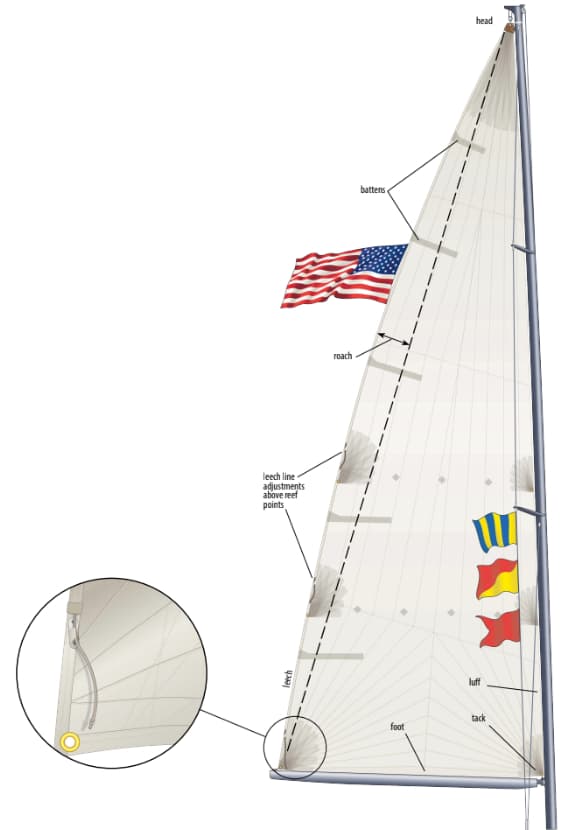
The small line that keeps a sail quiet
A leech line is one of the cheapest upgrades already hiding in plain sight, and it can make a real difference the moment the sail starts talking back. If the leech is fluttering, the edge is wasting energy and wearing itself out, and on many sails the fix is not a new sail, just a better read on a small cord buried in the tabling.
Don Launer’s explanation lands because it starts with the shape of the sail itself. A Bermudan, or Marconi, mainsail is often cut with roach so it can carry more area and make more power, but that extra area needs support. Battens help stiffen the leech, and on many sails a leech line gives that trailing edge just enough tension to stay settled instead of snapping like a flag.
What the leech line actually does
The leech line is not a general-purpose trim line. Precision Sails describes it as a line attached at the head of the sail and running down to just above the clew, with adjustment often handled by cleats or Velcro tabs near the clew or reef points. Its main job is narrow and practical: reduce flutter in the trailing edge and improve sail shape.
That distinction matters because leech tension is usually controlled elsewhere first. UK Sailmakers notes that upwind, the mainsheet and traveler normally control leech tension, while off the wind the boom vang takes over. The leech line comes in when the very edge of the sail still wants to shake, even though the bigger trim controls are already doing their job.
How to spot a loose leech line
A loose leech line usually announces itself quickly. The telltale sign is flutter at the aft edge of the sail, often louder as the wind builds and especially noticeable when you are sailing off the wind. Sail-World and UK-Halsey Sailmakers both emphasize that this flutter becomes more pronounced as wind increases, and that letting it continue shortens sail life.
This is where the hidden payoff shows up for cruising sailors. Flutter is not just noise that you learn to ignore. It reduces efficiency, it hammers cloth and stitching over time, and on an aging sail that has already stretched a bit, it can become the first symptom you notice long before the sail looks visibly tired.
How to tell when it is too tight
A leech line can be overdone, and that is where many sailors create a new problem while trying to cure an old one. MITNA warns that if the line is too tight, the leech can become cupped, which interferes with smooth airflow. Instead of calming the sail, you end up distorting it.
That distortion can also show up as a leech hooked to windward, which is the opposite of a clean release. If you see the sail flattening in the wrong place or the trailing edge looking pinched rather than relaxed, ease the line back. The goal is to remove flutter from the edge, not pull the sail out of its designed shape.

Do not blame the leech line for every trim issue
One of the most useful parts of this advice is knowing when the leech line is not the real problem. If the sail feels wrong across its whole body, the fix may be in the mainsheet, traveler, boom vang, or headsail lead position, not in the small line hidden in the leech. UK Sailmakers’ trim guidance is a good reminder that the major controls set the sail’s shape first, and the leech line fine-tunes the edge.
That matters on boats where several things are happening at once. A sail may be luffing because the lead is off, twisting badly because the vang is too slack, or loading up because the traveler is out of position. In those cases, tightening the leech line can mask the symptom for a moment while leaving the real trim problem untouched.
Why battens and leech lines work together
Battens and leech lines solve related problems from different angles. Spinnaker Sailing describes battens as stiffeners that help keep the leech from fluttering, and that stiffness is especially important when the sail carries roach and wants to open and close at the back end. The batten supports the structure; the leech line helps settle the edge.
On older or well-used sails, that partnership becomes even more valuable. As the cloth stretches, the leech has more freedom to move, and flutter tends to show up sooner and louder. That is why a properly handled leech line can feel like a minor adjustment while paying out in longer sail life over time.
A practical way to use it on board
The smartest way to approach the leech line is as a finishing control, not a brute-force fix. Start by trimming with the mainsheet, traveler, and boom vang as usual, then look at the trailing edge. If the leech still flickers or hums, add just enough tension to quiet the edge without changing the overall shape of the sail.
- If the leech flutters, add a little tension.
- If the leech hooks or the sail looks cupped, ease it.
- If the whole sail is out of shape, look to the primary trim controls first.
A good on-the-water read is simple:
Launer’s experience gives this advice extra weight. He built the two-masted schooner Delphinus from a bare hull, has held a USCG captain’s license for 40 years, and has written five books, which is a long record of learning that the smallest details often decide whether a sail feels crisp or aggravating. The leech line is one of those details, and once it is set correctly, the payoff is immediate: less noise, better trim, and a sail that lasts longer because its trailing edge is finally being treated with the respect it needs.
This article was produced by Prism’s automated news system from verified source data, official records, and press releases, then run through automated quality and moderation checks before publishing. The system is built and supervised by the people who set the standards it runs under. Read our full AI policy.
Did this article answer your question?