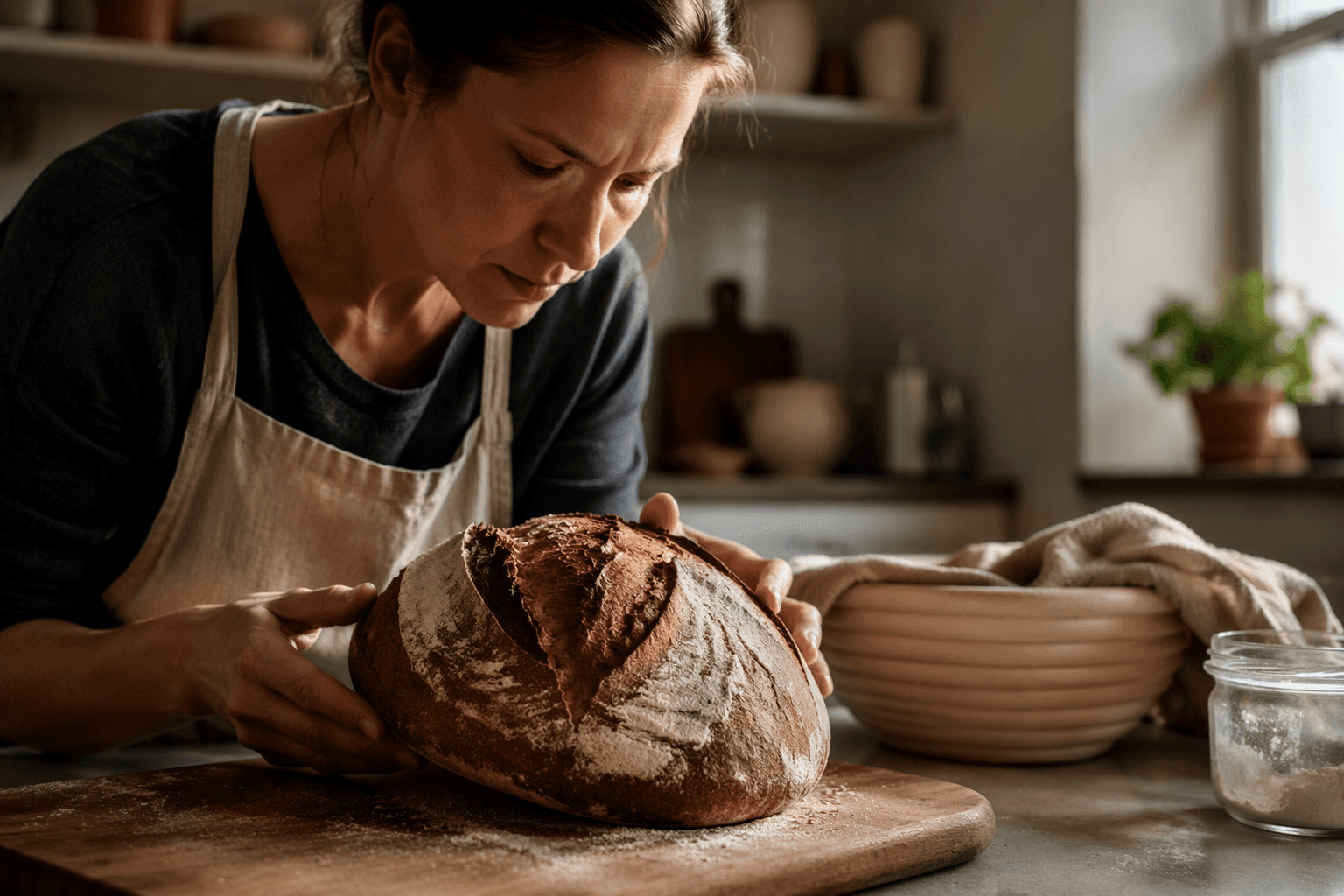
Evan Mitchell's New Cookbook Guides Beginners Through Every Sourdough Step
Evan Mitchell's debut sourdough book cuts through starter anxiety with schedule-specific timing and sensory cues that online tutorials rarely teach this clearly.
Three steps forward, one loaf at a time
Most beginners don't abandon sourdough because it's too hard. They abandon it because the gap between "I followed the instructions" and "I actually understand what's happening" never closes. Evan Mitchell's new cookbook, *The Homemade Sourdough Kitchen*, arrives at a moment when that gap is well-documented by the hobby community itself: search forums long enough and you'll find thousands of posts from bakers who built a starter, attempted one loaf, got a dense brick, and never tried again. The large-print paperback, released April 1, 2026, is Mitchell's direct answer to that dropout pattern.
The book's core promise, removing the guesswork from sourdough, is a phrase you'll see on a lot of beginner resources. What distinguishes Mitchell's approach is how concretely that promise is operationalized. Three deliverables in particular stand out as genuinely useful additions to what a standard online starter guide provides.
Deliverable 1: Schedule-adaptive fermentation timing
Online tutorials almost universally assume you're home all day. Mitchell doesn't. *The Homemade Sourdough Kitchen* offers timing strategies built around different home schedules, an acknowledgment that bulk fermentation doesn't care about your commute. A nine-to-five baker and a work-from-home parent operate in completely different temperature and attention windows, and the same four-hour bulk ferment that works for one will overproof for the other.
This is more than a convenience feature. Fermentation timing is where most beginner failures originate, and it's where Mitchell's tested schedules provide real structure. The book gives clear timelines rather than ranges like "4 to 12 hours," which appear in many online guides but offer beginners little traction. Knowing that a 70°F kitchen with a modest 20% starter inoculation will typically finish bulk in around five to six hours is the kind of concrete anchor that keeps a new baker oriented.
Deliverable 2: A sensory-cue framework that replaces guesswork with landmarks
The second standout is the book's emphasis on reading your dough rather than just watching the clock. Mitchell grounds readiness in three observable signals: smell, bubble structure, and surface tack. These sensory cues are mentioned in the research as core to the book's technique philosophy, and they matter because they scale across climates and flour types in a way that fixed timers don't.
A starter that smells pleasantly tangy and yeasty, has bubbles of varying sizes throughout (not just on the surface), and releases from the jar walls with a slight resistance is telling you something precise. A starter that smells sharply alcoholic has peaked and is hungry again. Dough that bounces back slowly from a poke is still active; dough that doesn't spring back at all has gone too far. These aren't abstract concepts in Mitchell's framework; they're landmarks on a map. For beginners who've been told to "trust their instincts" without being given the vocabulary to develop those instincts, this section of the book delivers something measurably different from a YouTube tutorial.
Deliverable 3: A progressive loaf pathway from boule to enriched formats
The third concrete value-add is structural. Rather than presenting forty recipes alphabetically, Mitchell builds a loaf progression that starts with the classic boule and moves outward to enriched and flavored formats. This matters for beginners because each loaf type adds one new variable: a flavored loaf introduces inclusions, an enriched loaf adds fat and eggs, a rye blend changes the fermentation behavior. Learning these in sequence rather than in parallel dramatically lowers the cognitive overhead of each new bake.
The inclusion of enriched loaves is also a quiet gateway to sourdough discard utility. Enriched formats often benefit from discard's mild acidity and developed flavor, making them an ideal first encounter with discard baking. Beginners who reach that chapter will find a natural use case for the discard they've been accumulating during the first two weeks of starter development, which helps reduce waste and keeps the momentum of early baking alive.
Who should buy it, and who can skip it
*The Homemade Sourdough Kitchen* is a strong investment for beginners who prefer structured, countertop-ready instruction over assembling a curriculum from multiple online sources. The large-print format is a deliberate choice: it's designed to be readable at arm's length, which is exactly where you need your reference when your hands are covered in dough and you're checking whether the surface tack is right.

It's less essential for bakers who have already mastered their first successful boule and are looking for advanced shaping techniques or deep fermentation science. And as with any sourdough resource, buyers should treat the book's hydration levels and fermentation times as starting points rather than gospel: local flour protein content, ambient humidity, and kitchen temperature all require micro-adjustment by region. A baker in Phoenix working with high-protein bread flour in a 78°F kitchen will need to shorten fermentation windows compared to the book's baseline; a baker in Seattle in winter may need to extend them.
For instructors building beginner lesson plans, the book's sample timelines and sensory-cue descriptions are directly incorporable into curriculum without significant translation. Its tested schedules can anchor a workshop's practical session in a way that a recipe collection alone cannot.
Week 1 Sourdough Plan: A starting framework, book or no book
Whether or not you buy Mitchell's cookbook, this plan will get you to your first viable loaf within seven days.
1. Day 1 (Build): Combine 60g bread flour and 60g room-temperature water (70-75°F) in a clean jar.
Mix until no dry flour remains. Cover loosely and leave at room temperature.
2. Day 2 (Observe): Check for any bubbling activity.
Don't feed yet. Note the smell: it should be faintly wheaty or slightly funky. That funk is normal at this stage.
3. Day 3 (First feed): Discard all but 60g of your starter.
Add 60g flour and 60g water. Mix well and cover. Bubble activity should begin to increase.
4. Day 4 (Rhythm): Repeat Day 3's discard-and-feed.
Your starter should start smelling more actively sour or tangy. Look for small bubbles forming within four to six hours of feeding.
5. Day 5 (Twice daily if needed): If your kitchen is above 75°F, feed twice.
If it's cooler, once is fine. Watch for the starter to begin visibly rising and falling between feedings. That cycle is your fermentation clock.
6. Day 6 (Float test): After a feed, wait until your starter is at its peak rise.
Drop a small spoonful into a glass of water. If it floats, your starter is ready to bake with. If it sinks, give it another feed cycle.
7. Day 7 (First loaf): Mix 375g bread flour, 275g water, 75g active starter, and 8g salt.
Rest 30 minutes, then stretch and fold four times over two hours. Allow bulk fermentation until the dough has risen 40-50%, shows bubbles on the sides of your container, and feels airy and elastic. Shape into a round, proof for one to two hours at room temperature (or overnight in the fridge), then bake covered in a Dutch oven at 500°F for 20 minutes, uncovered for 20-25 more.
The point of this plan isn't to replicate everything Mitchell covers; it's to get you through the door. The beginner sourdough community grows when new bakers get their first successful loaf fast enough to stay curious. Mitchell's book, at its best, is designed to make that first loaf feel like a beginning rather than a fluke.
This article was produced by Prism’s automated news system from verified source data, official records, and press releases, then run through automated quality and moderation checks before publishing. The system is built and supervised by the people who set the standards it runs under. Read our full AI policy.
Did this article answer your question?