New Hampshire sourdough moves beyond the boom, fueling local bakeries and pizzerias
New Hampshire’s sourdough scene now runs from loaves to pizza to cookies, showing how fermentation has become a local business model, not just a trend.
Sourdough has moved from side project to full market category
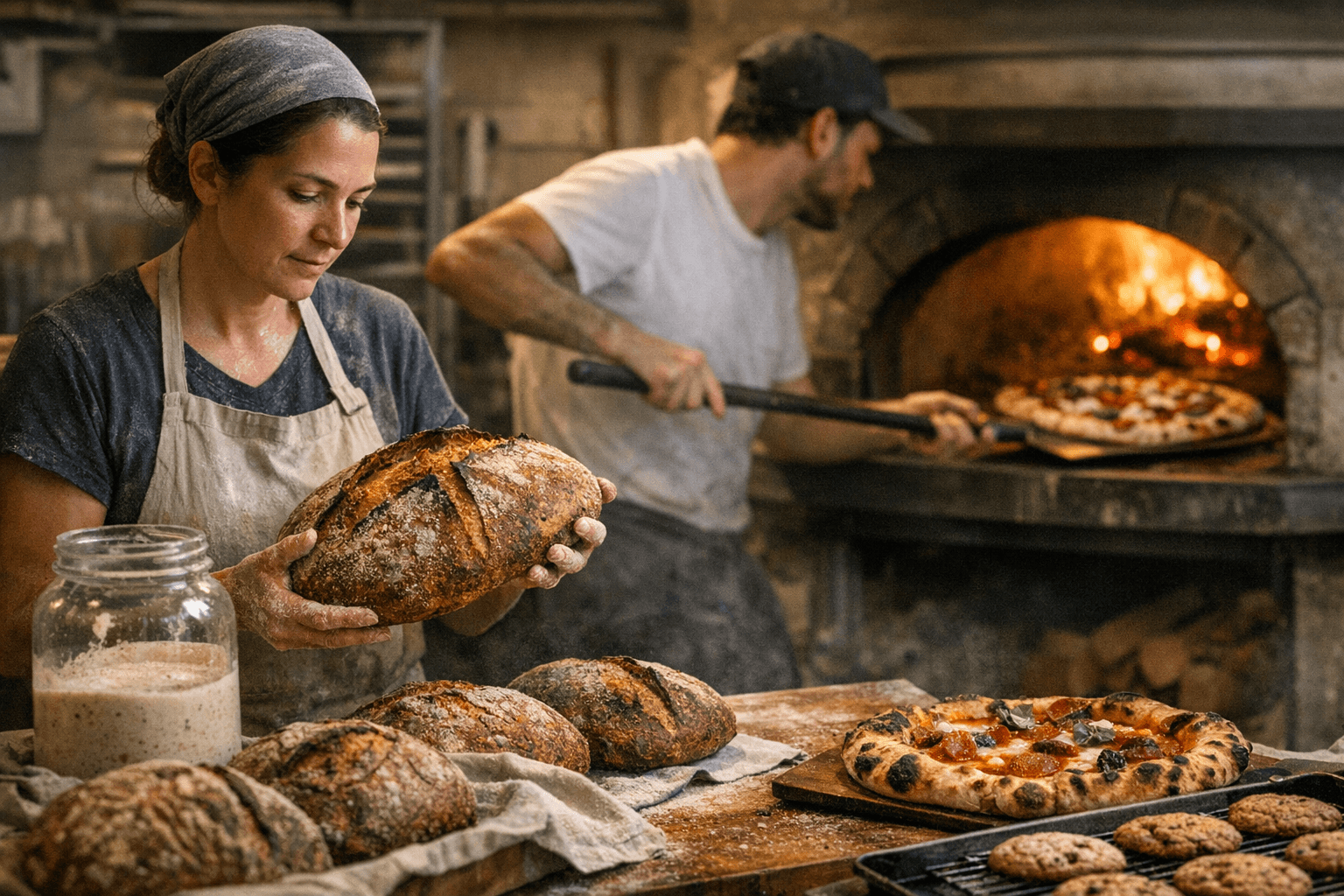
The clearest sign of sourdough’s staying power in New Hampshire is breadth. It is no longer just a loaf on a weekend counter, but cookies, pizza, cinnamon rolls, and bread working together as an all-day, all-meal business model. WMUR’s April 14 NH Chronicle segment captured that shift by moving between three very different operations, each using sourdough in a way that fits daily eating rather than novelty baking.
That matters for home bakers because it shows where the category is headed. The strongest sourdough businesses are not simply selling bread with a tangy label. They are building repeatable products around fermentation, using discard creatively, and finding formats that travel from a home kitchen into a commercial setup without losing the handmade feel.
Dragonfly Dough Co. turns discard into a wider bakery line
In Derry, Dragonfly Dough Co. is a clear example of sourdough becoming a practical bakery system. Katlynn Wageling started the business in 2025 and has built it around handcrafted sourdough breads, plus discard-based treats like cinnamon rolls and cookies. That mix is important: it shows sourdough functioning not only as a loaf formula, but as the foundation for an entire pastry line.
The business runs through Creative Chef Kitchens, a commercial kitchen and certified space for handmade, artisan small-batch food production and a food-business incubator. Its listed address is 35 Manchester Rd., Derry, NH 03038, and that kind of shared kitchen setup helps explain how small sourdough brands scale without giving up their home-baked identity.
Dragonfly’s ordering structure is also a clue to how modern sourdough businesses operate. Public ordering opens Mondays at 9 a.m., with early access on Sundays at 9 a.m., and pickup happens in Derry on Saturdays from 11:30 a.m. to 1:30 p.m. That rhythm creates a weekly loop that feels familiar to customers and manageable for production. Dragonfly Dough Co. LLC was registered in New Hampshire on December 9, 2025, with Katlynn Wageling listed as the agent, and the company’s setup shows how quickly a home baking habit can become a formal local bakery.
For readers watching the market, Dragonfly is one of the clearest examples of real sourdough innovation. The discard is not treated as waste. It is built into the menu.
Sourdough pizza shows how fermentation can anchor a whole shop
If Dragonfly shows sourdough as bakery expansion, Sourdough Pizzeria in New Ipswich shows it as a full restaurant identity. Lisa Armstrong and Chris Armstrong have built a family-friendly arcade-plus-pizza shop around sourdough crust, using it for most of what they make at 800 Turnpike Road, New Ipswich, NH 03071. That makes sourdough less of a specialty and more of a core operating choice.
The restaurant describes sourdough in the familiar way bakers do: a mix of wild yeast and lactic acid bacteria used instead of baker’s yeast. On the plate, the result is the part customers notice fastest. Review listings describe the crust as thin, crispy, slightly tangy, and a standout feature. That combination gives the business a real edge because it changes both texture and flavor, not just branding.
This is one of the biggest lessons for home bakers trying to read the trend. Pizza is where sourdough becomes especially practical because it carries fermentation into a format people order for dinner, parties, and family nights. It is easy to see why this style spreads locally: a crust like this becomes the signature, not just an ingredient note.
Bigfoot Sourdough shows the home-kitchen pipeline
Bigfoot Sourdough in Milford highlights the other side of the same story, the route from hobby to business. April Repoza and her daughter Bailey started by sharing hundreds of loaves with friends and family before turning the work into a company. Bigfoot Sourdough LLC was registered in New Hampshire on February 26, 2024, with a Milford address at 33 Cortland Rd, Milford, NH 03055.
That trajectory fits New Hampshire’s home food landscape. The state allows home food manufacturing under certain circumstances through homestead food operations, and University of New Hampshire Extension says beginning small with shelf-stable baked goods from a primary home kitchen is a practical way to launch a homestead food business. For sourdough bakers, that is a meaningful roadmap. A steady starter, a reliable loaf formula, and shelf-stable goods can create a sales pipeline long before a full storefront exists.
Bigfoot is also proof that sourdough’s appeal is not only technical. It is relational. Loaves shared around a table can become a customer base, and that kind of trust often matters more than flashy branding when a neighborhood bakery is taking shape.
What to watch for if you want to spot the next sourdough trend
The New Hampshire examples point to a few signals that are worth watching in your own market.
- Products that use sourdough for structure, texture, or shelf appeal are the ones most likely to last.
- Discard baking, especially in cookies and cinnamon rolls, is a strong sign the business is using fermentation as a full production system.
- Pizza crust built around sourdough usually signals a deeper commitment than a one-off menu experiment.
- Shared-kitchen production and homestead-to-commercial growth are both realistic pathways for bakers who start at home.
The weak version of the trend is simple labeling. The stronger version changes how the food is made, sold, and repeated every week.
The health story is more cautious than the marketing
Sourdough businesses often lean on the familiar pitch that it is easier to digest and may cause a smaller blood sugar spike. That message is popular because it sounds practical, and it helps explain why sourdough keeps attracting attention beyond bread nerd circles. But the science is more measured. Peer-reviewed reviews say some studies have found improvements in glycemic response, satiety, or gastrointestinal comfort, yet the overall evidence is not strong enough to establish clear clinical health benefits from sourdough alone.
That distinction matters. The real strength of sourdough in New Hampshire is not a medical claim. It is versatility, texture, and a better way to turn a starter into a saleable product. Cookies, pizza, and loaves are now feeding the same local audience, and that is the clearest sign the boom has matured into something more durable.
This article was produced by Prism’s automated news system from verified source data, official records, and press releases, then run through automated quality and moderation checks before publishing. The system is built and supervised by the people who set the standards it runs under. Read our full AI policy.
Did this article answer your question?