North Carolina sourdough class teaches starter care and discard baking
A Brevard sourdough class turns starter care, discard baking and basic kneading into a two-hour, in-person beginner reset.
A low-pressure way into sourdough
A sourdough starter can intimidate even eager home bakers, which is exactly why this Brevard class is built as a hands-on reset instead of a dense lecture. The session, listed for Wednesday, June 3, 2026 from 9 a.m. to 11 a.m., is organized by N.C. Cooperative Extension, Transylvania County and held at the N.C. Cooperative Extension - Transylvania County Center in Brevard.
The practical details are just as friendly to beginners as the teaching approach. Doors open at 8:45 a.m., the event is open to ages 16 and up, and ticket rules are no-refund. The county extension calendar also lists the same program as Sourdough Class, which keeps the focus on what matters most: getting people in the room, hands on the dough, and past the first nervous stage of starter care.
What the two-hour workshop actually covers
The value of the class is not abstract bread theory. It is the chance to walk through the whole beginner cycle in one short session: how to feed a starter, how wild yeasts and lactic acid bacteria shape bread, how to use discard in a recipe, and how to practice kneading with a classic sourdough formula. Attendees also get to sample bread fresh from the oven, which makes the process feel less like a kitchen mystery and more like something repeatable.
That structure matters because sourdough usually becomes hardest right at the start, when the culture is still unstable and the baker is trying to understand timing, temperature and dough feel all at once. A two-hour, in-person class lowers the barrier by connecting the jar on the counter to an actual loaf, then showing how feeding, mixing and kneading fit together in a single workflow. It is a much faster confidence builder than sorting through a generic online guide alone.
Why extension programming fits sourdough so well
This class is also a good example of how local extension education keeps turning fermentation into a community skill. N.C. Cooperative Extension says it staffs local offices in all 100 North Carolina counties and with the Eastern Band of Cherokee Indians, and the county office describes itself as the outreach arm of NC State University and North Carolina A&T State University. That explains why a sourdough workshop can be framed as public education rather than a niche hobby event.
Transylvania County has already shown a pattern of leaning into fermentation as practical home food knowledge. A 2024 county extension fermentation series described sourdough classes as hands-on and focused on food safety and home fermentation. A 2025 breadmaking basics class went further, explicitly covering classic sourdough techniques, starter feeding and sourdough terminology. This year’s beginner session fits that same pattern, which suggests the county sees sourdough as part of a broader home-cooking curriculum, not just a trend to chase.
Erin Massey’s role in making fermentation approachable
The recurring food-focused programming is tied to Erin Massey, the Transylvania County Extension Family and Consumer Sciences agent and a registered dietitian nutritionist. Extension describes her work as including fermentation topics such as sourdough, kimchi, kombucha and sauerkraut, which gives the sourdough class a clear local anchor and a practical teaching style.
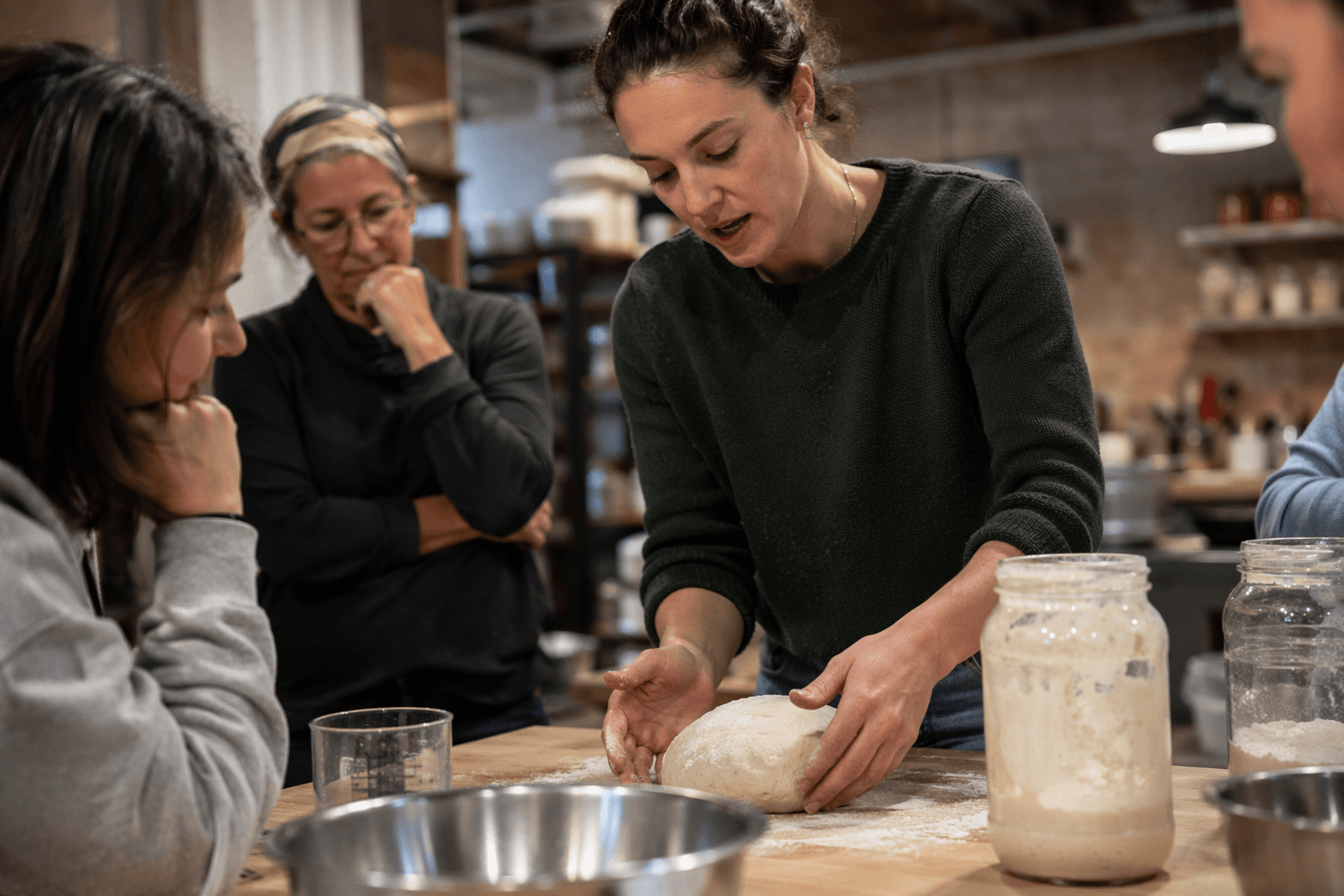
That matters for nervous beginners. A starter lesson can easily drift into jargon or internet folklore, but an extension-led class is built around everyday use: how to feed the culture, how to make something useful from discard, and how to recognize when dough is moving in the right direction. The point is not to overwhelm people with bread science. The point is to make sourdough feel manageable enough to repeat at home the next day.
What beginners can copy immediately
The strongest takeaway from a class like this is not a single recipe. It is a starter-care routine that can be used again and again. For a new baker, that means learning how much attention a starter actually needs, how to use discard before it piles up, and how to treat kneading as part of a simple, repeatable process rather than a test of intuition.
A beginner can leave with a short working framework:
- Feed the starter on a regular rhythm instead of guessing from one day to the next.
- Use discard in a recipe so the jar stays smaller and less wasteful.
- Watch timing, temperature and dough feel together, not as separate puzzles.
- Keep a classic sourdough formula simple enough to recognize what changes from batch to batch.
- Taste the finished bread while the lesson is still fresh, so the result is tied to the method.
That is the kind of classroom experience that can save a baker from the most common early mistakes. It gives people a feel for the process before they have a stack of failed loaves, and it does so in the same room where questions can be answered in real time.
A class built for the moment sourdough starts to feel possible
The appeal of the Brevard session is that it trims sourdough down to something a beginner can actually carry home and use. With a two-hour schedule, an in-person format, and hands-on work on starter feeding, discard baking and kneading, the class offers a cleaner path into the craft than another wide-open internet search ever could.
For anyone staring at a starter jar and wondering how to turn it into bread without wasting half the week, the answer here is refreshingly simple: show up at 8:45 a.m., learn the routine from the ground up, and leave with a method that is small enough to repeat and solid enough to stick.
This article was produced by Prism’s automated news system from verified source data, official records, and press releases, then run through automated quality and moderation checks before publishing. The system is built and supervised by the people who set the standards it runs under. Read our full AI policy.
Know something we missed? Have a correction or additional information?
Submit a Tip