Review: 'Probiotics in the Sourdough Bread Fermentation' — an accessible review of microbes, enzymes and functional properties
The "probiotic sourdough" label survives baking in marketing alone; here's what the microbiology actually changes in your flour, gluten, and gut.

The starter sitting on your counter is carrying roughly 100 million lactic acid bacteria per gram, outpopulating its yeast companions by a factor of ten. That imbalance is not a flaw. It is the whole story. A peer-reviewed review published in the journal *Fermentation*, authored by Ingrid Teixeira Akamine, Felipe R. P. Mansoldo, and Alane Beatriz Vermelho of the Federal University of Rio de Janeiro's Institute of Microbiology, synthesizes decades of sourdough microbiome research into a framework that should change how you think about fermentation time, temperature, and the "probiotic" claims printed on so many artisan loaf bags.
Here is the short version of what the science says: the bacteria in your finished loaf are dead. What they left behind is the point.
The Probiotic Myth You Need to Debunk Before You Bake
"Probiotic sourdough" is a marketing phrase that runs headlong into a basic constraint: delivering live probiotics through baked goods is technically challenging because oven temperatures kill most organisms. The World Health Organization defines probiotics as live microorganisms that confer health benefits when consumed in adequate amounts. A loaf baked at 230°C (446°F) does not meet that definition. Postbiotics, defined as non-viable microorganisms or their metabolites that offer health benefits, have emerged as a promising solution, and unlike probiotics, postbiotics do not present the risks associated with the viability of live bacteria.
Examples of postbiotic compounds present in sourdough include short-chain fatty acids (SCFAs), secreted proteins and peptides, bacteriocins, secreted biosurfactants, amino acids, flavonoids, exopolysaccharides (EPS), vitamins, organic acids, and other molecules. These compounds are real. They are measurable. And crucially, they are generated during fermentation, before the oven ever gets involved. The functional story of sourdough is therefore a pre-bake story: one driven by microbial chemistry acting on the flour matrix over hours and days.
What LAB and Yeast Are Actually Doing in Your Dough
Sourdough is a very complex ecosystem where heterofermentative LAB are the dominant organisms and coexist synergistically with yeasts, which are well adapted to the prevailing acidic environment and can grow to high concentrations of around 10^7 CFU/g, albeit lower than those of LAB at 10^8 CFU/g. More than 90 different LAB species have already been isolated from sourdough, including obligately and facultatively heterofermentative species and some homofermentative species.
The division of labor matters for your recipe decisions. LAB are your acidifiers and enzyme producers. Yeasts are your leaveners and secondary flavor contributors. The fermentation process generates mainly acids, alcohols, aldehydes, esters, and ketones, and this is the primary route of volatile compound formation in sourdough and bread crumb. The contribution of LAB to the flavor of sourdough bread is specifically associated with the production of lactic acid, which gives fresh acidity, and acetic acid, which gives sharp acidity.
Beyond flavor, the review by Akamine, Mansoldo, and Vermelho identifies three transformations happening in your dough during fermentation that directly affect the finished bread:
1. Gluten restructuring via proteolysis: Sourdough fermentation adjusts gluten structure through proteolytic action, meaning microbial enzymes are actively breaking down and rearranging gluten proteins.
Longer fermentation with an active LAB community produces a more extensible, open crumb structure, and for people with non-celiac gluten sensitivity, may reduce the immunoreactive peptide load in the final loaf.
2. Starch digestibility: Enzymatic pathways during fermentation transform how starch behaves in your body.
Acidification slows starch gelatinization and lowers glycemic response compared to yeasted bread. This is not a vague wellness claim; it is a measurable enzymatic effect on grain matrix structure.
3. Vitamin and mineral bio-accessibility: Sourdough fermentation increases the bio-accessibility of certain vitamins and minerals.
The mechanism is phytate degradation: phytase activity, boosted by the acidic fermentation environment, breaks down phytic acid, which otherwise binds iron, zinc, and magnesium and prevents absorption.
Temperature and Hydration: The Two Variables You Control
Understanding the LAB versus yeast dynamic gives you direct leverage over flavor. A wetter, higher-hydration starter promotes acid diffusion and favors lactic acid bacteria, leading to a milder flavor. Warm ferments produce lactic (smooth, creamy, yogurt-like) flavors and cold ferments produce acetic (sharp, tangy) flavors, and the longer each dough ferments under either warm or cold temperature conditions, the more pronounced those effects become.
In practical terms: if your last loaf was too aggressively sour and tangy, you likely ran a cool, stiff, or long bulk fermentation. If it tasted flat and milky with no real bite, a shorter cold retard or higher hydration may have pushed you deep into lactic territory. The Akamine et al. review frames these not as aesthetic preferences but as predictable metabolic outcomes. The microbial community in your starter responds to temperature and water availability in documented, reproducible ways.
A Weekend Experiment Worth Running
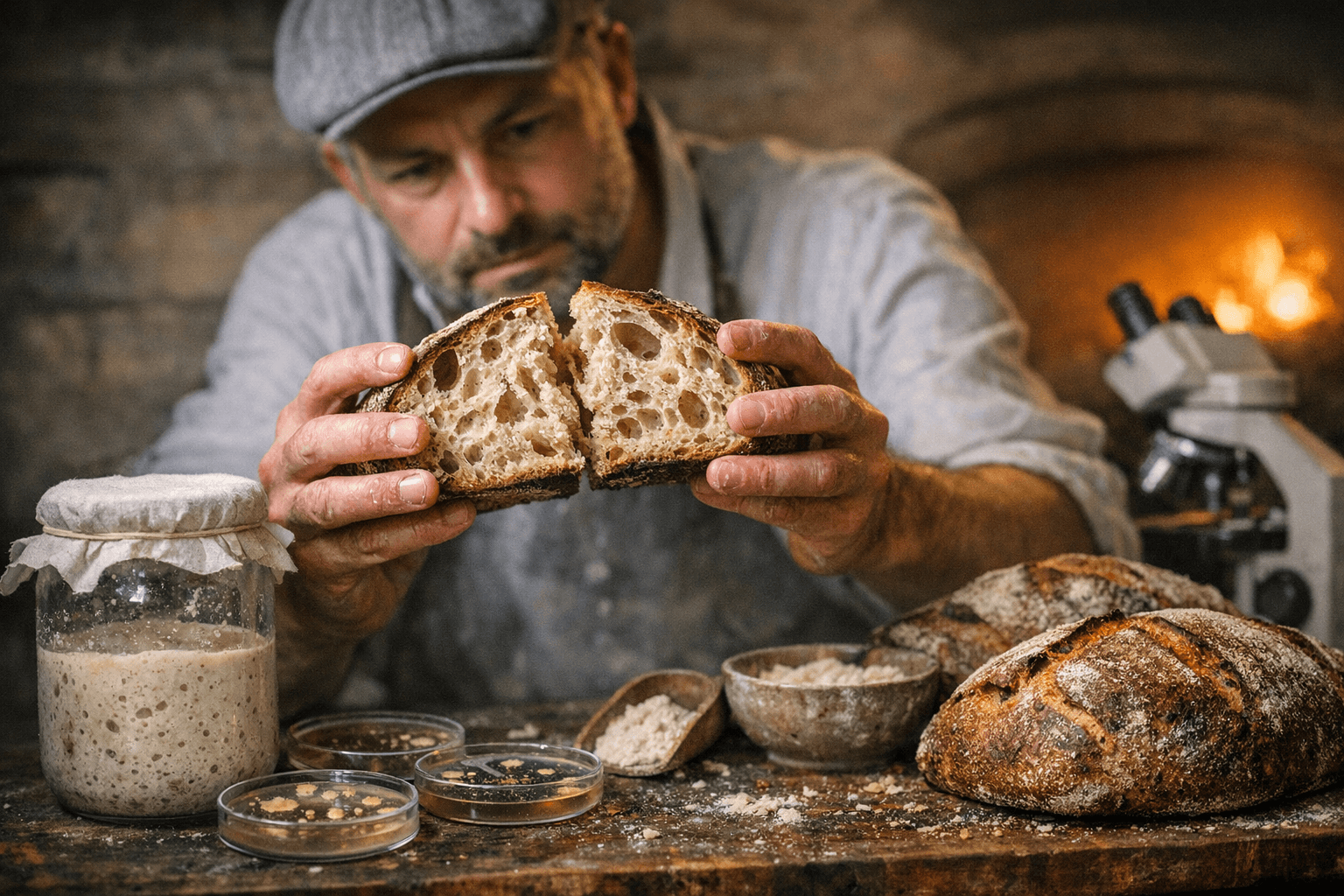
The cleanest way to internalize the LAB/yeast acid balance is to run a split-batch test with a single starter. Use the same flour, same hydration (say, 75%), same starter percentage (20%), and same total dough weight, then diverge only on fermentation temperature:
- Batch A: Bulk ferment at 26-28°C (78-82°F) for 4-5 hours. Shape, then retard in the fridge at 4°C for 10-12 hours.
- Batch B: Bulk ferment at 18-20°C (64-68°F) for 8-10 hours. Shape, then bake without a cold retard.
Batch A should produce a more open crumb, milder tang, and a flavor profile dominated by lactic notes. Batch B should yield tighter structure, pronounced acetic sharpness, and a more complex crust aroma. Taste them side by side. What you are observing is not gut feeling or baking intuition; you are watching the LAB community express different metabolic pathways in response to environmental input.
Inoculum Types and What They Mean for Starters
The review categorizes sourdough systems into three inoculum types: Type I, which are traditional continuously refreshed starters maintained at room temperature; Type II, industrial starters designed for large-scale production; and Type III, dried or commercially stabilized preparations. For the home baker, this classification helps decode claims about "professional-grade" or "heritage" starters sold online. A Type III preparation, however authentic its heritage marketing, behaves very differently from a living Type I culture that you have conditioned over weeks. The microbial diversity and the enzymatic activity that drive the three transformations above are products of that living, continuous fermentation history.
What Plausible Benefit Looks Like
The Akamine, Mansoldo, and Vermelho review is careful not to oversell. Many benefits of sourdough fermentation are mediated by fermentation-produced metabolites and enzymatic changes to the grain matrix, rather than by the delivery of live organisms. That framing is important. It means the digestibility improvement in your loaf is real and has a mechanism, but it is not because you ate live bacteria. It is because those bacteria transformed the flour before they died.
There is a growing demand from consumers for additive-free, safe, and nutritious foods and for bread with a longer shelf-life and less staling due to microbial spoilage, and sourdough offers advantages here. Several microorganisms, mainly LAB, have antimicrobial properties, which favors their use as probiotics and as bioprotective cultures in fermented products.
The antimicrobial properties are a practical benefit you can observe directly: a properly fermented sourdough, one with genuine LAB activity and a low pH, resists mold significantly longer than yeasted bread. That shelf-life extension is a postbiotic function, not a probiotic one, and it works whether or not a single organism in your loaf is alive when you slice it.
Starter Health as the Real Functional Variable
All three of the review's key transformations, proteolysis, starch modification, and phytate degradation, depend on a starter that is biologically active and well-conditioned. A sluggish, under-fed starter with a compromised microbial community will under-produce the enzymes and organic acids responsible for every benefit discussed here. Feeding schedule, flour type, hydration, and temperature are not just baking logistics; they are the environmental inputs that determine whether your LAB community is running a rich metabolic program or coasting on minimal activity.
The science in this review does not make sourdough more complicated. It makes your process choices more legible. When you decide to retard overnight, use whole wheat flour, or let a levain ripen an extra two hours, you are making decisions that have known microbial consequences. Understanding those consequences is the difference between following a recipe and actually baking.
This article was produced by Prism’s automated news system from verified source data, official records, and press releases, then run through automated quality and moderation checks before publishing. The system is built and supervised by the people who set the standards it runs under. Read our full AI policy.
Did this article answer your question?