Richard Hart shares sourdough secrets at Claridge’s new Mayfair bakery
Richard Hart’s Mayfair bakery turns sourdough into a lesson in craft, proof and provenance, with home-baker takeaways hidden inside the luxury.

A bakery that makes the process visible
Claridge’s Bakery has brought a rare kind of spectacle to Brook’s Mews in Mayfair: not just finished loaves, but the craft behind them. The new standalone space, tucked behind Claridge’s hotel, opened in January 2026 and quickly drew queues before 7.30am, with rain-soaked customers lining up for sourdough loaves and iced fingers. It is a luxury address, but the draw is not exclusivity alone. The appeal is watching a master baker turn technique, memory and provenance into something you can actually buy before breakfast.
The bakery is open Monday to Friday from 8am to 4pm, and Saturday and Sunday from 9am to 4pm, which makes it feel less like a velvet-rope patisserie and more like a working neighborhood bakery with Mayfair polish. That tension is the point. Claridge’s says the project is about classic British baking, but Richard Hart’s sourdough sits at the center of it, giving serious home bakers a useful reminder: the best bread is not only about a hot oven and a well-fed starter. It is about standards, sourcing and the discipline to make the process legible.
Why Richard Hart’s sourdough carries weight
Hart is not arriving in Mayfair as a newcomer with a trend-chasing recipe. He is Executive Baker & Creative Director at Claridge’s Bakery, and his career explains why his sourdough lesson matters. He spent seven years as head baker at Tartine in San Francisco, then founded Hart Bageri in Copenhagen in 2018 with René Redzepi of Noma, before later launching Green Rhino in Mexico City. That is a baker’s résumé built on iteration, not gimmick.
His 2024 book, *Richard Hart Bread: Intuitive Sourdough Baking*, runs 304 pages and contains more than 60 recipes. That scale tells you something useful right away: Hart works from method, not myth. For home bakers, the takeaway is that elite sourdough is rarely a single secret trick. It is a system, one that combines repeatable technique, close attention to ingredients and the confidence to treat bread as craft rather than guesswork.
The first lesson: sourdough starts with ingredient provenance
One of the clearest signs that Hart’s approach is more than aesthetics is how often he talks about where the ingredients come from. He has said he visited the fields where his flour comes from, naming Molino Paolo Mariani in Le Marche, Italy. He has also identified the farm supplying the free-range pork for the sausage rolls, Jimmy Butler’s Blythburgh farm. That level of traceability matters because it changes the baker’s relationship to the dough.
For home bakers, the practical lesson is simple: the flour is not just a background ingredient. If you want better sourdough, start paying attention to the flour’s behavior, not only its label. Hart’s emphasis on provenance suggests that consistency comes from knowing your inputs well enough to repeat the result, a standard that matters even more than luxury branding. A strong sourdough routine begins with flour you trust, water you understand and a process you can reproduce week after week.
The second lesson: a bakery should show its work
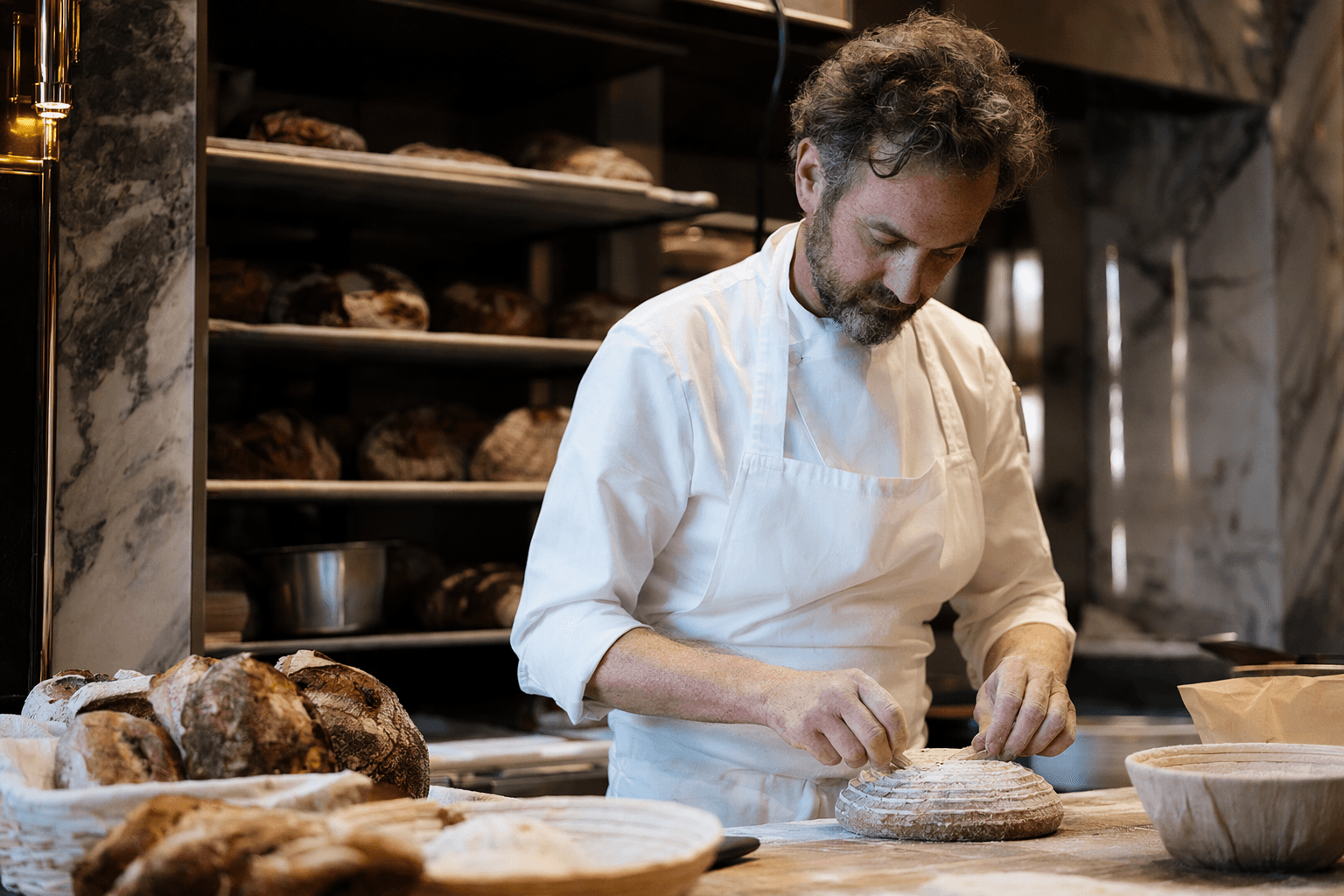
Hart has said he wants customers to see the craft of the team at work, and that idea cuts straight to the heart of sourdough improvement. In a serious bakery, the proofing, shaping and baking are part of the experience, not hidden behind the counter. The bakery was designed with John Pawson, which gives the room a clean architectural frame, but the real message is transparency: good bread should look like skilled labor, not a mystery.
That is a valuable mindset for home bakers. If a loaf keeps failing, the answer is usually in the process, not the drama. Hart’s approach encourages you to observe the stages more carefully: how the dough feels after mixing, how much structure it has before shaping, how the final proof compares with previous batches. The lesson is not to copy a luxury bakery’s styling. It is to adopt its discipline of visible, accountable craft.
Why the menu matters beyond nostalgia
Claridge’s Bakery is not a one-note sourdough counter. The menu moves from sourdough bloomers and granary loaves to jam tarts, custard tarts, Belgian buns, iced fingers, Marmite cheese straws, Hampshire pork scotch eggs, sausage rolls, Bakewell tarts, lardy cake and malt loaf. There are also Jammy Dodger tarts, which one report priced at £5, alongside a £6 sourdough bloomer and a £9 bacon roll. The range matters because it shows how Hart is positioning sourdough inside a broader British baking vocabulary rather than treating it as a standalone status symbol.
That is another practical clue for home baking: great sourdough does not have to live apart from the rest of your baking. Hart’s menu links crusty bread to the comfort of familiar classics, from fondant-fancy childhood memories to Bakewell tarts at his grandparents’ house. The result is a bakery that feels heritage-minded without being stiff, and that balance is part of its appeal. The sourdough is elevated, but it is still part of daily life, breakfast counters and afternoon tea trays.
Luxury prices, accessible habits
The pricing is unmistakably Mayfair. A sourdough bloomer at £6 and a bacon roll at £9 place Claridge’s Bakery in a different bracket from the average high-street loaf. But the queues outside the shop before 7.30am suggest something important: people are not only buying luxury, they are buying participation in a craft-led routine. The bakery’s opening hours support that idea, offering an early window for regulars, hotel guests and bread obsessives alike.
That is where the story becomes bigger than a hotel opening. Hart has described the project as the moment when the work, recipes and ideas finally meet the people they are meant for. For sourdough bakers at home, that is the real takeaway. Master-level bread is not defined by distance from everyday life. It is defined by whether the baker can make technique, provenance and flavor come together in a way that feels both exacting and generous.
What to borrow from Claridge’s Bakery
If you want the most useful lessons from Hart’s Mayfair bakery, they are not complicated.
- Treat flour source as part of the recipe, not an afterthought.
- Make your process repeatable enough that you can see what changes from bake to bake.
- Pay attention to structure and proof, not just flavor and crust.
- Keep sourdough connected to the wider baking tradition around it, from loaves to tarts and enriched doughs.
- Value transparency, because seeing the work sharpens your own standards.
Claridge’s Bakery shows sourdough moving into a bigger phase, one where technique, heritage and visibility matter as much as the loaf itself. Hart’s Mayfair opening is luxurious on the surface, but the real value for bakers is more democratic than that: a reminder that the best bread comes from rigorous habits, clear ingredients and a willingness to let the craft speak for itself.
This article was produced by Prism’s automated news system from verified source data, official records, and press releases, then run through automated quality and moderation checks before publishing. The system is built and supervised by the people who set the standards it runs under. Read our full AI policy.
Did this article answer your question?