Canyonlands Off-Road Guide: Permits, Gear, and Safety for Iconic Trails
Canyonlands demands a true low-range 4WD rig, not your AWD SUV — and that's just to get a permit. Here's everything you need before you turn off the pavement.

Fewer than 50 vehicles are allowed on the White Rim Road per day. That single number tells you everything about the caliber of adventure waiting inside Canyonlands National Park — and exactly how much planning stands between you and one of the Southwest's most coveted off-road experiences.
Canyonlands is a wilderness of countless canyons and fantastically formed buttes carved by the Colorado River and its tributaries, divided into four districts: Island in the Sky, The Needles, The Maze, and the rivers themselves. Three of those districts contain the park's iconic backcountry roads: White Rim Road, Shafer Trail, and Elephant Hill. Each one rewards a well-prepared rig and punishes an underprepared one.
Know the Routes Before You Commit
The 100-mile White Rim Road loops around and below the Island in the Sky mesa top, delivering expansive views, with the steep, exposed sections of the Shafer Trail, Lathrop Canyon Road, Murphy Hogback, Hardscrabble Hill, and the Mineral Bottom switchbacks making the loop a challenging adventure for both vehicles and mountain bikes. Driving the full loop may take over 12 hours whether driving or riding. The road is very exposed with little shade and no water, so don't rely on other visitors for assistance.
Tucked between Moab and Canyonlands National Park, the Shafer Trail is a must-drive for those craving adventure: 19 miles of dirt road that requires a high-clearance 4x4 vehicle, with steep switchbacks and narrow roads that will have you on the edge of your seat. The trail is named after the Shafer family, Mormon pioneer settlers, and starting in 1916, John "Sog" Shafer used it to move cattle from summer pastures on the mesa top to winter ground on the White Rim sandstone. After Canyonlands was established as a national park in 1964, the trail transitioned from a ranching and mining road to a recreation route — though its demands on driver skill have changed little.
Elephant Hill, accessed from the Needles District, is the hardest of the three. With steep drops, hairpin turns, and multiple ledges, Elephant Hill is rated as one of the most difficult 4-wheel drive roads in Utah. It is one of the premier rock crawling experiences in America's National Parks, featuring significant intermediate rock crawling as drivers wind their way through the twisted canyons of the Needles district. Named obstacles include Devil's Pocket, SOB Hill, and the Silver Staircase, with steep drives up and down slickrock, small boulder gardens, and ledges that require care in navigating. The trail must be driven in a clockwise direction, as much of it is too narrow for any form of passing.
Vehicle Requirements: This Is Not AWD Territory
The park's vehicle rules are non-negotiable and genuinely specific. A high-clearance, low-range 4WD vehicle is required, and the park does not permit all-wheel drive (AWD), ATVs, UTVs, or OHVs, even if street legal and registered, on these roads. Motorcycles must be equipped and licensed for interstate travel.
This distinction matters: a Subaru Outback or RAV4 with AWD will not satisfy park regulations for White Rim Road or Elephant Hill, regardless of how capable it feels on pavement. A high-clearance, four-wheel-drive vehicle with low range is required for Elephant Hill, and stock sport utility vehicles are not recommended. The Needles roads in particular have a reputation for breaking rigs that are underbuilt. The Needles offers a more remote backcountry experience, and inexperienced drivers should not attempt the backcountry roads there.
For Shafer Trail to Potash Road specifically, vehicle requirements are slightly more relaxed in practice, though 4WD with low range is still strongly recommended. High-clearance 4WD vehicles with a low range gear (4LO) are highly recommended, ATVs, OHVs, or UTVs are not permitted inside the park, and backcountry driving conditions can change rapidly after rain or snow.
The Permit System, Explained
Understanding which routes require permits saves both time and a wasted drive to the trailhead.
The park requires a day-use permit for each four-wheel drive vehicle, motorcycle, and bicycle on the White Rim Road, Elephant Hill, Salt Creek/Horse Canyon, and Lavender Canyon. A day-use permit is NOT required to drive Shafer Trail to Potash Road.
A reservation may only be made up to 24 hours in advance of your trip start date for day-use permits. Half of the 50 permits allowed each day on the White Rim Road, plus any permits not reserved online for all roads, are available in person at visitor centers the day of the trip. That means competition for those online slots is real — plan accordingly.
For multi-day trips, the permit structure shifts. A permit is required year-round for all backcountry overnight stays in the park, and you may stay up to 14 consecutive nights. The overnight permit carries a non-refundable $36.00 reservation fee plus a $5 per person per night recreation fee. The per-person fee is refunded for trips canceled at least 3 days before the start date, but you may not change a permit within 7 days of the trip start date, though you may cancel and rebook.
Up to 3 vehicles or motorcycles are permitted to travel together; groups larger than that must separate by at least 30 minutes or 0.5 miles to reduce congestion, noise, and to maintain a wilderness experience for all.
On top of permit fees, admission to Canyonlands National Park costs $30 per vehicle, and the pass is good for 7 days. The America the Beautiful annual pass covers this entry fee and pays for itself quickly if Canyonlands is part of a larger Southwest loop.
Timing and Seasonal Conditions
During winter, temperatures can get extremely cold and icy; summer can be dangerously hot; and early May to late June is flood season with a risk of monsoon rains. The most popular times to visit are spring and fall, when temperatures are milder.
During high water conditions on the Green River from May through June, sections of road on the west side of the White Rim can flood, making a complete loop impossible. If you're planning the full White Rim circuit, avoid those months or build contingency days into your itinerary.
Shafer Trail is open year-round but can close in winter months due to snow, and drivers should not attempt it in wet conditions or if rain or snow is forecasted. Always check the park's road conditions page before departure.
Gear and Recovery Essentials
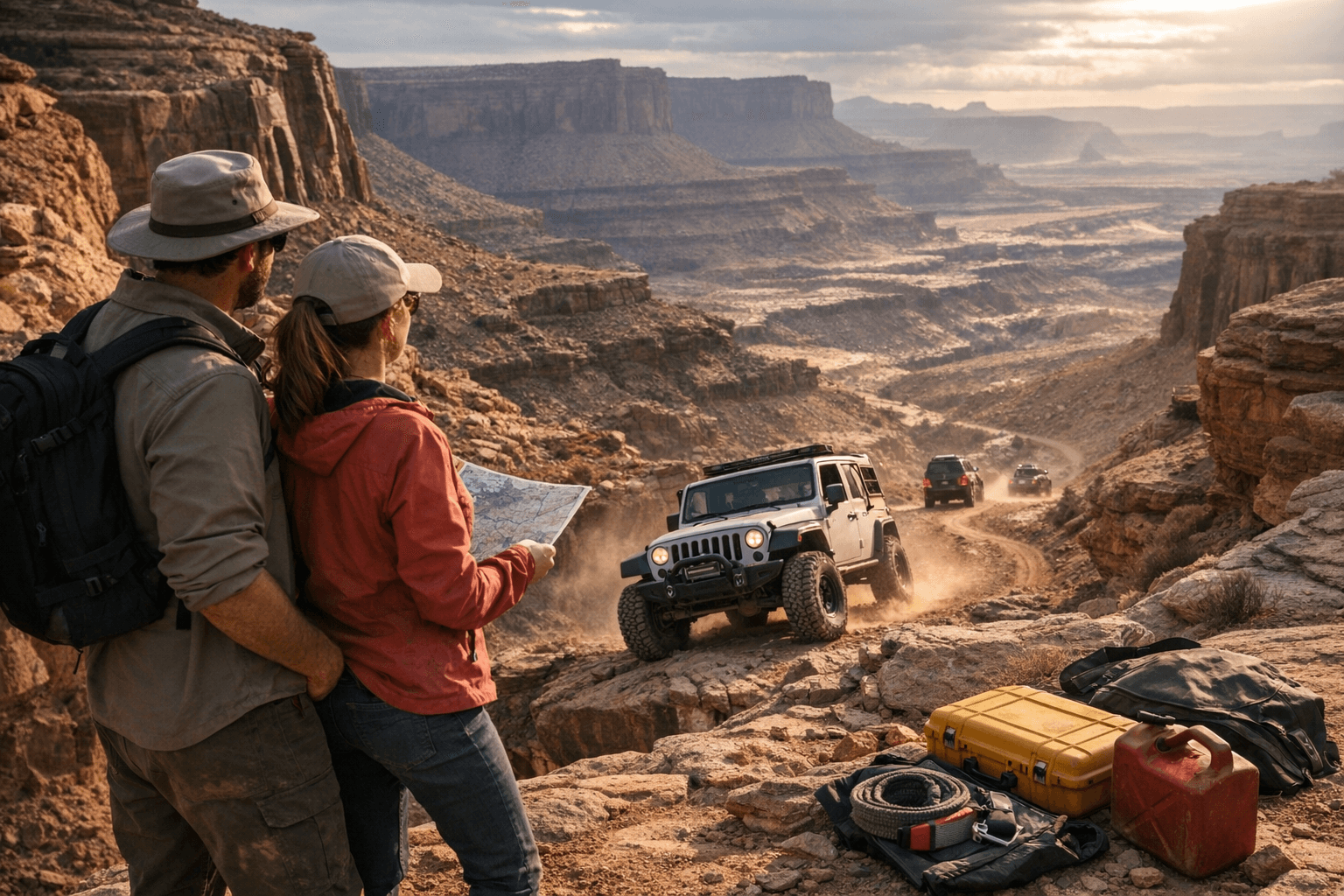
The park itself offers a stark advisory worth taking seriously: plan to travel in groups of two or more self-rescue capable vehicles, because towing recovery costs can exceed $2,000.
A solid recovery kit for Canyonlands backcountry roads should include:
- A recovery kit with a recovery strap, snatch block, shackles, tree trunk protector, and gloves
- Traction boards (such as Maxtrax), which provide a raised, grippy platform to keep the vehicle from spinning when stuck in sand
- A full-size spare tire and tire repair kit — Canyonlands slickrock and loose rock are ruthless on sidewalls
- Extra water and fuel, which are imperative on longer trips or in extremely remote locations
- A satellite communicator — a safety net not just for you, but for your passengers — and don't hit the trail without one
Water is the most critical consideration in Canyonlands backcountry. There are very few reliable water sources, and you should plan to carry as much water as possible, up to 1 gallon (4 liters) per person per day for long trails.
Cell signal is spotty at best in the eastern areas of the park and unreliable overall; satellite communication works well. Download offline maps before you leave Moab. Paper topographic maps, available at park visitor centers, remain the most reliable backup.
Campsite Planning for Overnight Runs
There are ten camping areas with a total of 20 individual campsites on the White Rim Road. Drivers planning a two-day run should reserve a campsite near the halfway point: Gooseberry (2 sites), White Crack (1 site), and Murphy Hogback (3 sites) are all well-positioned for this. A three-day itinerary calls for two different campsites, one near the beginning and one near the end of the drive.
Moab serves as the base for all practical logistics: hotels, restaurants, groceries, fuel, outfitters, and 4x4 rentals are all in town. Inside Canyonlands you'll find viewpoints, trails, and pit toilets, but virtually no services. Stock up on everything before the gate.
One Final Rule the Terrain Enforces
Canyonlands does not grade on a curve. The steep, exposed sections of the Shafer Trail, Lathrop Canyon Road, Murphy Hogback, Hardscrabble Hill, and the Mineral Bottom switchbacks make the White Rim loop a genuinely challenging adventure for both vehicles and mountain bikes. A rig that handles Moab's front-country jeep trails comfortably may still be outmatched by Elephant Hill's stair-step drops and mandatory backing maneuvers on a one-way, no-passing road. The permit system protects the wilderness and limits daily traffic to a manageable number — but once through the gate, you're on your own. Show up with the right truck, the right permits, enough water for the worst-case scenario, and a second vehicle you'd trust to pull you out. The canyon will take care of the rest.
This article was produced by Prism’s automated news system from verified source data, official records, and press releases, then run through automated quality and moderation checks before publishing. The system is built and supervised by the people who set the standards it runs under. Read our full AI policy.
Did this article answer your question?