Colorado drought and low reservoirs reshape spring and summer travel plans for skiers and boaters
Frisco Bay Marina's boat ramp is shuttered all summer, ski resorts are closing weeks ahead of schedule, and snowpack in the South Platte Basin hit a record-low 42% of normal - here's how to reroute.
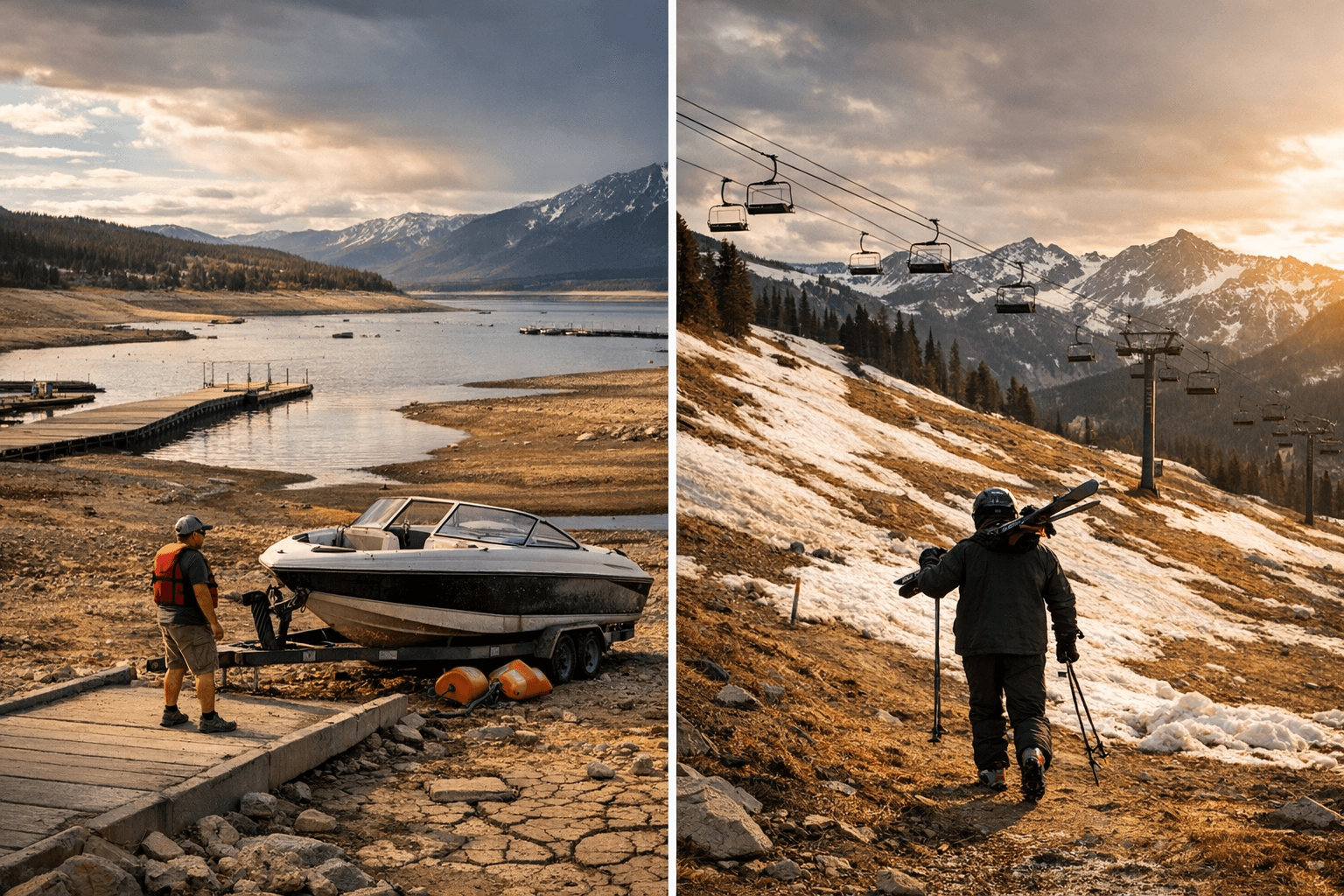
The Frisco Bay Marina on Dillon Reservoir has closed its boat ramp and dock slips for the entire 2026 summer season. Not a delayed opening. Not reduced capacity. Closed, with Denver Water's modeling projecting that the reservoir will never reach the 9,006 feet of elevation needed to operate the docks, and the bay bottom potentially remaining exposed through Labor Day. That single sentence should rewrite every summer itinerary that assumed a Summit County lake day.
This is what an extreme drought year looks like on the ground: not a slow degradation of experience, but a hard stop on specific infrastructure that trip packages were built around. The 2026 season is asking skiers, boaters, and the operators serving them to make a genuine planning pivot, not just lower their expectations.
The numbers driving the disruption
Snowpack as of March 23 was at or near record lows: the Colorado River Basin within Denver Water's collection system stood at 55% of normal, and the South Platte River Basin at 42% of normal. In Denver Water's decades of records, both basins ranked at their worst on record for March 23. The Blue River Basin, which encompasses all of Summit County, had snow-water equivalent at the 2nd percentile as of mid-February, meaning 98 out of 100 winters on record produced more snowpack than this one. Denver Water announced Stage 1 drought restrictions on March 24, folding a municipal water crisis directly into what was already a recreation planning crisis.
The share-worthy number here is the South Platte Basin figure: 42% of normal, a record low, is not a bad snow year. It is a structurally different season that invalidates assumptions baked into last year's packages.
Ski trips: what still works, what doesn't
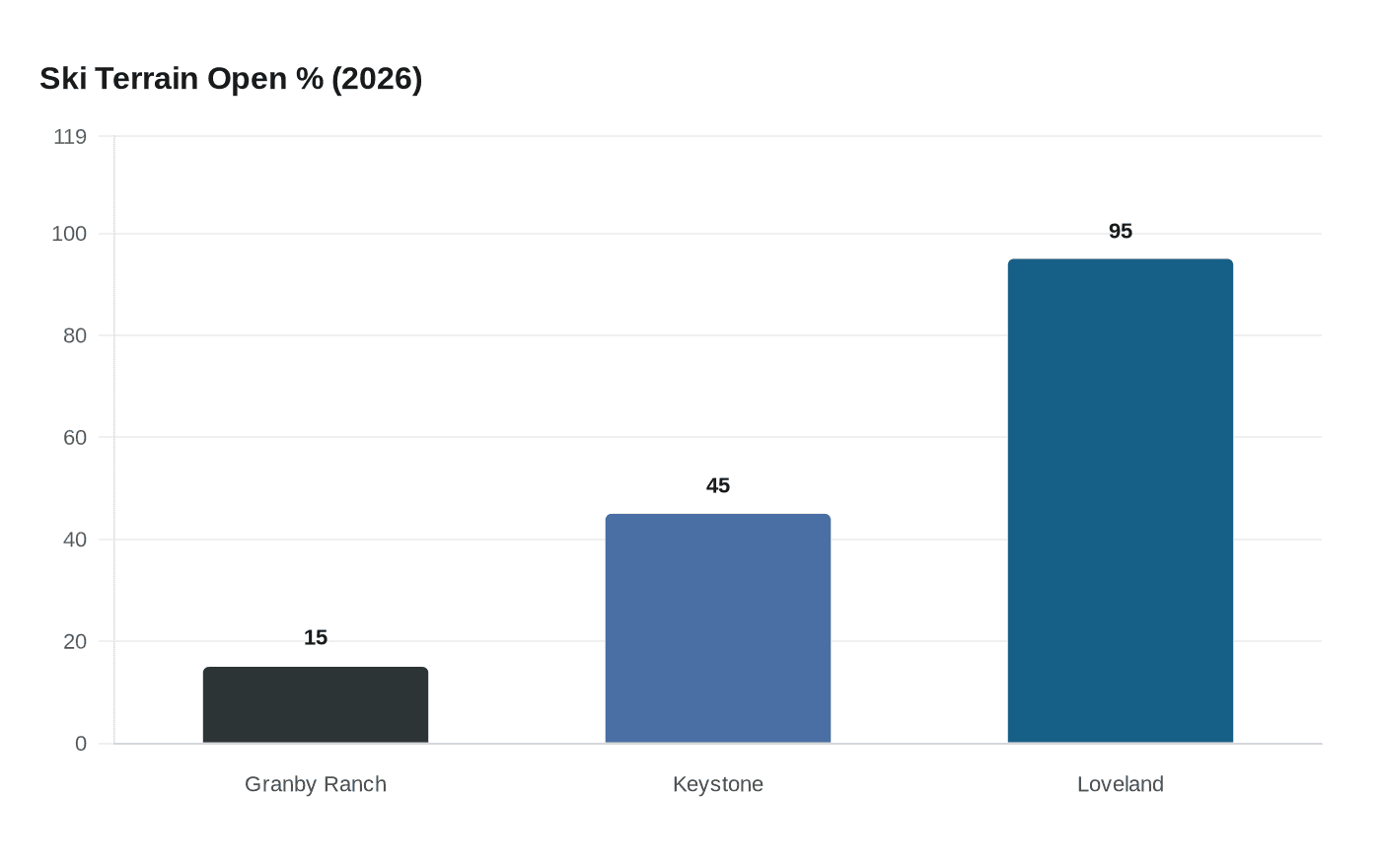
Most Colorado ski resorts did not get enough snow this season to open 100% of their terrain at any point, and warm March temperatures have been accelerating closures well ahead of historical windows. Copper Mountain announced an April 26 closing date, several weeks earlier than its May 11 closing date last year. Beaver Creek called its season on March 29, compared to April 13 the year before. Granby Ranch wrapped on March 29 with just 15% of terrain open.
The resorts still holding on are doing so with thin margins. Keystone was projecting an April 5 close with about 45% of terrain available and a 34-inch base. Loveland, historically one of Colorado's longest-season areas, was reporting 95% terrain open with a 41-inch base heading into early May. For anyone with a late-season ski trip still on the books, Loveland and Arapahoe Basin represent the last credible Plan A options. Book those with flexible cancellation windows and commit only after checking daily conditions, because the trajectory this season rewards caution over optimism.
The question worth asking before booking any remaining lift-served days is not simply "is it open?" It is whether 45% terrain and a 34-inch base justifies the drive, lodging, and lift ticket cost on a specific date. For many spring packages, that calculation has shifted.
Summit County boating: replace your Plan A now
Denver Water's guidance confirms Dillon Reservoir won't fill enough for the boat ramp and slips to operate this summer due to what the agency is calling "extreme drought conditions." Its modeling shows the reservoir is unlikely to fill, with the water level never reaching the 9,006 feet of elevation needed to operate the docks. The projection is that the bay bottom could remain exposed throughout the summer season.
The marina's 160 slip customers are being asked to store their boats on-site in limited capacity or find offsite storage for the season. If your itinerary included a Dillon Reservoir day as an add-on to a Summit County ski or mountain biking package, that activity needs a named replacement now, not a contingency note buried in trip terms.
Lake Powell: the Bullfrog reshuffle
At the other end of the Colorado system, Glen Canyon National Recreation Area is managing a significant logistical shift that will affect every houseboat trip built around Bullfrog Marina. The National Park Service is finalizing plans for a new, permanent long-term ramp at Stanton Creek, designed to function at lower lake elevations. Due to the project's size and complexity, that ramp will not be completed for the summer 2026 season. In the interim, Aramark is temporarily relocating the Bullfrog Marina and its fuel dock into deeper water near Halls Crossing Marina to maintain access through the summer.
This means the launch experience, services location, and dock geometry that repeat visitors know from prior Powell trips no longer apply for 2026. The Bullfrog North Launch Ramp is only operable for smaller motorized vessels at 3,525 feet elevation, and accessible to large vessels including houseboats at 3,529 feet. Those thresholds are not guaranteed. The NPS is explicitly advising boaters to check current lake levels, ramp status, and operating conditions before traveling. Build that check into your pre-trip protocol, ideally 72 hours out and again the day before departure.
Land-based services at Bullfrog remain open, and Lake Powell is still viable for water-based recreation. But the margin for a frictionless houseboat launch is narrower than it has been in years, and that should be reflected in booking language.
Plan A / Plan B: a decision framework by window
- Now through mid-April: Late-season skiing is viable only at Loveland and Arapahoe Basin, with daily condition checks required. Any Summit County boating plan needs a full replacement - Dillon is closed for the season.
- May through June: Monitor Lake Powell ramp status weekly via the NPS alerts page. The Bullfrog/Halls Crossing relocation should be operational, but verify before travel. This window is the strongest for high-elevation hiking and wildflower routes in the Rockies, where an earlier-than-normal snowmelt is opening trails above 10,000 feet ahead of schedule.
- July through August: Houseboat access through the relocated Halls Crossing-area services should be viable if levels hold. Build itineraries with an explicit 48-hour cancellation threshold tied to ramp operability metrics, not weather. If Lake Powell falls below operational thresholds, canyon-based substitutes in Grand Staircase-Escalante, Capitol Reef, and the San Juan Mountains all deliver comparable Southwest experiences without a launch ramp.
Resilient alternatives to anchor summer marketing
The experiences that hold value regardless of snowpack or reservoir levels are worth moving to the front of any summer product lineup. High-elevation hikes above 10,000 feet will see an earlier wildflower window in 2026 as snowmelt accelerates. Canyon routes through southern Utah, including Canyonlands, Arches, and the Grand Staircase corridor, are structurally unaffected by reservoir conditions. Scenic drives along the Million Dollar Highway and the San Juan Skyway deliver the mountain experience that doesn't require a working boat ramp or a minimum base depth.
For off-road travelers, the shoulder-season window between snowmelt and monsoon is opening earlier than usual. High-clearance routes in the Moab corridor, along the Kokopelli Trail, and into the La Sal Mountains will be accessible sooner this spring. That is a genuine opportunity for operators willing to pivot their messaging before the season fully arrives.
What operators need to do before Memorial Day
The clearest risk this season is a product built on 2024 or 2025 assumptions. Every itinerary that includes a Dillon Reservoir boat day, a Bullfrog Marina houseboat launch, or late-season Colorado lift access needs an explicitly named Plan B, with trigger conditions written into booking terms rather than buried in footnotes.
Practical steps worth taking before the season opens:
1. Add daily ramp and lift status checks to pre-trip communications for any Colorado mountain or lake itinerary.
2. Establish rebooking or refund thresholds tied to operational metrics (dock elevation, terrain percentage) rather than vague weather language.
3. Shift summer marketing emphasis toward canyon hikes, high-elevation trails, and off-road routes - experiences with no dependency on reservoir fill levels.
4. Communicate proactively: guests who hear about a boat ramp closure from your team two weeks out are manageable; guests who arrive at a closed marina are not.
The 2026 season is not a write-off for Colorado and Southwest adventure travel. It is a season where the gap between a great trip and a catastrophically wrong expectation is narrower than usual. The operators who name that honestly in their booking language and itinerary design now are the ones who will have repeat customers in 2027.
This article was produced by Prism’s automated news system from verified source data, official records, and press releases, then run through automated quality and moderation checks before publishing. The system is built and supervised by the people who set the standards it runs under. Read our full AI policy.
Did this article answer your question?