Conservation Groups File Appeal Over Water‑Export Pipeline That Critics Say Would Drain Great Basin Aquifers
Conservation groups appeal a 66-mile Utah pipeline that hydrologists say could drain Great Basin springs for decades before the damage becomes visible above ground.
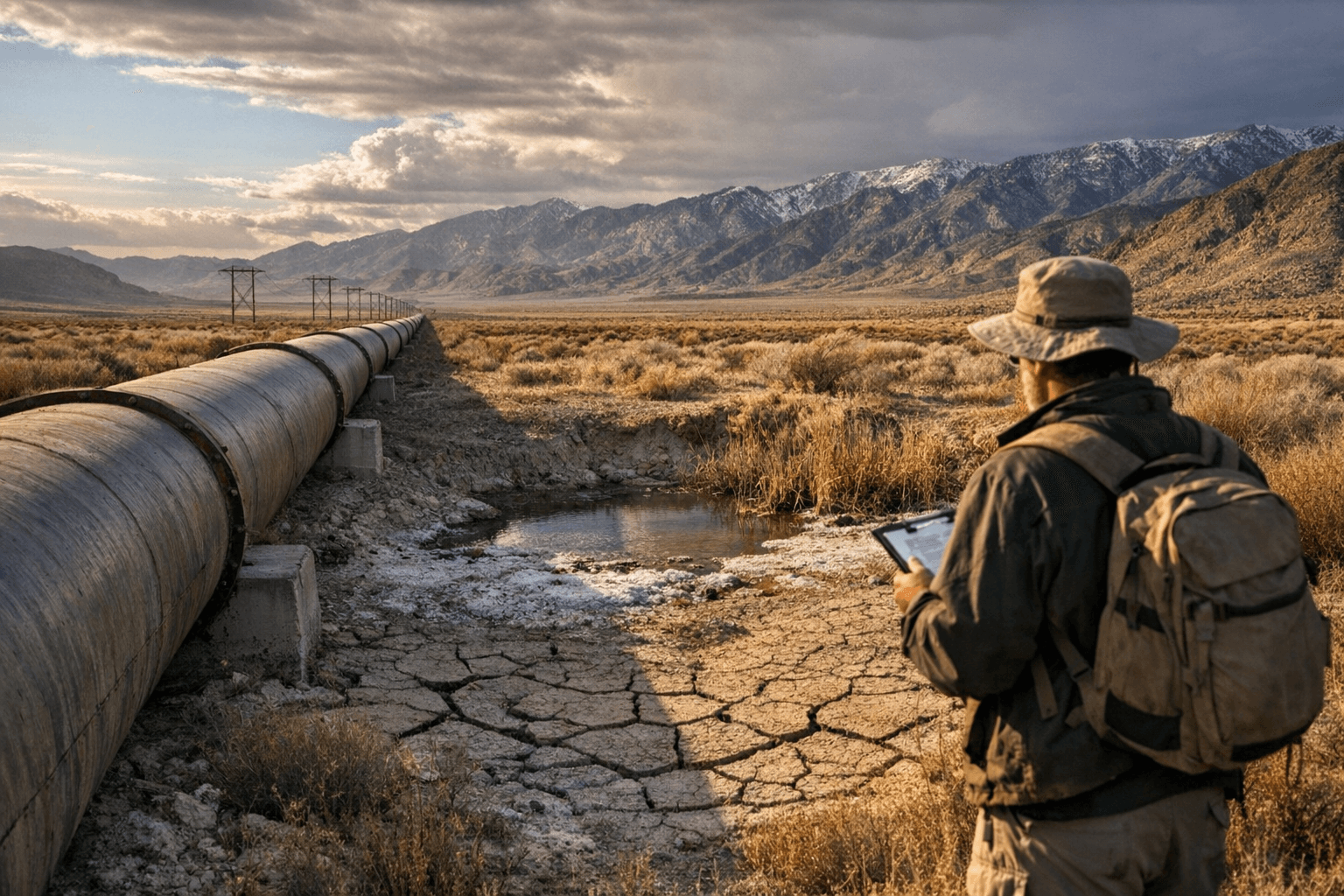
The springs that keep a Great Basin desert route viable, the ones you plan your camp around and cross a mile of alkali flat to reach, could be drawing down for 20 to 30 years before the surface shows any sign of it. That lag time is not a projection from critics. It comes from the project proponent's own documentation: the Central Iron County Water Conservancy District acknowledged that large-scale aquifer pumping at this depth "can sometimes take 20 to 30 years" before the drawdown becomes visible.
The Center for Biological Diversity, the Indian Peaks Band of the Paiute Tribe of Utah, and the Great Basin Water Network filed separate administrative appeals on April 1, challenging the Bureau of Land Management's March 2 Record of Decision approving the Pine Valley Water Supply Project. The primary challenge, a 528-page filing submitted to the Interior Board of Land Appeals, includes a request for a stay. The board has 45 days to grant or deny it. What the project would do in that meantime: pump 15,000 acre-feet of groundwater annually from Utah's West Desert and pipe it 66 miles to Cedar City for municipal, agricultural, and industrial use, driven by the Central Iron County Water Conservancy District's push to supply the region's growth.
The watch list for anyone running corridor routes through the Nevada-Utah border country is specific. Independent hydrologic modeling cited in the appeals projects hundreds of feet of aquifer drawdown in Pine Valley, with cascading impacts across Snake Valley, Wah Wah Valley, Tule Valley, the Sevier Desert, and the Escalante Desert. Two federally protected anchors sit inside that cone: Great Basin National Park in Nevada and Fish Springs National Wildlife Refuge in Utah. Both are touchstones for multi-day traversals and the kind of water-scarce dispersed camping where a reliable spring is not incidental to the route; it is the route.
Megan Ortiz, staff attorney at the Center for Biological Diversity, said the pipeline "would put plants and animals in our parks and refuges at real risk." Kyle Roerink, executive director of the Great Basin Water Network, framed the legal challenge plainly: "We aren't merely appealing a regulatory decision. We are appealing to common sense and reason."
The procedural complaint sharpens the timeline concern. The BLM released its final environmental analysis late on a Friday in February, then issued its Record of Decision on March 2, giving the public fewer than the standard 30 days to scrutinize a project with consequences that will unfold across state lines for generations. Critics note the project echoes the Southern Nevada Water Authority's long-running attempt to export groundwater from the same region for Las Vegas growth, a fight that stretched through years of litigation before the project was ultimately stopped.
The 45-day stay window is the first hard decision point. If the Interior Board of Land Appeals grants it, construction planning halts while the full appeals are adjudicated. If denied, the project moves forward on a drawdown timetable that, by the district's own reckoning, will still be invisible when today's trip-planning maps are long outdated.
This article was produced by Prism’s automated news system from verified source data, official records, and press releases, then run through automated quality and moderation checks before publishing. The system is built and supervised by the people who set the standards it runs under. Read our full AI policy.
Did this article answer your question?