Death Valley rangers warn hikers to carry water and avoid summer heat
Death Valley is telling summer visitors to rethink the hike entirely: keep it to early hours, low elevations are a bad bet, and one gallon of water a day is the floor.
Summer in Death Valley is not a hiking season, it is a decision test
The practical message from Death Valley rangers is blunt: if you are planning a summer trip, rethink when you hike, where you hike, and whether you hike at all in the low country. The warning landed with extra weight on the final day of Heat Awareness Week, and it matches what experienced desert travelers already know the hard way, Death Valley in summer is less about mile counts and more about staying alive long enough to enjoy the drive out.
What the park is really telling you
Death Valley National Park says summer temperatures can hit 130°F, and even the night does not offer much relief, with lows up to 90°F. That matters because the park is already the hottest, driest, and lowest national park in the United States, and Badwater Basin sits 282 feet below sea level. Add an average normal rainfall of just 1.94 inches, and you are not dealing with a place that forgives bad timing or sloppy planning.
The park’s hiking guidance is simple and worth taking literally: the best time to hike is November through March. Summer heat is dangerous in the lower elevations, and low-elevation hikes should be saved for cooler winter days. In other words, if your plan was to “beat the heat” with a dawn walk, that is not the same as making a safe hike in Death Valley.
How to plan a summer day that still works
If you are committed to being in the park during the hot months, the safest move is to keep outdoor time short and close to your vehicle. The National Park Service advises staying within a 10-minute walk of an air-conditioned vehicle in summer, which is a good reality check for route planning. Once you move beyond that, you are no longer sightseeing casually, you are managing a heat exposure problem.
The park also says not to hike at low elevations after 10 a.m., and that rule should shape your whole itinerary. Early morning is your window; after that, replace hiking with a scenic drive, a shaded stop, or a higher-elevation plan outside the hottest basins. Travel only on paved roads in summer, because the combination of heat, isolation, and vehicle trouble is exactly how a day trip turns into an emergency.
What to carry, and how much is actually realistic
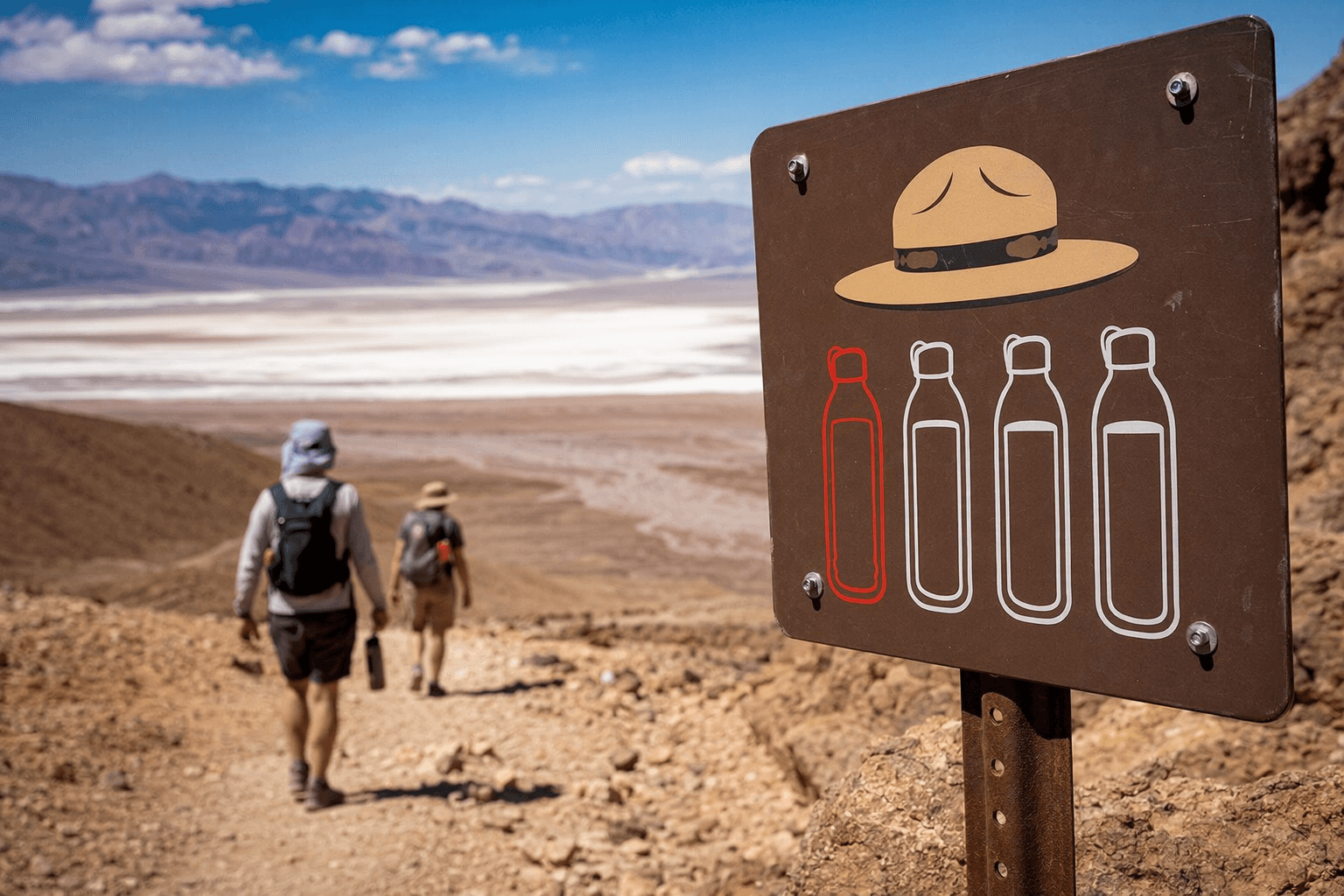
Water is the first line of defense, but it is not enough by itself. The park’s summer advice says to drink at least one gallon of water per day, and to pair that with salty foods or electrolyte drinks. That salty-snack advice is not just desert folklore; when you are sweating hard in furnace-level heat, replacing sodium matters as much as plain water.
For a day of driving with short stops, one gallon per person is the baseline, not the bragging point. If you are walking at all, especially before sunrise or near low elevations, bring more than you think you need and keep electrolytes handy. The mistake I see people make in the desert is assuming a liter bottle and a good attitude will cover a “light hike”; in Death Valley, that is wishful thinking dressed up as confidence.
Trails and places to think twice about
The dangerous part of Death Valley is that some of its most iconic names sit right in the hot zone. Badwater Basin, Zabriskie Point, the Badlands Loop, Natural Bridge Trailhead, and the open flats around Mesquite Flat Sand Dunes are all places where the heat can stack up fast. In July 2024, a woman suffering heat illness was rescued after hiking the Badlands Loop around 110°F, and rangers have also responded to a severe burn rescue at Mesquite Flat Sand Dunes after a visitor lost footwear.
That same summer also showed how quickly a normal-looking outing can turn deadly. A visitor died from heat exposure near Badwater Basin on July 6, another man died of heat exposure at Natural Bridge Trailhead on August 1, and a severe heat-illness rescue at Zabriskie Point happened on July 18. If you were ever looking for a reason to save the classic low-elevation walks for winter, that is it.
Why summer rescues are not a safety net
People sometimes assume a rescue is just minutes away in a national park. Death Valley’s own incidents show why that is a dangerous assumption. Rangers noted that some helicopters cannot fly above 115°F, which can delay air evacuations exactly when the heat is most punishing.
That is why the park’s advice keeps circling back to prevention, not response. If you break down, stay with your vehicle so you have shelter and so rescuers can find you more easily. The vehicle is not just transportation in Death Valley, it is your shade, your marker, and sometimes your only realistic chance of staying out of the sun long enough to get help.
What last summer proved
The 2024 heat wave was not an abstract warning, it was a brutal streak. Death Valley reached at least 125°F for nine consecutive days, from July 4 through July 12, and peaked at 129.3°F on July 7. That was the park’s second-longest run of 125°F-or-higher temperatures, behind the 10-day streak in 1913.
Those numbers matter because they tell you this is not a freak one-off. The park has a history of extreme heat setting the terms, and in 2024 the consequences were visible in the deaths, the rescues, and the logistical limits on emergency response. If you are building a Southwest itinerary, that should push Death Valley into the same mental category as a winter alpine pass: beautiful, but only on the right terms.
What to do instead of forcing the hike
For summer visitors, the smarter plan is usually a scenic-drive day with brief, controlled stops or a higher-elevation detour. Stay on paved roads, keep your car close, and treat any walking as an early-morning bonus rather than the centerpiece of the trip. If you want the classic low-country trails and basin viewpoints, save them for the November-through-March window when the park says hiking actually makes sense.
That approach is especially important in August, which the park says is often its second-busiest month and draws many international travelers who want to experience the extreme heat for themselves. Crowds do not make the desert safer; they just mean more people are making the same mistake at the same time. In Death Valley, the most seasoned move is the least glamorous one: hydrate hard, keep the walks short, and know when a hike should become a drive.
This article was produced by Prism’s automated news system from verified source data, official records, and press releases, then run through automated quality and moderation checks before publishing. The system is built and supervised by the people who set the standards it runs under. Read our full AI policy.
Did this article answer your question?