How to check flash flood risk before slot canyon hikes
A slot canyon is a go only when the whole drainage basin is clear, not just the trailhead. If thunderstorms lurk, swap to a lower-risk hike before you leave the hotel.
At The Narrows or Keyhole Canyon, a blue sky over your car can mean almost nothing. A storm miles away can send water, mud, and debris into a wash that looks dry and harmless when you arrive, so the decision happens the night before and again in the morning by reading the whole drainage basin that feeds the canyon, not just the sky above the trailhead.
Read the basin, not the parking lot
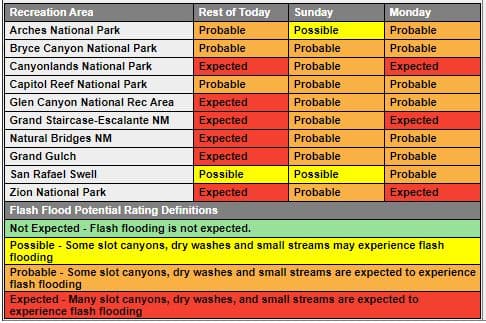
In Zion, flash flooding in slot canyons can be triggered by rainfall far upstream, where the water is out of sight but still flowing toward you. That matters for places like The Narrows, Virgin River Narrows, and Keyhole Canyon, where steep walls and a narrow channel can turn a storm into a trap fast. If the drainage basin has thunderstorm potential anywhere in it, the canyon is not just a harder hike that day. It is a different risk category.
That is why “good weather at the trailhead” is not enough. A cloudburst over part of Washington County, Kane County, or Garfield County can matter more than a blue sky in Springdale, and canyon visitors should treat any narrow, confined drainage as potentially dangerous even when conditions appear fine at the start.
Make the go/no-go call the night before
The safest routine is simple: check the forecast the evening before, then check again the morning of the hike. Canyon conditions can change quickly overnight, and afternoon thunderstorms are a particular concern during monsoon season. Around Zion, monsoon season runs from July through mid-September, when those afternoon storms become more common across the region.
Here is the same-day decision I would use for a slot canyon itinerary:
1. Check the regional forecast, not just the town where you are staying.
2. Look for any flash-flood watch or warning anywhere in the watershed.
3. If thunderstorms are possible in the basin, choose a different activity.
4. If conditions worsen after you start, turn around early rather than pressing deeper into the canyon.
That sequence is especially important because National Weather Service guidance treats flash floods as one of the deadliest weather hazards in the West. Once the word “possible” enters the forecast for the basin, the trip should stay flexible.
Know what changes once you are inside
The Narrows is unforgiving for familiar reasons: slippery rocks, cold water, and rapidly changing conditions. In a narrow canyon, your exit options are limited, so turnaround discipline matters more than stubbornness. Shoes need to stay on in water and give traction on wet sandstone and slick cobbles, and cotton clothing is a bad trade because it stays heavy when wet.
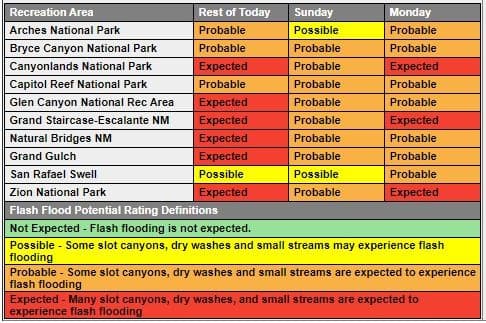
If water starts moving, debris begins to appear, or the sound of rushing water changes, move to higher ground immediately. Do not try to outrun a flood in a confined channel. That rule is especially important in routes where the walls are tight and the sky is only a ribbon overhead, because the canyon itself can block your escape as conditions worsen.
Have a backup plan before you leave the hotel
The best Southwest itinerary is built with a second option already in mind. If the canyon is a no-go, swap to a scenic drive, a museum, a viewpoint hike, or a park shuttle day so the trip still works without forcing a bad decision. That kind of flexibility matters in Zion especially, where a morning that starts clear can still end with a closure if the basin picks up storms.
It keeps the day from being lost when flash-flood risk rules out The Narrows, Keyhole Canyon, or another slot route.
The hard lessons from Zion and Grand Canyon
In July 2021, Zion National Park issued a flash flood update and closed State Route 9 to prepare for flooding. The Narrows and all slot canyons remained closed until two hours after the flood warning ended. Flash flood warnings also affected parts of southern Utah, including Springdale, Rockville, and portions of Zion National Park.
That same month, Grand Canyon National Park documented a fatality and multiple injuries after a flash flood.
A simple go/no-go standard for canyon days
If you want one rule to carry from Zion to every slot canyon trip, it is this: green light only when the drainage basin is quiet, the forecast stays clear through the day, and you can walk in and out without betting on luck. If thunderstorms are possible anywhere upstream, it is a no-go.
This article was produced by Prism’s automated news system from verified source data, official records, and press releases, then run through automated quality and moderation checks before publishing. The system is built and supervised by the people who set the standards it runs under. Read our full AI policy.
Did this article answer your question?