Moab Starts New Downtown Planning Push to Improve Walkability and Transit
Downtown Moab’s rewrite could change the first and last mile of every trip, from bus parking and sidewalks to how easy it feels to walk Main Street.
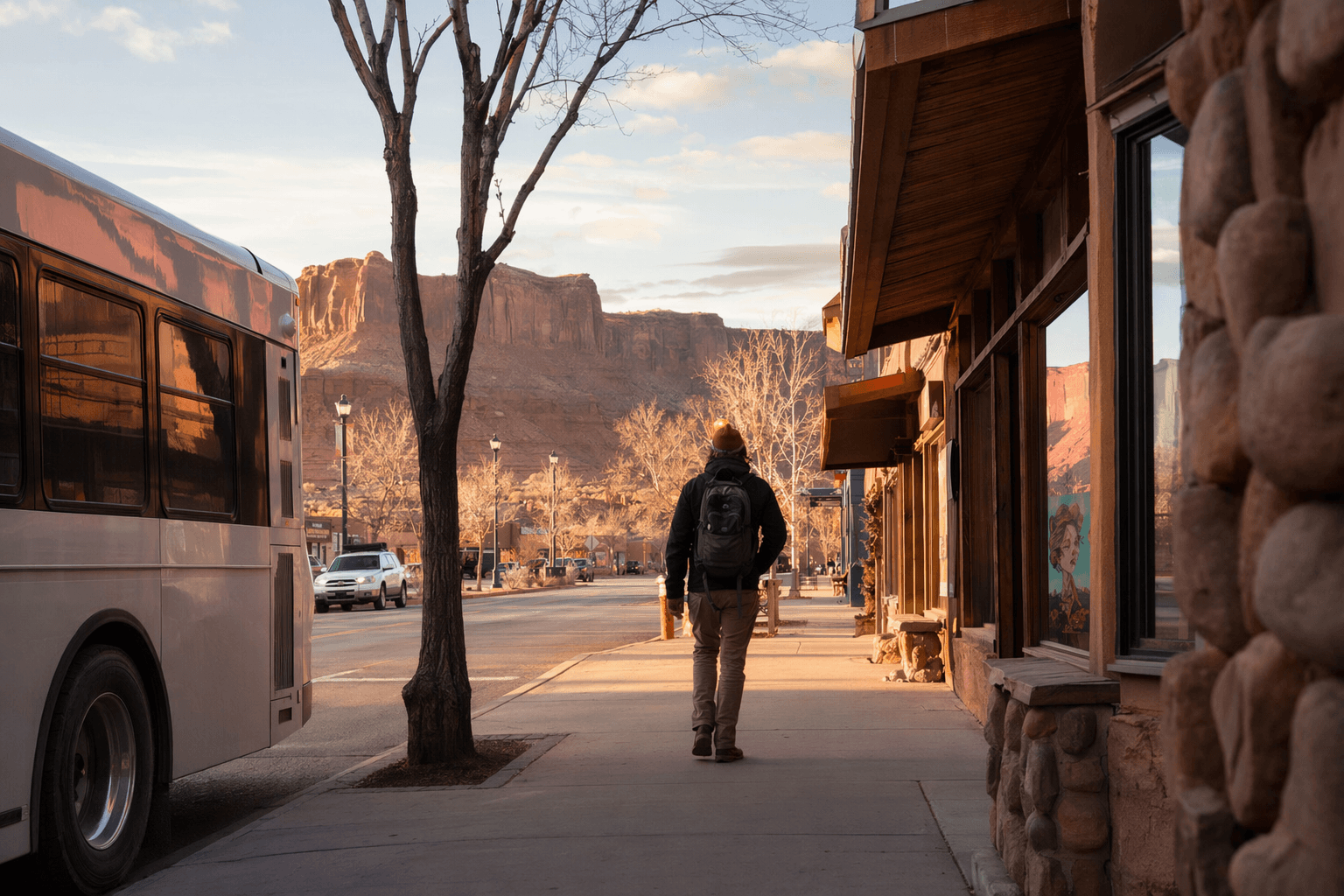
What could visitors notice first on a weekend in Moab? Most likely the small stuff that makes a gateway town feel either easy or exhausting: where the shuttle stops, how hard it is to cross Main Street, whether the sidewalks are usable, and how much room is left for cars, bikes, and people trying to get to breakfast before heading for Arches National Park or the river.
That is exactly what Moab and Grand County are now reopening together. The county has joined the city in a fresh rewrite of downtown’s aging land-use framework, and city staff have said the current C-1 and C-2 zones may be replaced by street-specific rules. The old downtown master plan was produced in 2017 but never adopted, and City Manager Michael Black said at the April 17 joint city-county meeting that the city is hiring a consultant to revise it, with work possibly starting in June if grant funding comes through.
For visitors, the practical stakes are obvious. Downtown Moab is where people park, shop, eat, board shuttles, and regroup before heading to Canyonlands National Park, the Colorado River, or trailheads across Grand County. A plan that pushes harder on walkability and transit could mean better sidewalk repairs, pedestrian bulb-outs, clearer transit signage, and stricter enforcement around bus parking. It could also shape parking and business uses along the downtown corridor, which is why the county’s involvement matters as much as the city’s.
The push did not come out of nowhere. In March 2024, downtown business operators Tony Lema and Karen Guzman-Newton pressed the city to deal with dangerous intersections, crumbling sidewalks, deteriorating buildings, dead trees, and trash receptacles. The earlier downtown master plan was meant to cover pedestrian and bicycle infrastructure, street design and parking, public spaces, traffic efficiency and noise impacts, zoning and land-use rules, urban design, active transportation, historic preservation, economic development, cultural and arts programming, resilience, sustainability, and a framework for implementation and monitoring. City materials put the price tag at $250,000, including a $50,000 CIB grant request and $200,000 from the general fund.
The rewrite is unfolding alongside other mobility work. Grand County and the City of Moab have launched a Transportation Safety Action Plan built on the 2022 Unified Transportation Master Plan, and Grand County’s Active Transportation and Trails Division is updating the Non-Motorized Trails Master Plan. At the April 17 meeting, officials also discussed Main Street sidewalks, senior housing, the UMTRA site north of Moab, the golf course, and water supply. The next joint meeting is set for August 18, 2026, and Moab’s general-plan page targets a broader update for 2027.
This article was produced by Prism’s automated news system from verified source data, official records, and press releases, then run through automated quality and moderation checks before publishing. The system is built and supervised by the people who set the standards it runs under. Read our full AI policy.
Did this article answer your question?