Singapore’s NUS Mega Challenge draws 50 seasoned cubers from 14 regions
Fifty returners filled every seat at NUS Mega Challenge 2026, and a Megaminx record-level single made the 14-region field feel bigger than the cap.

Fifty returners filled every seat at NUS Mega Challenge 2026, and the result was more than a full house. With a 28.59 Megaminx single, podiums spread across 2x2, 4x4, 6x6, Pyraminx and Skewb, and competitors arriving from 14 regions, the meet read like a snapshot of a scene with real depth.
The World Cube Association listed the June 14 meet at the National University of Singapore, in S17-0512 at 10 Lower Kent Ridge Rd, with Dylan Seah Tze Siang, Glen Goh Wee Zhuan, Lee Yu Zhe, NUS Cube Club and Troy Tan Hong Kai running the competition. Carmen Teo Bin Jie and Zhou Yichen served as delegates, and the event carried a hard cap of 50 competitors that was reached entirely by returners, with no first-timers in the field.
That detail mattered because the roster did not look local in the narrow sense. The 50 competitors came from Singapore, China, Japan, Malaysia, India, the Philippines, Hong Kong, Pakistan, Indonesia, the United Kingdom, the United States, Myanmar, South Korea and Chinese Taipei. In a June calendar already packed with NUS Cube Club meets, including NUS Clock Clash 2026 on June 6 and Please Be Quiet Singapore June 2026 on June 13, the campus was operating like a genuine hub rather than a one-off host.
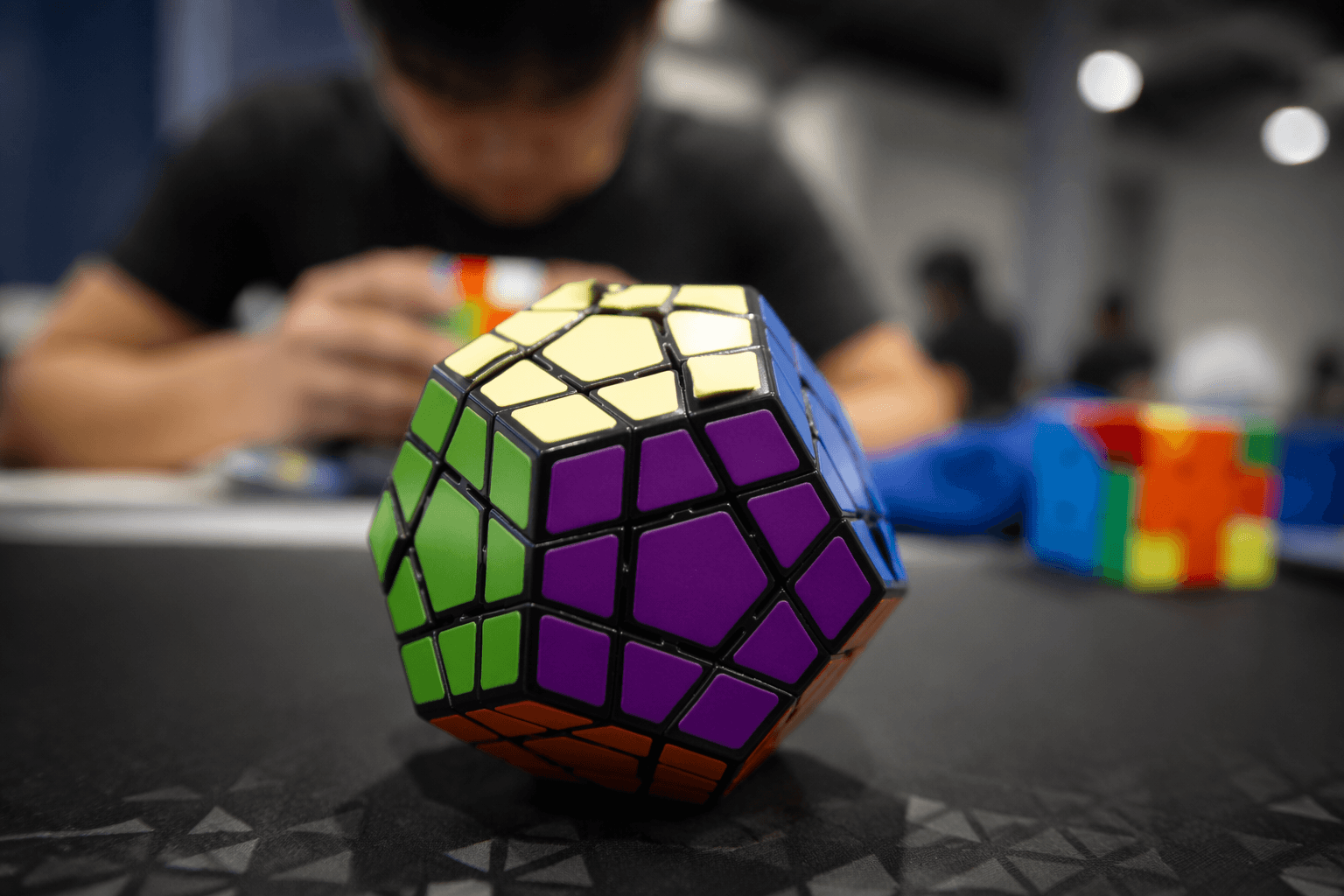
On the results sheet, Nigel Phang led 2x2 with a 0.92 best and 1.29 average. Emmanuel Kao topped 4x4 in 20.02 seconds and averaged 25.13, then repeated at 6x6 with 1:09.98 and 1:12.06. Beth Lee won Megaminx with a 30.58 average, while Masayuki Hirai’s 28.59 single stood out as the sharpest individual mark of the day; Hirai finished second on average at 33.51, with Emmanuel Kao third at 36.00. Evan Tan Yitian took Pyraminx and Luis Tan Hong Yi led Skewb, reinforcing how many events had legitimate depth rather than a single runaway winner.
That spread is the clearest sign that Singapore cubing has moved beyond only producing headline names. The World Cube Association traces the Rubik’s Cube back to Ernő Rubik in 1974 and commercial availability in 1977, and Singapore’s own pipeline has been sustained by institutional meets such as the annual Singapore Cube Championship run by the NUS Mathematics Society, which the NUS Faculty of Science says includes NUS, School and Open categories. Daryl Tan Hong An’s 12 Guinness World Records titles once showed how far a Singaporean cuber could go; NUS Mega Challenge showed the next layer, a local scene that can fill a capped field, field multiple organizers, and still produce meaningful results across the board.
This article was produced by Prism’s automated news system from verified source data, official records, and press releases, then run through automated quality and moderation checks before publishing. The system is built and supervised by the people who set the standards it runs under. Read our full AI policy.
Did this article answer your question?