Australian builder’s Cooper tiny home maximizes space for full-time living
Cooper’s dual-loft layout puts daily life on the ground floor and sleeping upstairs, with 47 square meters of usable space for full-time comfort.
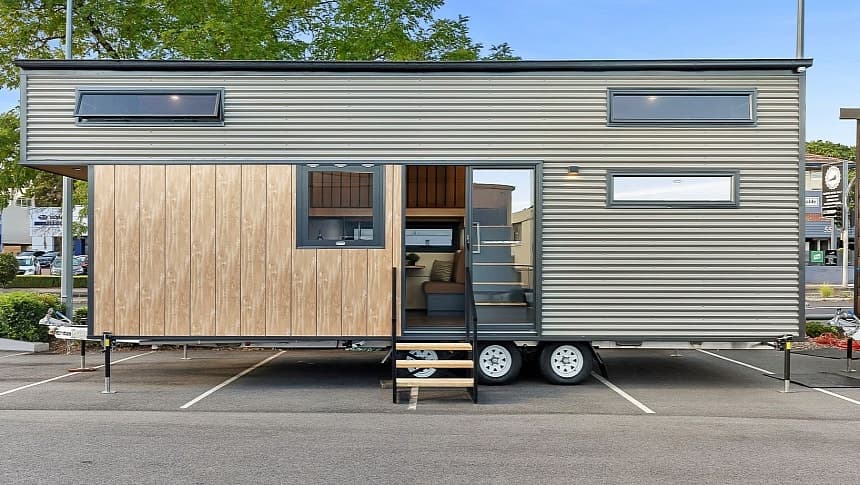
The Cooper tiny home makes a sharp case for itself the moment you look past the cute-factor and into daily life. With 47 square meters, or 506 square feet, of usable space in the larger version, it is built less like a novelty and more like a compact full-time house, especially for people who want their sleeping space separate from the rooms where they cook, work, and unwind.
A tiny house that acts more like a small home
Cooper sits on a triple-axle trailer and measures 8.4 meters long by 3 meters wide, which gives it a footprint that feels unusually generous for a towable tiny house. That extra room is the whole point: the layout is designed around everyday living, not around proving how little space someone can tolerate.
That matters because the broader tiny-house category still tends to lean heavily on lofts and very tight circulation. Granny Flat Solutions notes that tiny houses are generally between 10 and 30 square metres and often use lofts for sleeping and storage. Cooper pushes past that expectation, and in doing so it changes the livability question from “Can I fit everything?” to “Can I live here without constantly adapting to the house?”
Why the dual-loft idea works
The smartest move in Cooper’s layout is not just adding lofts, but assigning them a clear job. The ground floor handles the everyday action, while the upper level becomes private sleeping space. That separation reduces the friction that usually comes with tiny-house living, where one room often has to be kitchen, lounge, office, wardrobe, and bedroom all at once.
For full-time living, that split solves several pain points at once:
- Privacy: Sleeping is lifted away from the social zone, so the house feels more like a proper home than a studio squeezed into a trailer.
- Circulation: Keeping daily activity on the ground floor means fewer climbs and less constant movement between levels.
- Storage logic: When the lofts are reserved for sleeping and private use, the lower level can stay cleaner and more functional instead of being overrun by furniture.
- Hosting: Guests can stay in the shared living area without the whole home feeling like a bedroom.
That is the real livability upgrade here. The dual-loft format is not just a floor-plan trick, because it gives the home a natural rhythm: active below, private above.
The exterior signals that this is a serious build
Cooper’s outside finish matches that practical approach. The home uses dark grey corrugated metal with vertical timber planks around the entrance and main window, creating a modern industrial look that feels polished without being cold. Large glass doors and several windows bring in daylight, but the design stops short of turning the home into a glass box.
That balance is important. The home wants light, but it also wants privacy and practicality, which is exactly what a full-time tiny house needs. A space meant for everyday use cannot rely on aesthetics alone; it has to work in the morning, at night, and when life gets cluttered.
The builder behind Cooper brings more than a trendy name
Tiny Home Solutions, based in Waitara in Sydney, launched in 2023 as the tiny-home arm of Granny Flat Solutions. Even though the tiny-home brand is new, its backing company brings more than 40 years of building experience, which helps explain why Cooper reads as thoughtful rather than experimental.
That builder context matters. Granny Flat Solutions says it operates across Greater Sydney, Newcastle, and the Illawarra, and describes itself as a multi-award-winning granny flat company with more than 15 awards. In other words, Cooper is coming out of an ecosystem that already knows how to turn compact square metres into functional housing rather than just clever design concepts.
Customization is part of the pitch
Cooper is also presented as part of a broader tiny-home range, not a one-off showpiece. Tiny Home Solutions says its designs can be customized, including modified floor plans or fully custom layouts, and it promotes “design and budgetary options” for tiny homes on wheels. That flexibility is a big part of the model’s appeal, because tiny-house buyers rarely want the exact same internal trade-offs.
The Cooper design page shows how that flexibility plays out. One listed version is a 2-bedroom, 1-bathroom Cooper with a height of 4.3 meters, a width of 2.5 meters, a length of 8 meters, 17.5 square meters of floor area, 13.5 square meters of loft area, and 31 square meters total area. The page also shows facade-style choices, including Live and Dream facades, plus roof options such as gable, skillion, double-skillion, and protruding.
A Tiny Home Solutions video walkthrough adds another layer to the picture, describing Cooper as the “2nd build” of the design with a few upgrades. That suggests the home is already being refined in the real world, not frozen as a single prototype.
What Cooper says about the future of tiny living
The strongest argument for Cooper is not that it is large by tiny-house standards, but that it uses its size intelligently. The layout supports full-time living by separating public and private space, keeping circulation simple, and preserving a feeling of openness without sacrificing comfort.
For anyone weighing whether a dual-loft tiny home is actually better than a standard single-loft plan, Cooper makes a persuasive answer. It treats the ground floor like the part of the house you live in every day, and the lofts like the parts that let you keep your life organized. That is what makes it feel less like a space-saving stunt and more like a tiny home that knows how people really live.
This article was produced by Prism’s automated news system from verified source data, official records, and press releases, then run through automated quality and moderation checks before publishing. The system is built and supervised by the people who set the standards it runs under. Read our full AI policy.
Did this article answer your question?