Backcountry Tiny Homes’ Knoll blends color, light and family-friendly space
Backcountry’s Knoll turns the tiny-house script bright, boho and practical, pairing 390 square feet with family sleep space, storage and daylight.
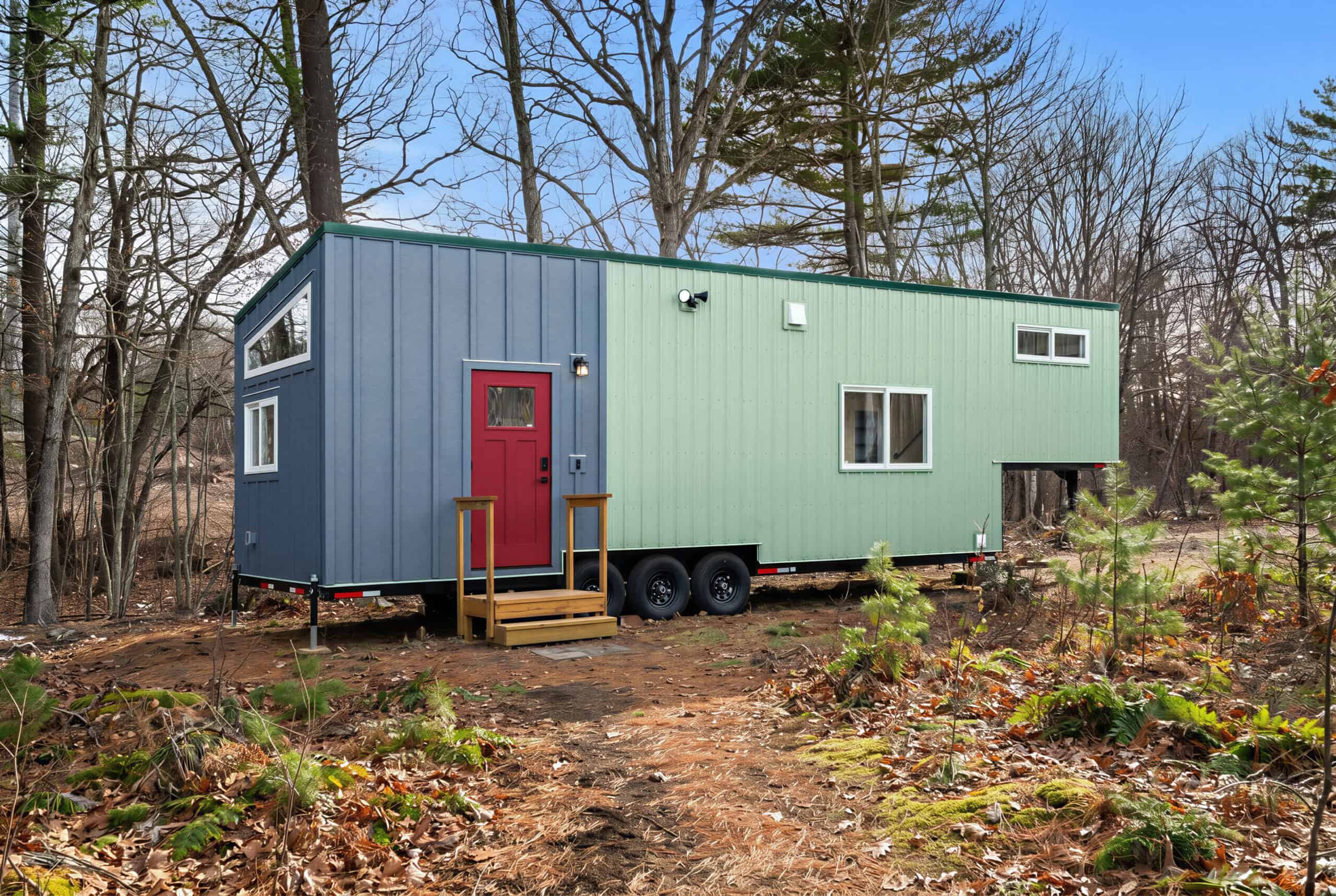
Backcountry Tiny Homes’ Knoll is a small house with a bigger design argument. Instead of chasing the stripped-down tiny-house look that still dominates so much of the market, this 38-foot gooseneck leans into color, windows and everyday function, while still sleeping up to five people in 390 square feet. The effect is less like a display piece and more like a compact home that is trying to win over people who actually plan to live in it.
A countertrend tiny home with a louder point of view
The Knoll reads as a deliberate pushback against the ultra-minimal aesthetic that has shaped tiny-house culture for years. Backcountry frames the home around two things that often get treated as extras in compact living: natural light and color. That philosophy shows up immediately in the exterior, which combines slate blue-grey and sage-green siding with a red entry door, and it carries inside where the palette stays warm and vivid rather than washed out.
That matters because taste in tiny homes is changing. Buyers are still chasing efficiency, but they are also asking for homes that feel personal, not just optimized. The Knoll answers that shift with a boho-leaning look that makes room for books, storage, and a lived-in feel, which is exactly why it stands out in a field full of pale wood boxes and sparse finishes.
Why the layout feels bigger than the footprint
The Knoll’s gooseneck profile is doing real work here. The elevated section creates a standing-height loft, which is a meaningful quality-of-life upgrade in a compact home where stooping and crawling can wear thin fast. In tiny-house terms, that single move changes how the space feels day to day, especially for anyone planning to stay longer than a weekend.
Inside, the living room is wrapped in windows and daylight, and that light helps the whole house read larger than its 390 square feet. A burnt-orange sleeper sofa, bookshelves and built-in storage make the space feel furnished rather than staged. That is part of what separates a compact home that works from one that only photographs well: every corner needs a job, but it also needs to feel open enough to use without constant rearranging.
The sleeping capacity also gives The Knoll a wider lane than many tiny homes. Backcountry lists the model for one to five people, which makes it more plausible for a couple with kids, guests or occasional multigenerational stays. In a market where many tiny homes are built for solo owners or couples, that added flexibility is one of the model’s clearest selling points.
A kitchen built for real meals, not just a photo shoot
Backcountry is also making a practical argument through the kitchen. This is not a token kitchenette tucked into the corner. The Knoll’s kitchen includes deep green cabinets, a wood countertop, a subway-tile backsplash, a gas range and a stainless sink, and a retro teal refrigerator appears in outside coverage of the model. That combination gives the house the feel of a real cooking space, not a decorative compromise.
The builder says the big kitchen and storage are useful, but it is the natural lighting and bright colors that make the home feel alive. That framing is telling. Instead of treating utility and style as tradeoffs, the Knoll treats them as partners, with storage, prep space and daylight reinforcing each other. For daily living, that is what turns a tiny house from aspirational into functional.
A practical take on the interior looks like this:
- windows that keep the main living area bright throughout the day
- built-in storage that reduces clutter without swallowing floor space
- a full kitchen setup that supports regular cooking
- a sleeper sofa that extends guest capacity without requiring a separate bedroom
- a loft that can actually be used standing up, not just crawled into
How Backcountry packages the model
Backcountry Tiny Homes, a woman-owned carpentry, construction and engineering company based in Hampstead, New Hampshire, says it specializes in mobile tiny home design and construction. The company also says its models are the result of years of custom projects, which helps explain why The Knoll feels more refined than a first-pass concept build.
On its current model page, Backcountry lists The Knoll at 38 feet by 10 feet under model reference number CST3810CF. The pricing is clearly segmented: $162,950 turnkey, $81,475 unfurnished and $155,250 shell. That spread tells you a lot about the tiny-house buyer journey, because people are not just shopping for design. They are also deciding how much of the build they want finished before delivery.
Backcountry says its turnkey and unfurnished homes are NOAH certified, while shell homes are pre-NOAH certified and dried in. In practical terms, that makes certification part of the product rather than an afterthought. The company also offers find-land, insurance and financing resources, which reflects a basic reality of tiny-house ownership: the house itself is only one piece of the puzzle.
Why certification and towability still shape the market
NOAH says its certification process is designed to give consumers confidence and to help builders, lenders, insurers and municipalities by inspecting against national building, plumbing, electric and RV codes. The organization also says certification can help with zoning, insurance, financing, resale value and buyer pool expansion. That matters because tiny homes still run into the same old obstacles, even when the design is stronger than ever.
The broader market context is hard to ignore. NOAH says the tiny-house movement grew by more than 900% over the prior decade, which helps explain why trust markers like certification and transparent pricing now sit beside layout and finish choices in the buying decision. In a category where placement and lending can be as difficult as the build itself, those details are not background noise. They are part of the value proposition.
The tow setup adds another layer of reality. Tiny House Talk’s coverage describes The Knoll as sitting on a heavy-duty gooseneck trailer with a 21,000-pound GAWR and notes that it needs a one-ton-plus truck to tow. New Atlas, in coverage published April 23, 2026, also highlighted the triple-axle gooseneck trailer and the wider footprint, pointing out that the layout feels closer to a proper apartment than a camper. That wider stance is part of what makes the home’s family-friendly plan work.
The Knoll ends up saying something important about where tiny-house taste is headed. Buyers still want compact living, but they do not necessarily want it to look austere. In this case, color, daylight and storage are not decorative add-ons. They are the reason the house feels ready for daily life, and that is what makes the bright, boho countertrend feel less like a styling choice and more like a smarter way to live small.
This article was produced by Prism’s automated news system from verified source data, official records, and press releases, then run through automated quality and moderation checks before publishing. The system is built and supervised by the people who set the standards it runs under. Read our full AI policy.
Did this article answer your question?