Bahama tiny house brings maritime style to compact coastal living
The Bahama turns maritime styling into a usable tiny-house language, using rope, wood, and a compact loft to feel like a real coastal retreat.
The Bahama tiny house does not just wear a nautical look, it builds its whole identity around it. The rope-draped terrace, the warm wood interior, and the loft styling all work together to make the home feel like a small harbor cabin rather than a generic trailer dressed up in blue paint. That is the real test here: whether a strong theme makes compact living richer, or whether it turns into novelty once the first impression fades.
The exterior sets the tone before you step inside
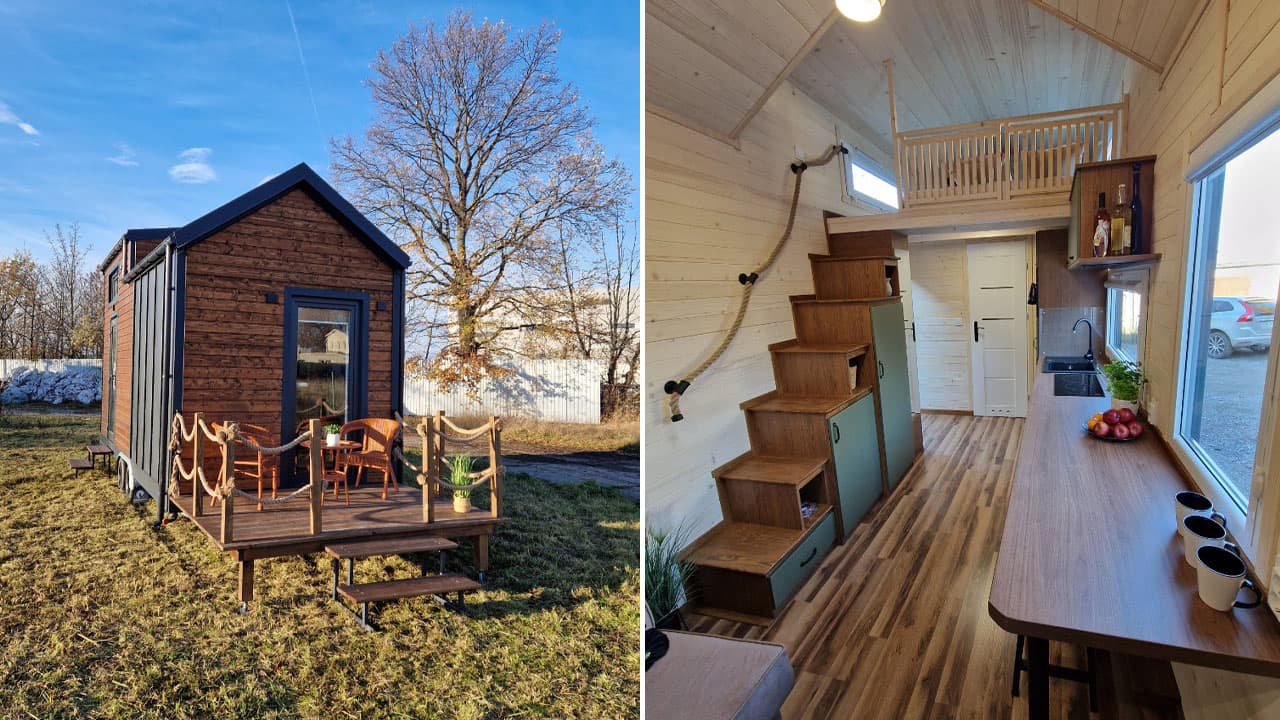
Tiny House BAR-TOF positions the Bahama as a lakeside nautical cabin, and the exterior immediately carries that story. Homecrux describes the terrace as wrapped in jute rope, echoing ship mooring lines and dock hardware, while the official Bahama listing adds rope railing and an optional terrace awning to the package. The result is a home that uses maritime cues as a spatial device, not just decoration, because the terrace reads like an extension of the living area and opens the house to its setting.
On paper, the size stays firmly in tiny-house territory. The cabin sits on a double-axle trailer and measures 22 feet long, 8.4 feet wide, and 13 feet high, with a 226-square-foot footprint. Tiny House BAR-TOF lists the same model at 21 square meters, with a platform length of 6.60 meters, a total length of 8.30 meters, a width of 2.55 meters, and a total height of 3.95 meters. It is built for 2 to 4 sleeping places and carries a permissible total weight of 3.5 tons.
Inside, the theme stays useful
The strongest version of themed tiny-house design is the one that keeps paying rent after the photo op, and the Bahama largely does that. Homecrux shows a warm, wood-wrapped layout organized around a living area with a convertible sofa bed, a dark coffee table, a wall-mounted TV, and storage cubbies. That combination matters because it keeps the room flexible, letting the main floor shift from lounging space to sleeping space without losing circulation.
The kitchen follows the same logic. It is linear and efficient, with an electric two-burner hob, sink, sage green cabinetry, an integrated oven with microwave function, and a refrigerator with freezer. None of those choices are oversized or ornamental, and that restraint is what keeps the maritime styling from overwhelming the plan. The room still reads as a cabin, but it functions like a compact home that expects real cooking, not just coffee and snacks.
The loft carries the story upward
The loft is where the Bahama’s styling could have tipped into costume, yet it stays grounded through storage and clean utility. The stairs include storage, which is one of the most practical moves in any tiny house because every step earns its footprint. The loft itself contains a double bed plus storage cabinets and a countertop at the foot of the bed, so the upper level becomes more than a sleeping perch.
That bedroom rope railing is a small detail with outsized effect. It reinforces the nautical language without adding clutter, and it ties the loft back to the terrace so the design feels consistent from outside to inside. In tiny-house terms, that kind of visual continuity can make a compact plan feel bigger, because the eye keeps reading one connected story instead of a series of disconnected tricks.

What the spec sheet says about daily living
Tiny House BAR-TOF treats the Bahama as a fully equipped home, not a shell for weekend use. The listed features include mineral wool insulation, standing-seam roofing, Scandinavian spruce exterior cladding, full LED lighting inside and out, floor heating, an air-to-air heat pump, a fully equipped kitchen, a large shower, and a standard toilet. It also includes PVC double-glazed windows and doors, a 30-liter water-heating boiler, and a TV connection with a 32-inch TV.
Those details matter because they show how the model balances style with year-round usability. Mineral wool insulation and floor heating point to comfort beyond mild-weather camping, while the heat pump and double-glazed openings support a more stable interior climate. In other words, the maritime skin is not hiding a fragile shell underneath it.
Where strong identity helps, and where it can box a house in
The Bahama is a good case study in how visual identity adds value when it is tied to use. The terrace treatment, rope railing, and warm wood palette create immediate atmosphere, and the layout supports that mood with practical storage, a compact kitchen, and a loft that still handles the basics. For a buyer who wants a coastal retreat, the styling does real work: it makes a small footprint feel intentional, not improvised.
The risk, of course, is that a sharply themed house can narrow its appeal over time. A jute rope terrace and nautical loft details are charming when the setting matches the story, but they are less neutral than a blank-slate cabin. That means the Bahama is strongest for someone who wants the theme to remain visible, because the home is built around that identity rather than merely decorated with it.
The builder behind the approach
Tiny House BAR-TOF describes itself as a family business with more than 15 years of experience. It says it has won several construction awards, has been building and delivering tiny houses across Europe, and shows its homes at trade fairs in Poland and abroad, including Karlsruhe, Germany. The company also says its homes are distributed across Germany, Austria, Switzerland, Hungary, and the Czech Republic, which gives the Bahama context beyond one showpiece build.
That background helps explain the confidence of the design. This is not a one-off mood board made into a house, but part of a larger line that treats compact living as something that can be tailored to a specific atmosphere. The Bahama makes its best case when those choices are treated as architecture, not props, and that is why the rope-draped terrace works: it frames the house as a small coastal retreat while still leaving room for the everyday life that has to happen inside it.
This article was produced by Prism’s automated news system from verified source data, official records, and press releases, then run through automated quality and moderation checks before publishing. The system is built and supervised by the people who set the standards it runs under. Read our full AI policy.
Did this article answer your question?