Bluebell tiny house channels country-home charm with mobile design
Bluebell sells the country-house dream in a towable shell, but its real test is whether that polished look still feels livable once the wheels are the point.
Bluebell’s promise is bigger than its footprint
Bluebell works because it refuses the usual tiny-house script. Instead of leaning into the familiar boxy trailer look, the Australian concept, credited to Otilia Drăgan and shown through Tiny Easy imagery, reaches for the atmosphere of a grand country home and asks whether that feeling can survive in a mobile format.
That is the tension at the heart of the design. Bluebell is not trying to look merely efficient. It is trying to look gracious, settled, even a little theatrical, which makes it a useful sign of where the tiny-house world is headed as style becomes part of the value proposition, not just an afterthought.
The exterior makes the strongest case for the concept
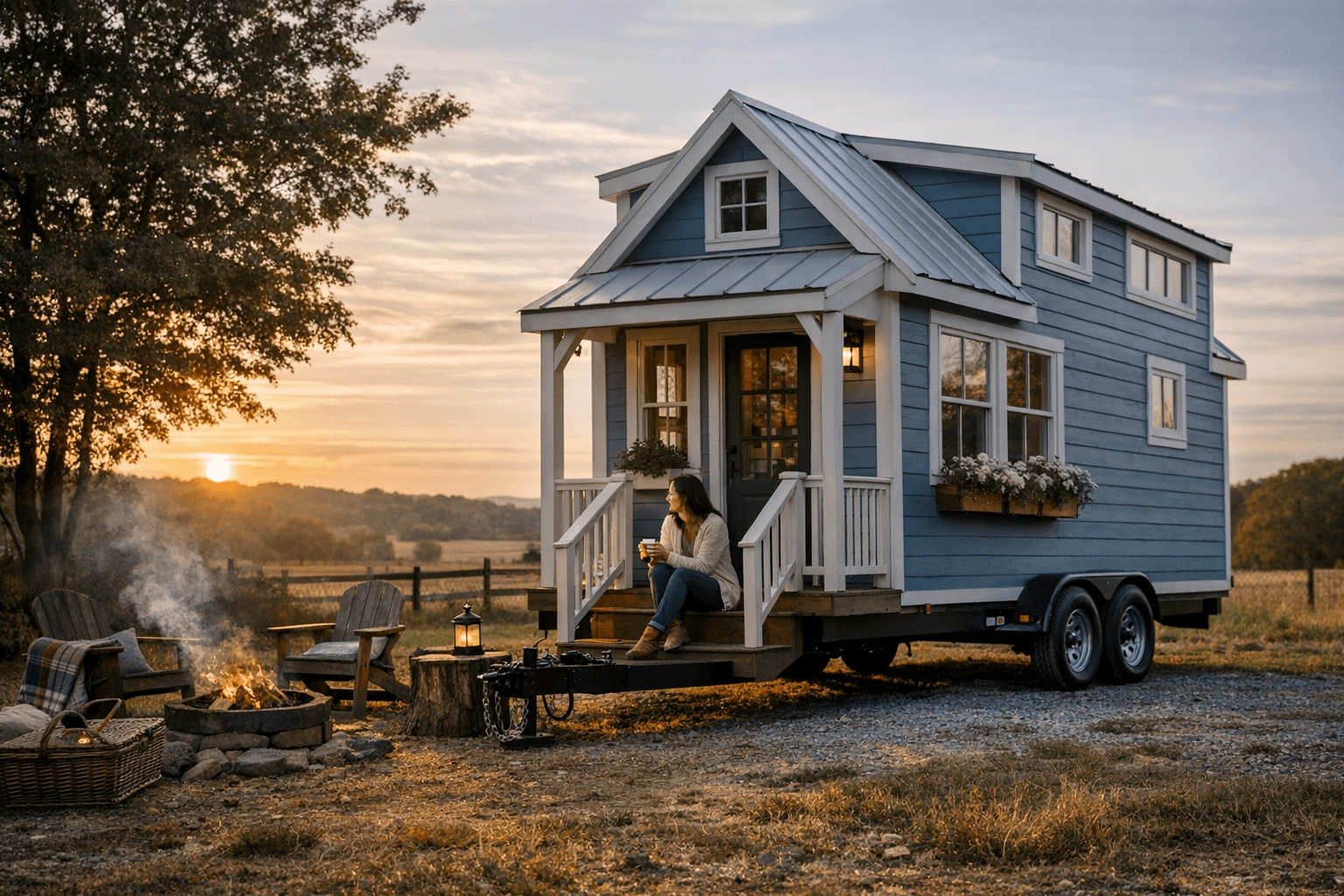
Bluebell’s outer shell does most of the persuasion work. Timber cladding, white French windows, and a segmented roof give it the outline of a small country estate rather than a compromise dwelling, and that matters because the silhouette reads as timeless instead of trendy.
The blue cladding shifts the mood again, adding a coastal, modern-glam edge without undoing the traditional vocabulary underneath it. The result is a tiny home that feels rooted in familiar domestic cues, yet polished enough to signal aspiration rather than austerity. In a market where so many compact homes default to hard-edged minimalism or rugged cabin shorthand, Bluebell says charm can be a design strategy too.
Inside, the color contrast does the heavy lifting
The interior pushes the idea further with navy cabinetry, bright white walls, and tall ceilings. That combination is doing more than decorating a small space. It is managing weight, using darkness where it can add richness and brightness where the room needs air.
That is why the layout reads as elegant instead of cramped. Dark cabinetry in a compact home can easily feel heavy, but Bluebell’s palette keeps the room balanced and inviting, almost like a scaled-down manor interior. The design’s success here is not that it hides the size of the home. It is that it turns size into mood, making the space feel intentional rather than reduced.
Style is the argument, but livability is still the question
Bluebell is presented as a concept, so the emphasis falls on what a tiny house can look like rather than on a full technical breakdown of storage, services, or build specifications. That actually makes the project revealing, because it shows how much emotional lift a well-chosen finish package can provide in a small footprint.
The real measure of this kind of design is whether the comforts feel usable or merely picturesque. Bluebell suggests that the answer can be both, at least in theory. Tall ceilings, a bright envelope, and a disciplined palette all support everyday comfort, while the country-house styling supplies the sense of permanence that many compact homes struggle to achieve.
Bluebell fits a broader Australian tiny-house definition
The Bluebell idea lands inside a tiny-house movement that has become much more clearly defined in Australia. The Australian Tiny House Association describes a tiny house as a dwelling of no more than 50 square metres on a wheeled trailer base, built with domestic-grade materials and finishes, and capable of being permanently occupied.
That definition also draws a clear line between tiny houses and caravans, vans, buses, or small fixed homes on foundations. In other words, the category is not just about small size. It is about a moveable dwelling with the standards of a home, which helps explain why Bluebell’s mobile framing matters as much as its décor.
The movement itself is being driven by housing unaffordability, cost-of-living pressures, and climate and environmental concerns. That context makes a design like Bluebell more than an aesthetic exercise. It becomes part of a larger conversation about what kind of compact home people actually want to live in, and what kind of life they expect that home to support.
Mobility changes the stakes
Once a tiny house is on a trailer base, the conversation shifts from admiration to logistics. The Western Australian government says tiny houses can be regulated as either buildings or caravans depending on how they are classified, and the rules treat vehicles and buildings as mutually exclusive categories. That means the same home form can trigger very different approval pathways.
Coffs Harbour’s guidance makes the practical side even clearer. Mobile tiny houses registered as trailers often do not require development approval, while fixed tiny homes usually do. For a concept like Bluebell, that distinction is crucial, because mobility is not just a lifestyle flourish. It can determine how easily a home is placed, moved, and used in the real world.
Why Bluebell arrives at the right moment
The timing matters because the Australian tiny-home market is no longer a niche curiosity. The Australian Tiny House Association says the industry has seen a 120 percent increase in sales over five years, with modular and kit-home inquiries up as much as 50 percent in 2025. Queensland alone recorded a 373 percent surge in demand for DIY builds.
Those numbers help explain why a style-forward concept can land with such force. Buyers are not just chasing smaller floor plans. They are looking for identity, comfort, and a home that matches the life they want to project. The first Tiny Homes Expo for 2026 kicking off in Melbourne in early April only underscores how visible and commercially active the sector has become.
Bluebell fits that shift neatly. It stands in the longer evolution of tiny homes, from a movement that began in the United States into a distinctly Australian moveable-dwelling typology where regulation, livability, and design taste all carry real weight. Its biggest contribution is not that it invents a new structure. It shows that a tiny home can look like a country house without giving up the language of mobility.
In the end, Bluebell feels less like a branding exercise than a pointed challenge to the category. It argues that compact living does not have to dress itself in minimalism or rough utility to be credible. If the wheels can stay hidden in the story and the comfort still feels real, then the tiny-house market has room for something rarer than novelty: a small home with the manners of a much larger one.
This article was produced by Prism’s automated news system from verified source data, official records, and press releases, then run through automated quality and moderation checks before publishing. The system is built and supervised by the people who set the standards it runs under. Read our full AI policy.
Did this article answer your question?