Tiny Homes Perth display unit embraces bold industrial style and dark textures
Tiny Home 1038 swaps the usual white-box tiny-house look for a dark industrial palette, and its panoramic loft makes the compact plan feel unexpectedly expansive.
The loft is the luxury move
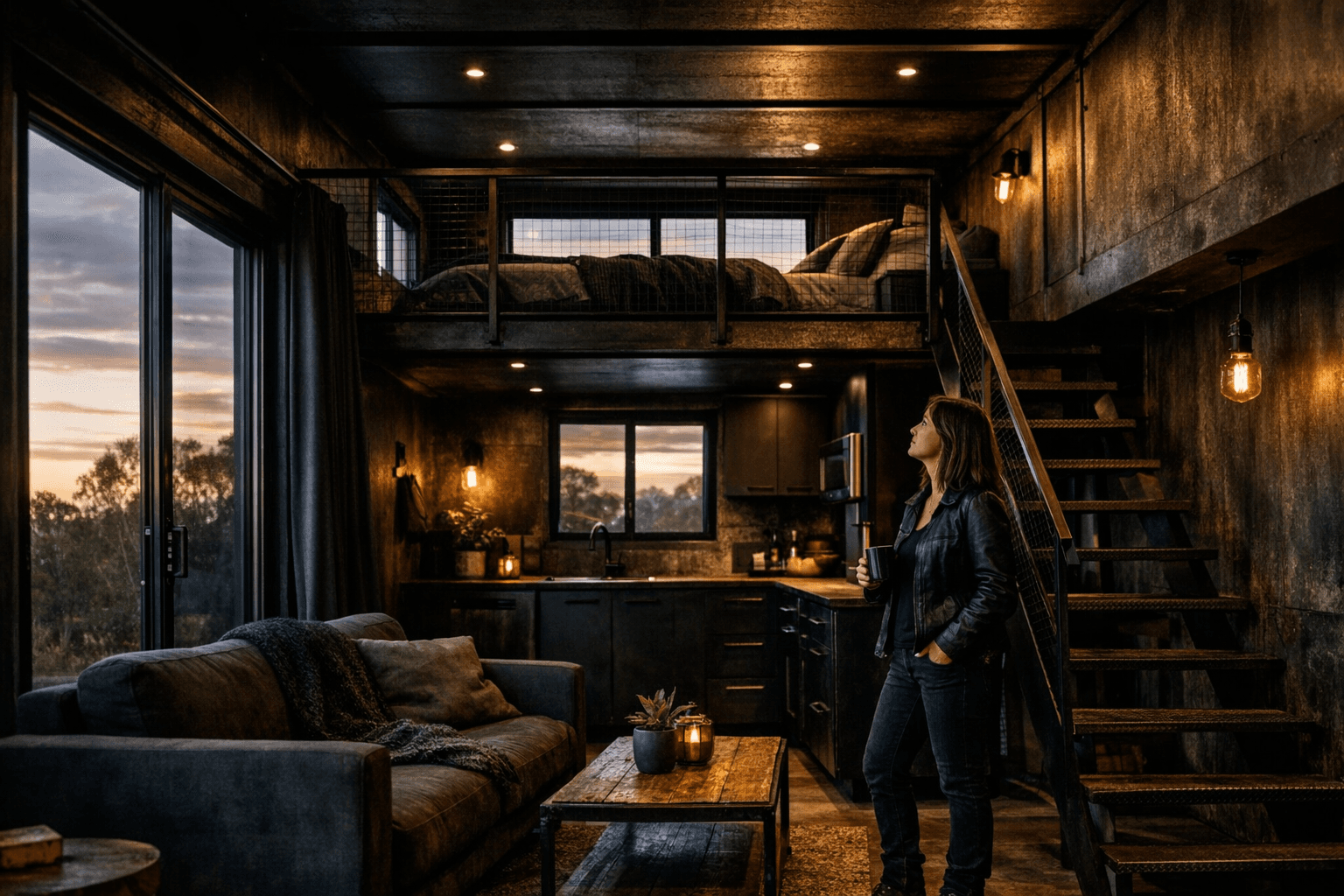
The first thing this Tiny Homes Perth display unit gets right is the thing tiny homes usually struggle most with: it refuses to feel boxed in. Tiny Home 1038 uses its loft bedroom as the emotional center of the build, pairing a corner window and skylight with walnut-finished Acacia Birch plywood so the sleeping space feels open rather than tucked away. That choice changes the whole reading of the home, turning vertical space into a feature instead of a compromise.
The effect is especially striking because the loft is not dressed as a novelty. It is presented as the place where the house becomes most polished, with light, height, and material warmth doing the heavy lifting. For a tiny home, that matters more than almost any decorative flourish, because the bedroom is where a compact footprint can either feel clever or feel cramped.
A dark palette with real personality
Tiny Homes Perth describes the design as a “light industrial theme,” and the home earns that label through a mix of dark tones and hard-edged finishes that are rarely this confident in the tiny-house world. Instead of leaning into the all-white, airy aesthetic that dominates many compact builds, this one uses deep chocolate browns, gray, dark blue accents, and rich textures to build atmosphere. The result feels more like a boutique loft apartment or a small ski chalet than a trailer-based dwelling.
That mood is carried across the whole interior. The brown leather sofa, matching bar stools, elegant kitchen with dark-toned cabinets, and ultra-slim wood-burning stove all contribute to a room that feels considered from every angle. Even the ceiling fan reads as part of the design story rather than a leftover utility item, which is exactly why the home feels upscale instead of merely efficient.
Materials do the talking
The materials are where the build moves from stylish to memorable. Tiny Homes Perth says the home uses a Colorbond shingle feature wall, a seamless lining board ceiling, a feature window and bench seat, and exterior timber with the loft finished in Zincalume. Those choices give the house texture on both sides of the wall, with the exterior and interior speaking the same industrial language.
Inside, discrete LED strips and modern fixtures finish the space without cluttering it. The home never feels overloaded with décor, which is important in a small footprint where every added object can tip the balance from curated to crowded. Instead, the materials do the work, and they do it with enough contrast to keep the interior visually lively even in a compact plan.
Why the layout still works for daily living
The strongest custom tiny homes are not just pretty on camera. They also make sense when you live in them, and Tiny Home 1038 appears to understand that balance. The article notes that the layout is smart and uncluttered, making it well suited to couples, which is a useful reminder that good tiny-house design is as much about circulation and storage logic as it is about style.
That livability is part of what makes the display unit persuasive. The bold finishes could easily have overwhelmed a small interior, but here they are managed with enough discipline that the home still reads as usable. The feature window and bench seat, the streamlined kitchen, and the careful handling of the loft all help the footprint feel intentional rather than overworked.
What makes the loft so effective
- The corner window and skylight bring daylight directly into the sleeping zone.
- Walnut-finished Acacia Birch plywood gives the loft warmth and contrast.
- The elevated view makes the bedroom feel like a destination, not an afterthought.
- The design creates a sense of height that expands the whole home visually.
That is the real trick here. The loft does not just add a sleeping area, it changes the emotional scale of the house.
Built as a display, sold as a proof point
Tiny Homes Perth identifies this home as Tiny Home 1038 and says it was its latest display unit, later sold in early 2024. That detail matters because display units have a job beyond shelter: they have to show what a builder can do when every decision is deliberate. In this case, the build works as a showroom piece for a company that clearly wants to be known for more than minimalism.
The company says it offers a free design service and individually designs its tiny homes, which helps explain why the house feels so specific. It is not a generic template dressed up for photos. It is a custom build that uses bold finishes to make a point about what a compact home can be when the design brief is allowed to stretch beyond beige practicality.
The builder’s experience is part of the story
Tiny Homes Perth says founder Simon Joiner has more than 35 years of experience in fabrication and the modular homes industry, and that all of its tiny homes are built on premises in Western Australia. That combination of long experience and in-house construction helps explain the tight execution here. Homes like this depend on precise joins, confident finishing, and a willingness to commit to materials that can carry the design without relying on excess ornament.
The Western Australia base also matters because it anchors the company in a hands-on build culture rather than a purely conceptual one. When a tiny home leans this far into dark cabinetry, custom finishes, and highly visible joinery, execution becomes the whole story. This one feels built, not assembled.
A tiny-home movement with a bigger backstory
Tiny Homes Perth also places its work within a broader history of tiny living. The company’s history page links the rise of the movement to post-Hurricane Katrina housing efforts in 2005, then to affordability pressures that sharpened during the 2007 to 2008 global financial crisis. That context helps explain why tiny homes have evolved far beyond novelty cabins and weekend escapes.
The company says these homes now serve as weekenders, granny or teenage flats, art studios, glamping stays, and farm accommodation. Tiny Home 1038 fits neatly into that wider evolution because it treats the tiny house as a serious design object, not just a smaller one. The bold palette and panoramic loft show what happens when a compact home is allowed to feel atmospheric, lived-in, and architecturally confident at the same time.
This article was produced by Prism’s automated news system from verified source data, official records, and press releases, then run through automated quality and moderation checks before publishing. The system is built and supervised by the people who set the standards it runs under. Read our full AI policy.
Did this article answer your question?