Casagaea's Algarve tiny house keeps living all on one level
Casagaea’s Algarve ditches the loft ladder, pairing a single-level plan with a platform bed, full bath, and bright glazing.
Casagaea’s Algarve tiny house keeps the ladder out of the equation
Casagaea is making a clear case for a different kind of tiny house: one that stays on a single level and still feels like a real home. The Algarve model leans hard into that idea, using an open plan, generous glazing, and a ground-floor sleeping setup to answer the biggest complaint many people have about tiny living, the loft ladder.
The pitch is straightforward. Instead of forcing daily life upstairs, the Algarve keeps everything on one floor and aims for comfort first. Casagaea says the model is intended for up to two people, which immediately frames the design as a couple’s home or a solo retreat rather than a scaled-down family house. That focus shapes everything from the bed arrangement to the kitchen layout and the modest footprint.
A compact footprint without the loft compromise
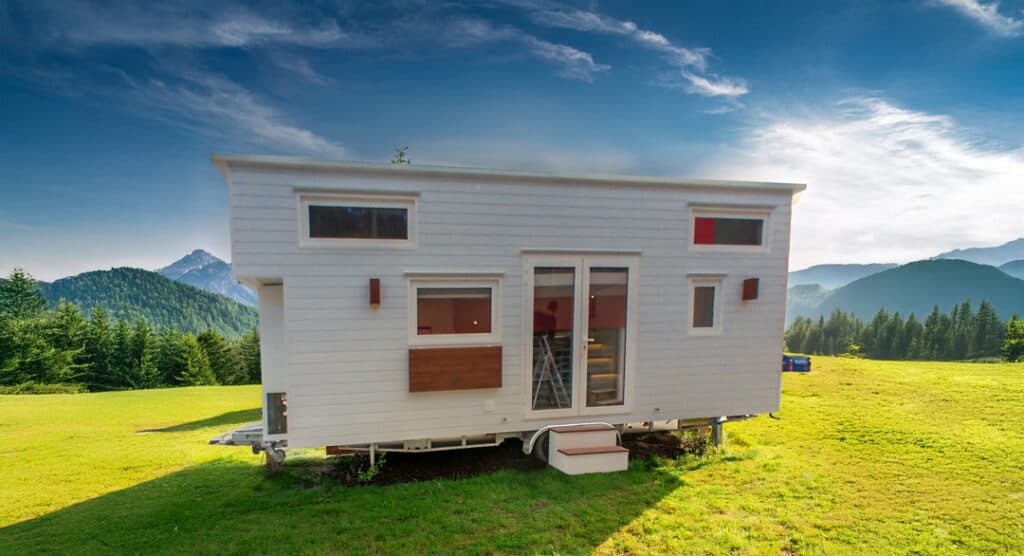
Casagaea lists three Algarve versions, with floor areas of 17.5 m², 19 m², and 20.5 m². The house sits on a double-axle trailer and keeps a consistent width of 2.5 m, with a height of 3.7 m. In practical terms, that makes the Algarve compact enough to tow, but not so constrained that it turns into a gimmick.
The most important choice is the one Casagaea refuses to make: there is no mezzanine or loft. That decision matters in tiny-house circles because the loft has become both a signature and a liability. It saves floor space, but it also asks owners to climb, crouch, and adapt to a sleeping area that can feel inconvenient at best and inaccessible at worst. The Algarve sidesteps that problem entirely.
Why the layout reads more like a small home than a cabin
The house is built around an open-plan interior that relies on large glazing and light rather than visual tricks. That matters in a small footprint because bright interiors tend to feel less compressed, and Casagaea appears to understand that the feeling of space is as important as the measurement on paper. New Atlas highlighted that the Algarve combines compact dimensions, a single-level layout, and large glazing, which is exactly the formula many tiny-house buyers are looking for when they want openness without excess square footage.
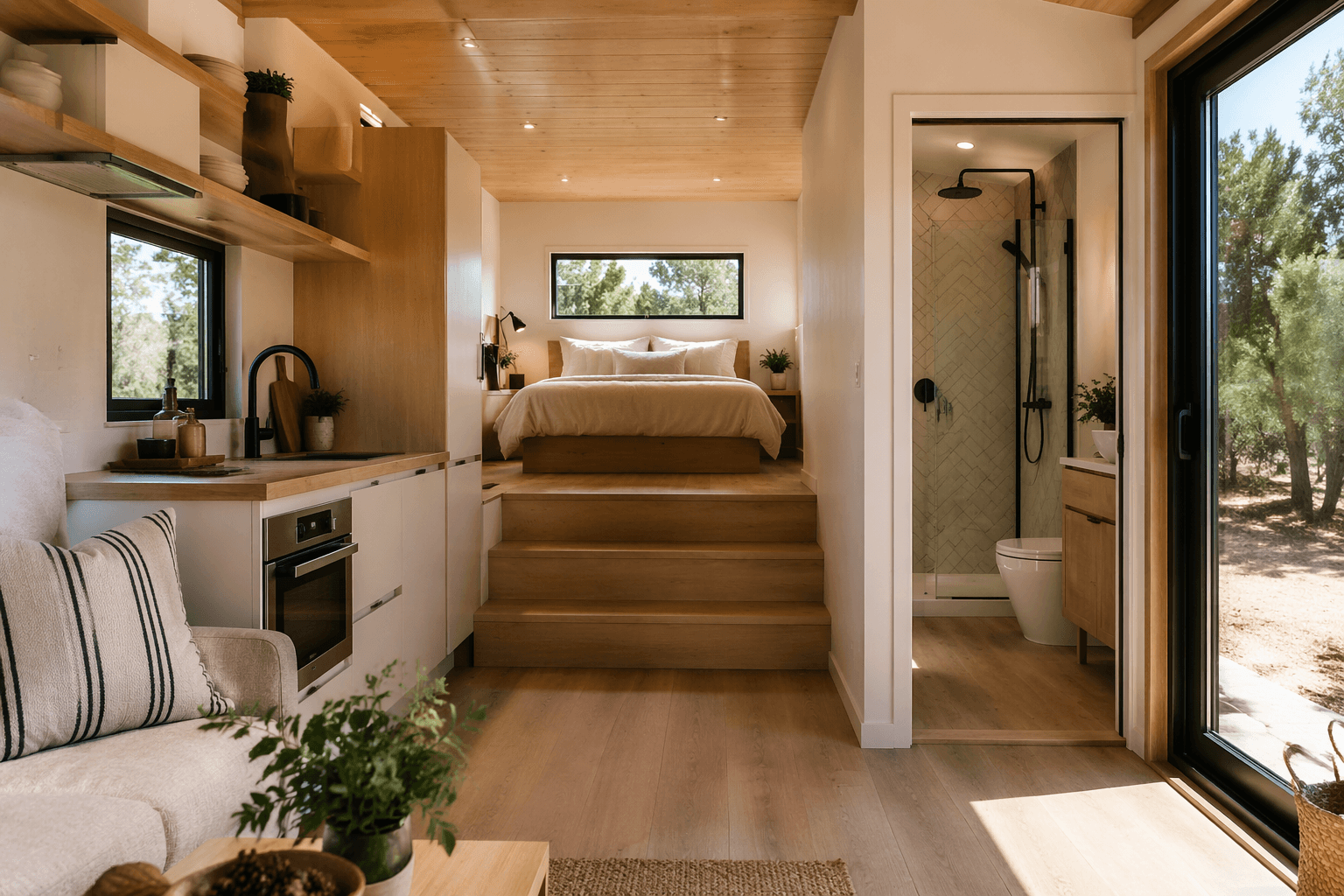
The sleeping area sits on a wooden platform with integrated drawers and a lift-up section. That means the bed does double duty as storage, which is one of the smartest ways to recover usable space in a tiny layout without crowding the rest of the room. Instead of dedicating extra floor area to wardrobes or under-bed dead space, the Algarve turns the bed itself into part of the storage system.
Kitchen, bath, and day-to-day livability
The kitchen stays close to the sleeping zone in a studio-style arrangement, reinforcing the home’s compact logic. Casagaea equips it with an oven, induction cooktop, sink, fridge, cabinetry, indirect lighting, and a pop-up power outlet built into the countertop. Those are not decorative add-ons. They are the basics that make a small home feel like a functioning kitchen rather than a break room on wheels.
A dining area for two sits nearby, which keeps the plan honest about its intended audience. This is not a layout trying to squeeze in a crowd. It is built for everyday use by one or two people who want enough room to cook, eat, and move without constantly reconfiguring furniture.
On the other side of the main space, the bathroom includes a shower, vanity sink, and flushing toilet. Casagaea says the shower cubicle measures 80 x 120 cm, a useful detail for anyone who measures tiny-house comfort in real-world terms rather than renderings. The bath is compact, but it is complete, and that is the difference between a novelty build and a livable one.
Exterior styling that stays practical
Outside, the Algarve uses engineered wood and a sloping roof, which gives it a clean, modern profile with a slightly Scandinavian feel. That aesthetic fits the house’s larger message: this is a towable dwelling that wants to look calm and durable, not playful or overly rustic. The design reads as considered, not cute.
Casagaea also says the Algarve can be customized in materials and furniture, which gives buyers some room to tune the interior without losing the core logic of the model. For tiny-house buyers, that flexibility is often the difference between something that looks good in a catalog and something that feels personal once lived in.
- Delivered fully equipped
- Built on a double-axle trailer
- No mezzanine or loft
- Intended for up to two people
- Optional off-grid package with solar power and rainwater collection
Transport, delivery, and build timeline
Casagaea says transport for the Algarve requires a BE category licence for trailers up to 3,500 kg, or C1E for heavier weights. That is the kind of detail that matters long before move-in day, because towability is part of the ownership equation in the tiny-house world. A compact home still has to make sense on the road, not just on the lot.
The company says the house is delivered fully equipped, and its FAQ puts a typical production time at 10 to 12 weeks. Delivery is available throughout Portugal and Europe, and Casagaea can also handle installation. That combination makes the Algarve feel less like a one-off object and more like a repeatable product, which is important for buyers who want a streamlined path from order to placement.
The builder behind the model
Casagaea says it is based in Braga, Portugal, at Rua Fonte do Paraíso, 4, Mire de Tibães, and it invites customers to visit its factory and showroom. Visits are available Monday to Friday from 9:00 a.m. to 6:00 p.m. The company also says it has more than 25 years of experience working with wood and more than 15 years in tiny-house construction.
That background helps explain the confidence behind the Algarve. Casagaea describes its mission as becoming a reference in the European tiny-house market through innovation, quality, comfort, and sustainability. In practice, the Algarve is the clearest expression of that pitch so far: a home that treats access, daily ease, and livability as design priorities rather than afterthoughts.
For readers who like the tiny-house idea but not the climb, the Algarve lands in a very specific sweet spot. It keeps the footprint compact, the interior bright, and the sleeping space on the ground where it belongs. That is the whole argument in one model: tiny living does not have to mean loft living.
This article was produced by Prism’s automated news system from verified source data, official records, and press releases, then run through automated quality and moderation checks before publishing. The system is built and supervised by the people who set the standards it runs under. Read our full AI policy.
Did this article answer your question?