Hawaii governor clashes with auditor over tiny-home kauhale spending
Green called the kauhale audit a vendetta as auditors flagged nearly $40 million in HomeAid Hawai‘i payments and warned of oversight gaps.

Gov. Josh Green turned Hawai‘i’s kauhale debate into an accountability test on April 29, blasting State Auditor Les Kondo’s preliminary review as overly aggressive and saying the process felt like a personal vendetta. The clash put the state’s signature tiny-home homelessness strategy under a harsher spotlight, with Green defending the villages as a meaningful success while the audit raised fresh questions about spending and oversight.
The stakes are large because kauhale has become one of Hawai‘i’s most visible responses to homelessness. A 2024 governor presentation projected 1,411 total kauhale units housing about 2,116 people if occupancy holds near 90 percent, which gives lawmakers and residents a concrete benchmark to measure against. The program is also still growing. In December 2024, a new downtown Honolulu kauhale opened as the administration expanded the model, and by October 2025 the first neighbor-island site was expected to open on Maui with 64 tiny-home units and supportive services.
Kondo’s warning, issued April 21, sharpened the dispute before Green’s public attack. The auditor told legislators and the state human services director that deficiencies in the kauhale program warranted immediate attention, and he flagged payments to HomeAid Hawai‘i that had cost taxpayers nearly $40 million so far. That is the number now hanging over the project: not just how fast Hawai‘i can build tiny-home villages, but whether the money is being tracked tightly enough to prove the model is worth scaling.
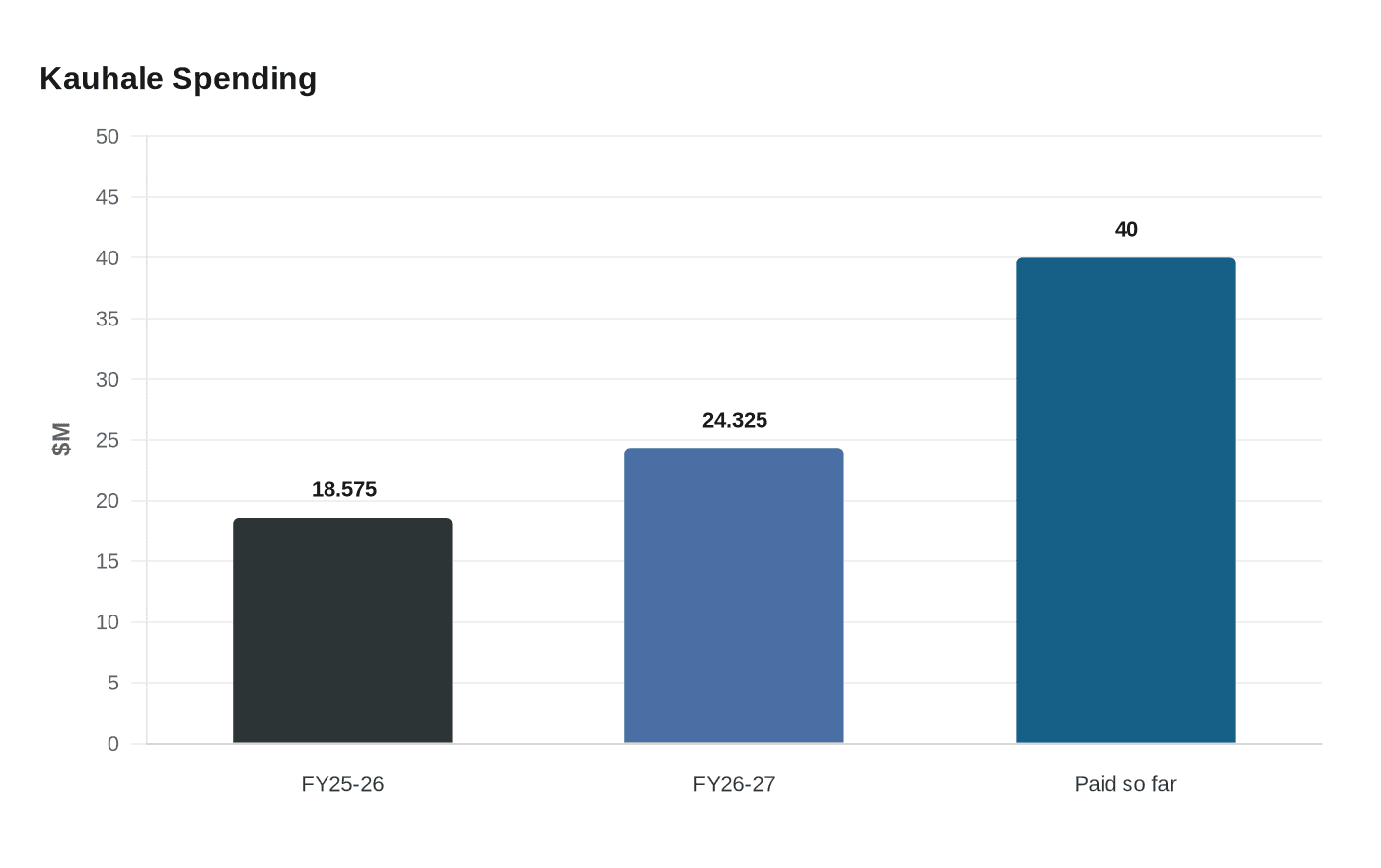
The audit itself was not a surprise. Act 309, Session Laws of Hawai‘i 2025, directed the State of Hawai‘i Office of the Auditor to conduct a management and performance audit of the Kauhale Initiative and report back to the Legislature by early 2026. Legislative documents also show the funding commitment has been substantial, with appropriations of $18.575 million for fiscal year 2025-2026 and $24.325 million for fiscal year 2026-2027 for continued operation of the initiative. For supporters, those numbers reflect a statewide homelessness response finally being financed at scale. For critics, they raise the question of whether oversight kept pace with expansion.
That is why Green’s pushback matters beyond the politics of the moment. Kauhale is no longer a pilot or a novelty. It is a statewide bet on micro-housing, wrapped in big expectations about cost, speed to open, resident outcomes, and repeatability from Honolulu to Maui. The auditor’s findings suggest the program’s books may not yet match its ambition, and the governor’s defense suggests the administration intends to fight that narrative. The next test is whether kauhale can prove its promise in units opened, people housed, and dollars accounted for.
This article was produced by Prism’s automated news system from verified source data, official records, and press releases, then run through automated quality and moderation checks before publishing. The system is built and supervised by the people who set the standards it runs under. Read our full AI policy.
Did this article answer your question?