Hawaii opens 20-home kauhale village in Waimānalo for mixed-age residents
Waimānalo’s new 20-home kauhale added Hawaii’s 26th village, pairing private front doors with case management, health care, and mixed-age living.

Ke Kauhale o Luhia opened in Waimānalo with 20 new homes and a clear signal that Hawaii’s kauhale model is no longer being treated as a pilot idea. The village, on the makai side of the former Weinberg Village site, became the 26th location under the statewide Kauhale Initiative and was designed for an intergenerational mix of single adults, kūpuna, and families living in one connected community.
What sets this site apart is not just the unit count. State leaders are presenting it as a housing model built around private space and daily support, with residents getting their own doors along with case management, health and wellness services, workforce development, and community-building activities. That combination reflects the larger kauhale approach, which is meant to move beyond emergency shelter by pairing tiny-home living with the structure people need to stabilize over time.
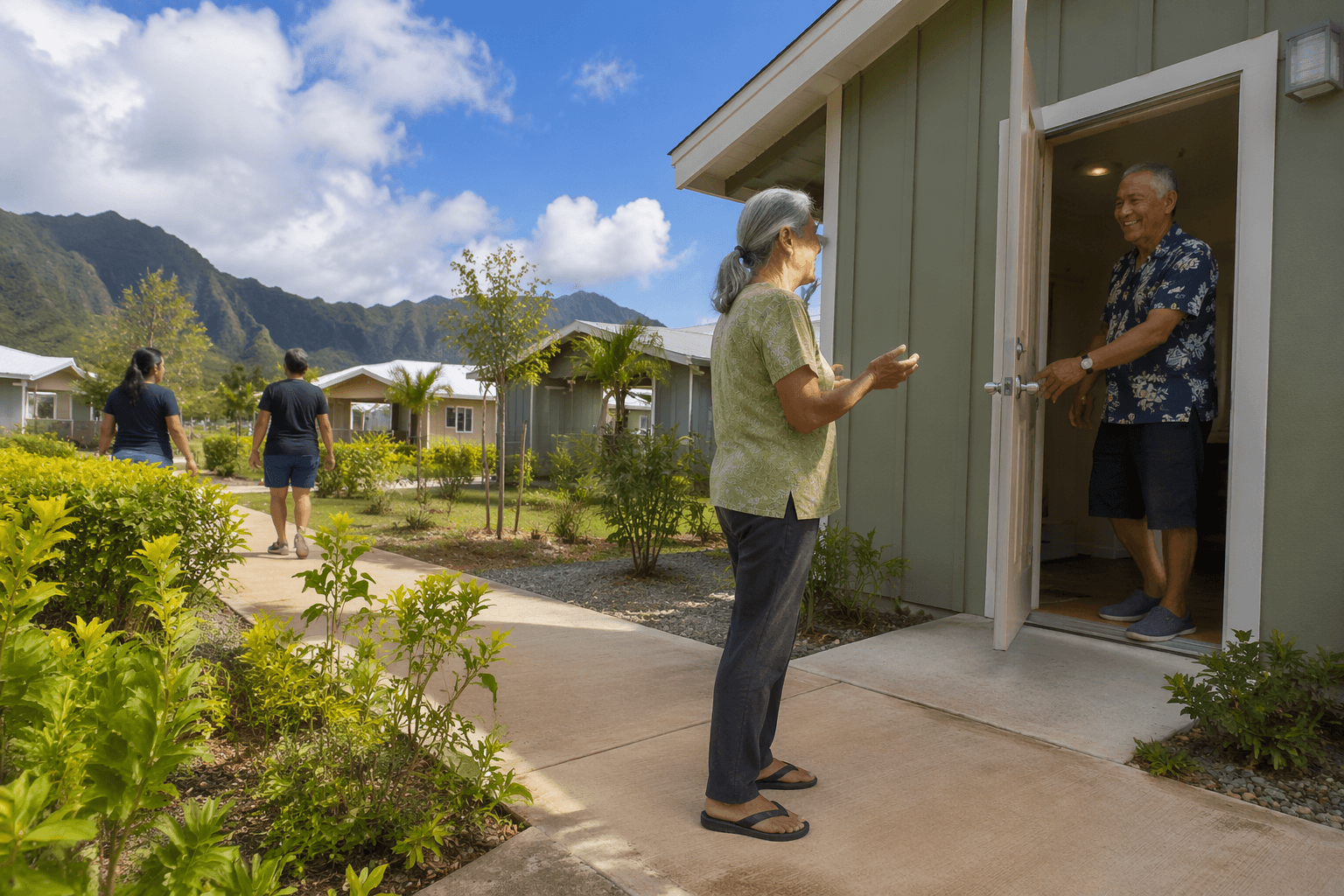
Governor Josh Green’s office framed the opening as part of a broader state strategy to reduce unsheltered homelessness, not as a standalone shelter launch. The emphasis on each resident’s own space fits that message. The state is using the Waimānalo village to show how small-home communities can offer privacy and dignity while still keeping people connected to services and to one another.
The project also gives a look at how Hawaii is putting these villages together. HomeAid Hawaii, the initiative’s nonprofit development partner, built the site on state land. The state said the project was supported by $1.6 million in state funding, public-private partnerships, and emergency proclamation efficiencies that saved about $650,000. Alternative Structures International will remain the operating partner.
For advocates and tiny-home watchers, the significance is in the scale and repetition. The 26th kauhale does more than add another address to the map. It shows the state continuing to standardize a small-footprint, village-style housing model that can be delivered again, operated again, and tied to services from the start. In Waimānalo, the newest kauhale is both a neighborhood and a test case, and its opening suggests Hawaii is now building these communities as infrastructure, not experiment.
This article was produced by Prism’s automated news system from verified source data, official records, and press releases, then run through automated quality and moderation checks before publishing. The system is built and supervised by the people who set the standards it runs under. Read our full AI policy.
Know something we missed? Have a correction or additional information?
Submit a Tip