Portugal’s Gerês tiny house fits six adults in 25.7 feet
A 25.7-foot towable tiny house claiming six adult sleepers sounds like a stunt, but Gerês leans on real layout choices to make it workable.
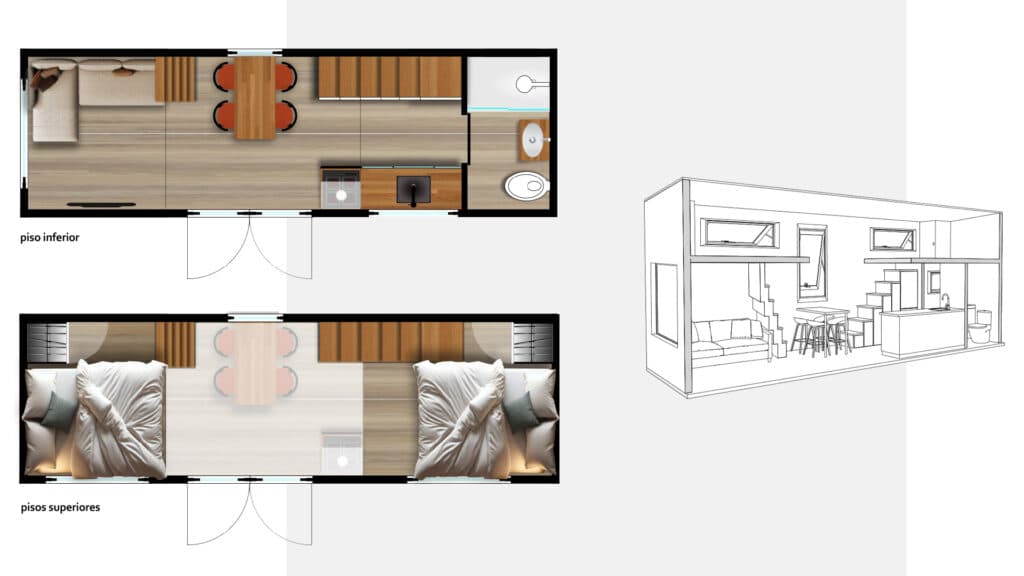
A six-sleeper tiny house that actually earns the claim
Gerês is the rare tiny-house release that does not hide behind clever marketing language. Built by Portugal-based Casagaea, the towable model stretches just 7.8 meters, or 25.7 feet, yet still offers about 30 square meters, or 322 square feet, of interior space and sleeping capacity for up to six adults. That combination makes it a useful reality check for anyone tracking the family-sized end of the tiny-house market: the question is not whether it can fit six bodies, but how much daily comfort it gives up to do it.
How Casagaea makes six sleepers fit
The core trick is vertical space management. Casagaea says Gerês uses two mezzanines as bedrooms, each reached by its own staircase, while the living room can also be fitted with a sofa bed. That arrangement turns the house into a layered sleep system rather than a single-room bunk stack, which is a smarter answer for group travel and family use.
That matters because the usual tiny-house compromise is simple: once sleeping capacity rises, circulation gets worse. Gerês pushes back on that with an open kitchen and living area that keeps the center of the house usable instead of carving it into narrow pockets. The result is a layout that can serve as a shared daytime zone first and a multi-sleeper setup second, which is exactly the kind of flexibility families need when four to six people are spending real time inside.
What the 30 square meters actually buy you
The interior package is more substantial than the footprint suggests. The kitchen includes a sink, oven, induction cooktop, and fridge/freezer, so this is built for ordinary cooking rather than campsite improvisation. The bathroom is equally serious, with a vanity sink, glass-enclosed shower, and flushing toilet, which keeps the house in full residential territory instead of dropping into RV-style compromises.
Those details matter because a six-person sleeping claim is only as useful as the rest of the house. If the kitchen cannot support normal meals or the bath feels like an afterthought, the extra beds become a burden rather than an asset. Gerês avoids that trap by keeping the core daily functions intact, which is why it reads more like a compact home on wheels than a novelty bunkhouse.
Towability comes with real trade-offs
The road-ready part is not window dressing. Gerês sits on a double-axle trailer, a setup that helps carry the load and stabilize the house on the move, but also signals the practical limits of a build this size. A 25.7-foot towable unit is still small enough to stay mobile, yet large enough that towing, parking, and siting will always involve more planning than a lighter one- or two-person micro-home.
That is the central compromise in a design like this. You get a mobile family-capable shell, but you give up some of the looseness that smaller, simpler tiny houses enjoy. More bedrooms mean more built-in structure. More structure means less spare floor area for lounging, storage overflow, or the kind of open-ended living many buyers imagine when they picture tiny-house freedom. Gerês is practical, but it is practical within tight boundaries.

Why the build feels more like a home than a shell
Casagaea helps the exterior read as a finished dwelling, not a stripped-down trailer, by cladding it in engineered wood and adding a storage box near the tow hitch. That may sound cosmetic, but it matters in a market where curb appeal and real function often overlap. The storage box, in particular, is a small but useful touch for travel-ready living because it gives the house a place for the gear that tends to pile up around family trips.
The company also says the model comes in a version of up to approximately 30 square meters, and that it can be configured for up to six people. In practice, that makes Gerês less of a one-off concept and more of a product with a clear use case: a vacation rental, a family retreat, or a full-time compact home for buyers who need sleeping capacity without moving into a larger footprint.
Casagaea is selling more than a single model
Gerês fits into a broader Casagaea lineup rather than standing alone as a stunt build. The company says it has more than 25 years of experience, delivers tiny houses throughout Portugal and Europe using specialized transport, and operates a factory and showroom in Braga, Portugal. That gives the model a level of operational backing that matters when a house is expected to travel and function across borders.
Casagaea is also clearly leaning into self-sufficiency as an upgrade path. Gerês can be specified with off-grid capability, and the company’s broader range includes options such as solar panels and autonomous water systems on other models. That suggests a builder aiming at buyers who want the tiny-house lifestyle to feel more like a managed household system and less like a stripped-down experiment.
Why this lands now in Portugal
The backdrop is impossible to miss. OECD reporting says housing affordability in Portugal remains a major challenge in 2026, while a Federal Reserve Bank of St. Louis series puts Portugal’s residential property price index at 261.0065 in Q4 2025. In that kind of market, compact, movable housing is not just a design trend, it is part of the conversation around affordability, tourism, and alternative living arrangements.
That does not mean Gerês is an answer for every buyer. It does mean the house arrives with a stronger purpose than a typical tiny-home showcase. It is trying to prove that a towable build can sleep a family of four to six without collapsing into chaos, and that is a much tougher test than simply packing in extra bunks.
Gerês succeeds because it does not pretend six adults in 25.7 feet is easy. It makes the family-size promise believable by stacking the sleeping zones smartly, protecting the communal area, and keeping the kitchen and bath close to full-home standards. The trade-off is obvious, but so is the point: this tiny house is built to make group travel practical, not just to advertise clever sleeping capacity.
This article was produced by Prism’s automated news system from verified source data, official records, and press releases, then run through automated quality and moderation checks before publishing. The system is built and supervised by the people who set the standards it runs under. Read our full AI policy.
Know something we missed? Have a correction or additional information?
Submit a Tip

