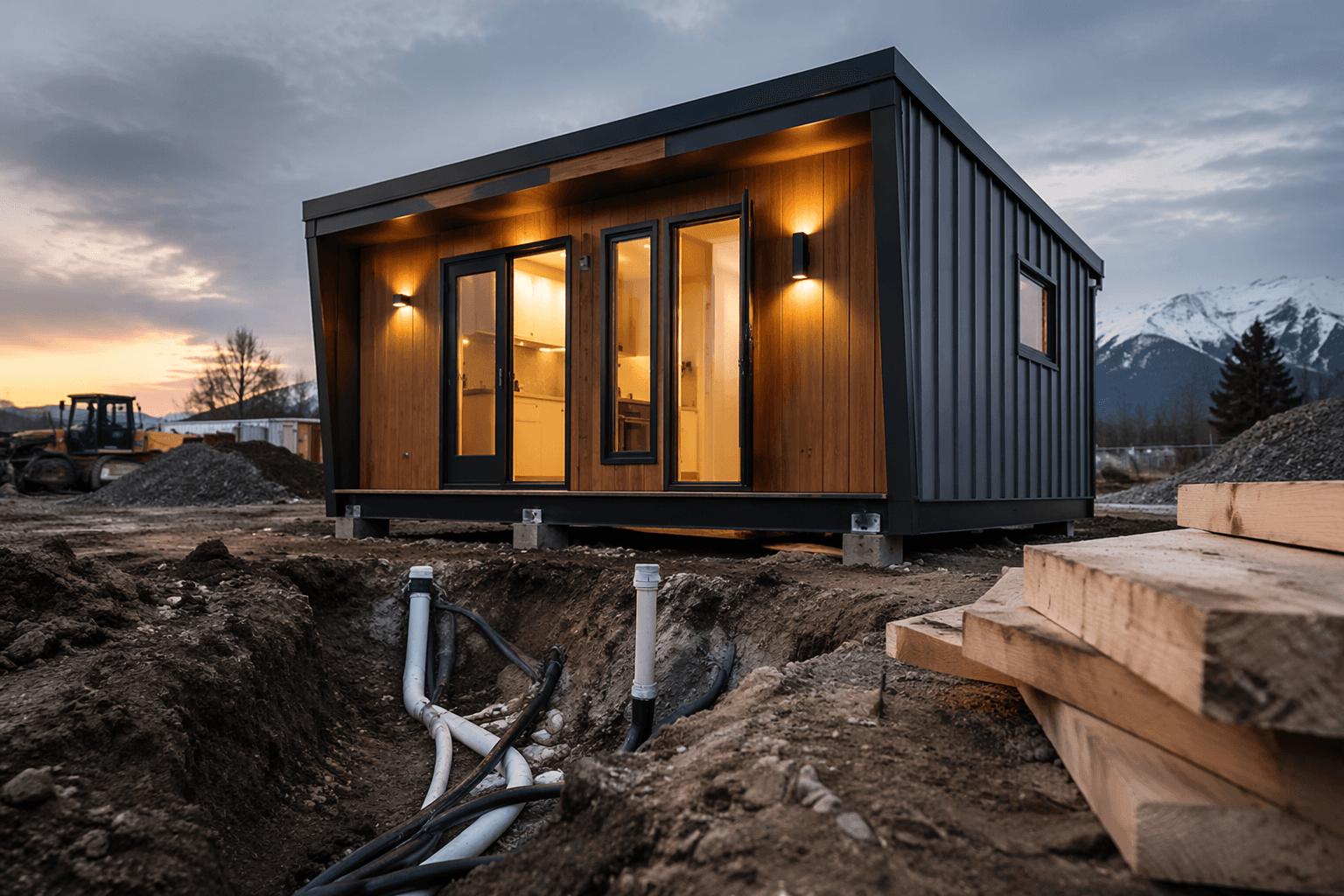
How to Plan, Design, and Build Your Own Tiny House
Building a tiny house rewards builders who treat it like a full-scale project: permits, building science, and trailer specs matter as much as square footage.

Tiny houses succeed or fail in the planning phase, long before a single board is cut. Whether you're going mobile with a tiny house on wheels (THOW) or setting a permanent foundation, the sequence of decisions you make upfront, covering budget, regulatory classification, and system sizing, determines whether you end up with a durable home or an expensive problem.
Start With an Honest Budget and a Priorities List
Before choosing a floor plan, set a realistic budget and ruthlessly separate needs from wants. The non-negotiables in any tiny build are the same as any full-sized house: sleeping, cooking, sanitation, and storage. Every square foot and every dollar beyond that is a trade-off. Builders who skip this step tend to over-engineer interiors and run short of funds before mechanical systems are complete.
Talk to your local building department early. This single step is the highest-value hour you'll spend on the project. Local officials can tell you whether your planned design can be permitted, whether the property is zoned for a tiny dwelling, and which code path applies to your build. Getting that clarity before you order materials prevents costly redesigns later.
Mobile or Fixed: The Foundation Decision
The choice between a THOW and a foundation build shapes nearly every downstream decision, from structural engineering to utility hookups to what inspections you'll face.
For a THOW, trailer selection is a structural decision, not just a logistical one. Verify the GVWR (gross vehicle weight rating) and axle specifications before purchasing, since an under-sized trailer is one of the most common and most expensive mistakes in tiny house builds. Axle spacing affects both road stability and how loads transfer into the frame, and many states require trailer braking systems above a certain weight threshold, so check your jurisdiction's requirements before finalizing the spec.
For a foundation build, the basics of conventional construction apply: properly engineered footings, a slab or crawlspace suited to the soil and climate, and frost protection appropriate to the local freeze depth. A foundation build is often the cleaner regulatory path, since the rules are well-established and inspectors are familiar with the process.
Framing the Envelope
Tiny house framing demands the same engineering discipline as a full-sized house, applied to much smaller spans. Two primary approaches dominate: structural insulated panels (SIPs) and traditional stick framing. SIPs offer a tight, thermally efficient envelope with minimal framing members, which is an advantage in a compact build where every inch of wall thickness matters. Stick framing with 2×4 studs spaced 24 inches on center, using engineered headers sized to reduce lumber mass, is a proven, cost-effective alternative that most builders and inspectors know well.
Thermal bridging deserves serious attention in a tiny envelope. Because the ratio of wall framing to floor area is high in a small structure, heat loss through studs and headers is proportionally greater than in a conventional home. Continuous exterior insulation, careful detailing at window and door openings, and thoughtful connection design between the floor, walls, and roof are all strategies worth building into the plan rather than retrofitting.
Weatherproofing, Roof Design, and Windows
Roof geometry and window selection are system-level decisions, not aesthetic ones. In a small, well-insulated box, condensation control is a recurring source of post-build problems. Moisture that can't escape accumulates in walls and roof assemblies, leading to mold and structural deterioration. Proper vapor management, ventilation detailing, and air sealing must be planned as part of the building science strategy, not addressed as an afterthought.
Window placement affects daylighting, cross-ventilation, and heat gain. In a tiny footprint, a poorly placed window can undermine the thermal performance of an entire wall. Choose windows with appropriate U-values for your climate and make sure the rough openings are flashed and sealed as carefully as they would be in any permanent structure.
Mechanical Systems: Do More With Less
Routing plumbing through a tiny footprint requires planning that larger homes don't demand. Keeping wet walls consolidated, locating the bathroom adjacent to the kitchen to minimize pipe runs, and specifying compact fixtures all reduce complexity and cost. For water heating, a tankless unit is the standard choice: it eliminates the footprint of a storage tank and delivers hot water on demand, which suits the intermittent usage patterns of a small household.
HVAC in a tiny house is well-served by a mini-split heat pump. Mini-splits are efficient because they move heat rather than generate it, work in both heating and cooling modes, and can be sized precisely to the small load of a tight tiny house envelope. Avoid oversized systems: a mini-split that's too large for the space will short-cycle and fail to properly dehumidify.
Electrical load planning deserves the same rigor. Account for EV or device charging, induction cooking (which draws significant peak load), and heat pump operation when sizing your service and panel. Induction cooktops are increasingly the preferred choice in tiny builds because they eliminate combustion and the ventilation demands that come with it, but the electrical load must be planned from the start.
The RV vs. Dwelling Classification Question
How your tiny home is classified under local code has real consequences. A THOW registered as an RV falls under a different regulatory framework than a dwelling unit: the permitted systems, inspection milestones, and utility hookup requirements differ significantly. RV classification may make siting easier in some jurisdictions but can limit the quality and permanence of the systems you're allowed to install. A dwelling classification opens up the full building code, which in most cases means better structural, plumbing, and electrical standards and greater long-term livability.
California's Department of Housing and Community Development has clarified that a tiny home that doesn't meet the definition of a manufactured home, RV, or park trailer is a dwelling unit and must comply with the full California Building Standards Code, covering structural, plumbing, electrical, energy, mechanical, and fire protection standards. Whatever your state, know which category your build falls into before you finalize the design.
Practical Tips and Common Mistakes
A few recurring mistakes show up in tiny house builds across skill levels:
- Under-sized trailer: always verify GVWR against your estimated finished weight, with a margin for personal belongings
- Poor ventilation: tiny envelopes need mechanical ventilation; relying on operable windows alone is insufficient
- Over-complicated systems: simpler is more serviceable; a system you can diagnose and repair yourself is worth more than a sophisticated one that requires a specialist
- Skipping mockups: dry-fit assemblies and physical mockups of loft heights, stair angles, and countertop clearances prevent costly rework in a space where every inch counts
On cost, the trade-off between pre-built cabinets and custom millwork is a meaningful decision. Custom millwork can maximize storage in odd corners and lofts, but it adds time and cost. Pre-built cabinet runs adapted to the floor plan are a practical way to control the budget without sacrificing functionality.
Use inspection milestones as quality checkpoints. Rough framing, rough mechanical, insulation, and final inspections aren't just regulatory hurdles; they're structured opportunities to catch problems before they're buried behind drywall.
Building It Right From the Start
The central principle that runs through every phase of a serious tiny house build is straightforward: treat it like a full-scale house that's been carefully scaled down. The same building science that governs moisture management, thermal performance, and structural integrity in a 2,000-square-foot home applies at 200. Shortcuts that might go unnoticed in a large structure become critical failures in a small one, because there's nowhere for the problem to hide.
With careful planning, a well-selected site or trailer, and the discipline to engage local officials before breaking ground, a durable, comfortable tiny home is within reach for a motivated builder. The timeline and final cost will hinge on the systems chosen and the regulatory path in your jurisdiction; the builds that come in on budget are almost always the ones that resolved those questions first.
This article was produced by Prism’s automated news system from verified source data, official records, and press releases, then run through automated quality and moderation checks before publishing. The system is built and supervised by the people who set the standards it runs under. Read our full AI policy.
Did this article answer your question?